Self-Care for Busy Women: 12 Small Habits That Make a Real Difference
 Noah Orono
Hair thinning in women is very common, especially from your 40s onward, and most cases have a clear cause and a treatment that helps. The most likely culprits are female pattern hair loss, which runs in families and becomes more common after menopause, and temporary shedding after stress, illness, childbirth or rapid weight loss. Over-the-counter minoxidil is the treatment dermatologists recommend most for female pattern hair loss, but it takes 6 to 12 months to work. If your hair is thinning, see a doctor or dermatologist early, because treatment works best when it starts at the first signs.
Key takeaways
- Losing 50 to 100 hairs a day is normal. Noticeably more than that, a widening part or a thinner ponytail is worth checking.
- Female pattern hair loss is the most common cause of thinning in women. It usually starts in midlife and becomes more common after menopause.
- Shedding after a trigger such as illness, stress or weight loss usually starts a few months later and recovers on its own within 6 to 9 months.
- Minoxidil (2% or 5%) is FDA-approved for women. Expect extra shedding in the first weeks, results after 6 to 12 months, and losing the gains if you stop.
- Thyroid problems, low iron or protein, medicines and tight hairstyles can all cause thinning, so a proper diagnosis matters.
- Don’t take high-dose biotin “just in case”. It rarely helps and can interfere with some blood tests.
Is it hair shedding or hair loss?
Everyone loses hair every day. The American Academy of Dermatology (AAD) and the NHS both say it’s normal to lose 50 to 100 hairs a day, often without noticing. The question is whether you’re losing more than that, or whether your hair is growing back thinner.
Dermatologists separate two different problems:
- Excessive shedding (telogen effluvium): more hairs than usual fall out, often in noticeable amounts in the shower or on your brush, but they grow back once the trigger has passed.
- Hair loss: something stops hair from growing or makes each new hair finer, so the overall volume drops. Female pattern hair loss is the most common example.
Some women have both at once, which is one reason a proper diagnosis helps.
Signs it’s worth getting checked:
- Your part is getting wider, or you can see more scalp on top.
- Your ponytail feels noticeably thinner.
- You’re finding much more hair than usual on your pillow, brush or shower drain for more than a few weeks.
- You have bald patches, a receding hairline, or redness, scaling or pain on your scalp.
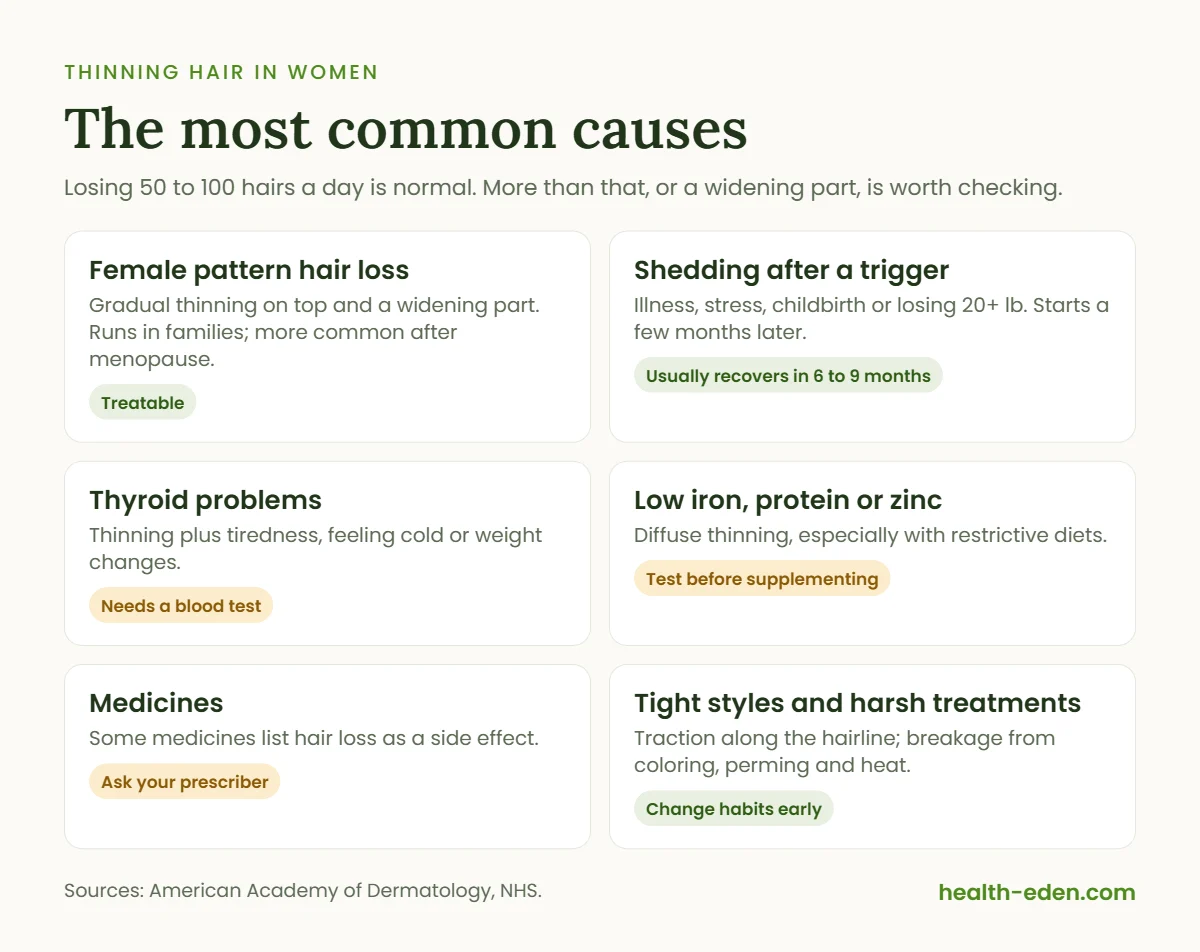
The most common causes of thinning hair in women
| Cause | Typical pattern | What usually helps |
|---|---|---|
| Female pattern hair loss | Gradual thinning on top, widening part; hair near the temples may recede | Minoxidil; prescription options from a dermatologist |
| Excessive shedding (telogen effluvium) | Sudden, diffuse shedding a few months after a trigger | Usually recovers by itself within 6 to 9 months |
| Thyroid problems | Diffuse thinning, often with other symptoms such as tiredness or weight change | Treating the thyroid condition |
| Low iron, protein, zinc or biotin | Diffuse thinning | Correcting the deficiency (after a blood test) |
| Medicines | Thinning after starting a new medicine | Talk to your prescriber; never stop a medicine on your own |
| Tight hairstyles (traction alopecia) | Thinning along the hairline or where hair is pulled | Looser styles early; it can become permanent |
| Harsh hair care | Breakage and thinner-looking hair | Less coloring, perming, relaxing and heat |
Female pattern hair loss
Female pattern hair loss (FPHL) is the most common type of hair loss in women. According to the AAD, it usually begins in midlife, often in your 40s, 50s or 60s, although it can start earlier. It runs in families, and hormones may play a role, since it becomes more common after menopause.
Unlike men, women rarely go bald. Instead, hair thins more widely across the top of the head, and the part gradually widens. Hair near the temples may also recede.
Shedding after stress, illness or weight loss
Telogen effluvium happens when a shock to the body pushes many hairs into their resting phase at once. The AAD lists common triggers as:
- Losing 20 pounds or more
- Childbirth
- A high fever, surgery or recovering from an illness
- Intense stress, such as a divorce or the death of a loved one
- Stopping birth control pills
The shedding usually starts a few months after the event, which is why many women don’t connect the two. The good news is that it usually stops on its own as your body readjusts, and the AAD says hair generally regains its fullness within about 6 to 9 months.
A note on weight-loss medicines: the AAD reports that some people on GLP-1 medicines such as semaglutide notice thinning hair, which dermatologists believe is mainly due to rapid weight loss. Losing weight slowly and eating a balanced diet, with a daily multivitamin if your intake drops, may help. If you’re prone to hair loss, the AAD suggests seeing a dermatologist before you start.
Thyroid problems, nutrition and medicines
- Thyroid disease can cause thinning hair. If you also feel unusually tired, cold, or notice changes in your weight or skin, ask your doctor about a thyroid test.
- Low iron, protein, zinc or biotin can cause noticeable hair loss, according to the AAD. Only take supplements if a blood test shows you need them.
- Too much vitamin A is toxic and can itself cause hair loss, so be careful with high-dose supplements.
- Some medicines list hair loss as a side effect. Talk to the doctor who prescribed it before you stop anything.
Hairstyles and hair care
Wearing your hair tightly pulled back for long periods can cause traction alopecia, which the AAD warns can become permanent. Frequent coloring, perming or relaxing can also damage hair over time, causing breakage that makes hair look thinner.
Treatments that work for female hair thinning
Treatment depends on the cause, which is why a diagnosis comes first. For female pattern hair loss, these are the main options.
Minoxidil (over the counter)
Minoxidil is the most recommended treatment for female pattern hair loss, and products with 2% or 5% minoxidil are FDA-approved for women. Depending on the product, you apply it to a dry scalp once or twice a day. It can slow hair loss and help regrow hair.
What to expect:
- Extra shedding at first. The AAD says you may notice a temporary increase in hair loss for the first 2 to 8 weeks. This is expected and usually stops as new hair starts to grow, so don’t give up too early.
- Slow results. You need to use it continuously for about 6 to 12 months to see the full effect.
- Ongoing use. If you stop, the hair you gained will gradually fall out.
- Possible side effects: scalp itching or irritation, and unwanted hair growth on the face, which is more common with the stronger 5% strength.
Don’t use minoxidil if you’re pregnant, trying to get pregnant or breastfeeding.
Prescription treatments
If minoxidil isn’t enough, a dermatologist may suggest:
- Spironolactone: a prescription tablet that can help restore hair growth and stop hair loss from getting worse. The AAD notes it works in about 40% of women with female pattern hair loss. Tell your doctor if you have kidney or adrenal problems.
- Low-dose oral minoxidil: a prescription tablet some dermatologists now use. Your dermatologist will decide whether it suits you.
- Other prescription medicines that block the hormones involved in hair loss.
Results from prescription treatments also take 6 to 12 months. Some of these medicines can cause birth defects, so doctors recommend reliable contraception for women who could become pregnant.
Light therapy, PRP and hair transplants
- Laser and red light devices (caps, combs and helmets) are sold without a prescription. The AAD says some studies support them, but long-term results and safety are unknown, and red light “won’t regrow a full head of hair.” You need to keep using them to maintain any benefit.
- Platelet-rich plasma (PRP) injects concentrated platelets from your own blood into the scalp. Early research is promising, but more studies are needed.
- Hair transplants can work for some women, but not for those with thinning across the whole scalp, as there may not be enough healthy donor hair.
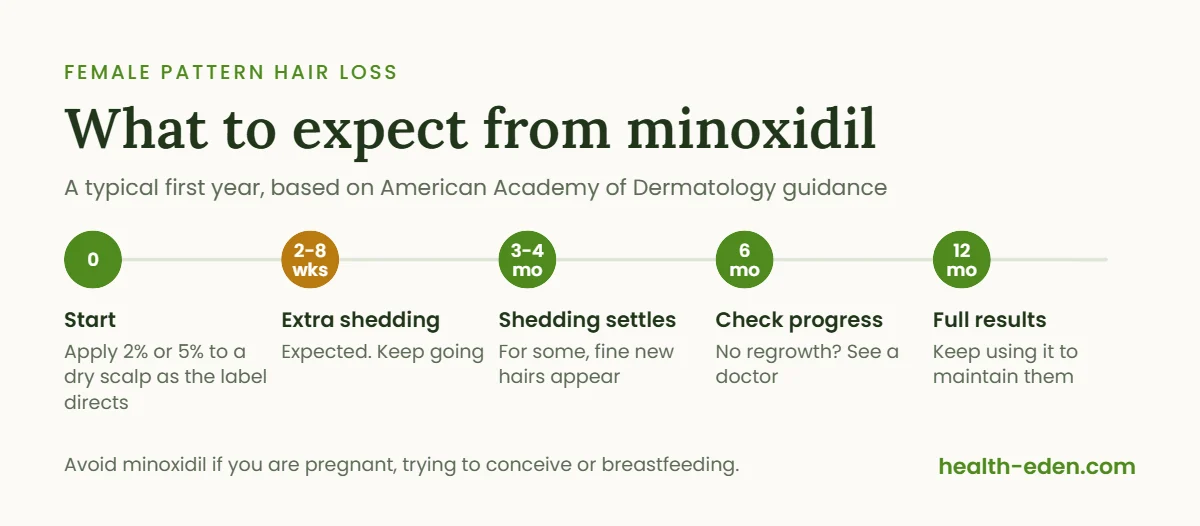
Worked example: what a year on minoxidil looks like
Because minoxidil works slowly, knowing the timeline helps you stick with it. Here is a typical course for someone starting in January, based on AAD guidance:
| Month | What to expect |
|---|---|
| Month 1 to 2 (Jan to Feb) | Possible extra shedding for 2 to 8 weeks. Keep going. |
| Month 3 to 4 (Mar to Apr) | Shedding settles. For some women, fine new hairs start to appear. |
| Month 4 to 6 (Apr to Jun) | Good time to review progress with your doctor. |
| Month 6 to 12 (Jun to Dec) | Full results become visible. |
| After 12 months | Keep using it to maintain results. Stopping means losing the regrowth. |
A simple way to track progress: take a photo of your part in the same spot, with the same lighting, on the first day of each month. Changes are slow and hard to notice day to day, but side-by-side photos at month 1, 6 and 12 show you whether it’s working.
For context on shedding: at the normal rate of 50 to 100 hairs a day, you lose roughly 1,500 to 3,000 hairs a month (50 × 30 = 1,500; 100 × 30 = 3,000) without it being a problem. Seeing hair in your brush is normal; seeing a lot more than usual for weeks is the signal to act.
Everyday hair care for thinning hair
Gentle care won’t regrow hair, but it stops breakage from making things look worse:
- Wear looser styles and vary where you place ponytails, buns and clips.
- Be gentle when wet. Use a wide-tooth comb and detangle from the ends up.
- Limit heat styling and use the lowest effective heat setting.
- Space out chemical treatments such as coloring, perming and relaxing.
- Eat enough protein and a varied diet. Protein matters even more if you’re cutting calories.
- Look after your stress and sleep. Shedding after stressful events is common, and our guide to mindfulness for better sleep and these small self-care habits for busy women can help with both.
If you’re losing weight, a steady pace is kinder to your hair. Our guide to nutrition for sustainable weight loss explains how to lose weight without crash dieting. Thinning hair often shows up alongside other skin changes in midlife, which we cover in our anti-aging skincare routine for women over 40.
What about biotin and hair supplements?
Biotin is the most heavily marketed “hair vitamin”, but it only helps if you’re actually deficient, which is uncommon. Hair, skin and nail supplements can contain up to 100 mg of biotin per pill, thousands of times the recommended daily amount of 0.03 mg.
That matters because high-dose biotin can interfere with some laboratory tests. The FDA has warned that it can cause falsely low results on certain tests for heart attacks (troponin tests), which could delay a diagnosis. If you take biotin, tell your doctor before any blood test.
A blood test that checks iron and other nutrients is a better starting point than guessing with supplements.
Honest pros and cons of hair thinning treatments
Pros
- Minoxidil is widely available without a prescription and FDA-approved for women.
- Many causes of thinning, such as shedding after illness or stress, are temporary and recover on their own.
- Treating an underlying cause such as low iron or a thyroid problem can restore hair.
- Starting early gives the best results.
Cons
- Minoxidil and prescription treatments are slow, taking 6 to 12 months to show results.
- Treatment usually has to continue indefinitely to keep the results.
- Minoxidil can cause scalp irritation, early shedding and unwanted facial hair.
- Prescription options have side effects and aren’t suitable during pregnancy.
- Many “hair growth” products and supplements have little evidence behind them.
Who should be careful
- If you’re pregnant, trying to get pregnant or breastfeeding, avoid minoxidil and prescription hair loss medicines, and ask your doctor about safe options.
- If you have heart problems or low blood pressure, ask your doctor before using minoxidil, and stop it if you notice dizziness, chest pain or a racing heartbeat.
- If you have kidney or adrenal problems, tell your doctor before taking spironolactone.
- If you take biotin, tell your doctor before any blood test.
- If you have a light-sensitive condition such as lupus, or take medicines that make you sensitive to light, check with a dermatologist before using red light devices.
- If you take any prescription medicine, don’t stop it because of hair loss without speaking to the prescriber.
When to see a doctor
See your doctor or a board-certified dermatologist if:
- Your hair is thinning or shedding more than usual for more than a few weeks.
- You have sudden hair loss, bald patches or hair coming out in clumps.
- Your scalp is red, scaly, itchy, painful or has sores.
- You have other symptoms, such as tiredness, feeling cold, weight changes or heavy periods, which can point to thyroid problems or low iron.
- You’ve used minoxidil for 6 months without any regrowth.
- Hair loss is affecting your confidence or well-being. The NHS encourages you to mention this to your GP too.
The AAD stresses that treatment works best when it starts at the first sign of hair loss, so it’s better to go early than to wait.
Frequently asked questions
What causes hair thinning in women?
The most common cause is female pattern hair loss, which runs in families and becomes more common after menopause. Other causes include shedding after stress, illness, childbirth or rapid weight loss, thyroid problems, low iron or protein, some medicines, tight hairstyles and harsh hair treatments.
How much hair loss is normal for a woman?
Losing 50 to 100 hairs a day is normal, according to the AAD and the NHS. See a doctor if you’re losing noticeably more for several weeks, or if your part is widening or your ponytail is getting thinner.
Does thinning hair from menopause grow back?
Female pattern hair loss, which becomes more common after menopause, doesn’t usually reverse on its own, but treatments such as minoxidil can slow it and help regrow hair. Shedding caused by a trigger like stress or illness usually recovers within 6 to 9 months.
How long does minoxidil take to work for women?
You may see extra shedding for the first 2 to 8 weeks. Full results take about 6 to 12 months of continuous use, and you need to keep using it to maintain them.
Does biotin help hair growth?
Only if you’re deficient, which is uncommon. High-dose biotin supplements can interfere with some blood tests, including tests for heart attacks, so tell your doctor if you take them.
Can stress cause hair loss in women?
Yes. Intense stress can trigger telogen effluvium, a temporary increase in shedding that usually starts a few months after the stressful event and recovers on its own as your body readjusts.
The bottom line
Hair thinning in women is common and usually treatable. Work out the cause first: female pattern hair loss responds to minoxidil and prescription options, temporary shedding after a trigger usually recovers on its own, and problems like low iron or thyroid disease need medical treatment. Start early, be patient for 6 to 12 months, and see a doctor or dermatologist if your hair loss is sudden, patchy or getting worse.
Sources
- American Academy of Dermatology. Thinning hair and hair loss: could it be female pattern hair loss?
- American Academy of Dermatology. Do you have hair loss or hair shedding?
- American Academy of Dermatology. Hair loss: who gets it and causes.
- American Academy of Dermatology. Finding the right treatments for genetic hair loss.
- American Academy of Dermatology. How can GLP-1 drugs affect my skin, hair, and nails?
- American Academy of Dermatology. Is red light therapy right for your skin?
- NHS 111 Wales. Hair loss.
- TCTMD. FDA reminds clinicians about biotin interference with troponin tests. November 2019.
Information checked as of October 2026. Read how we research and update articles in our editorial policy.
This article is for general information and isn’t a substitute for personal medical advice. Talk to your doctor, pharmacist or dermatologist before starting any hair loss treatment or supplement. See our full medical disclaimer.

I'm Noah Orono, founder and editor of Health Eden. I write about skincare and healthy aging, strength and weight management, and women's health from your 30s into midlife and beyond. Every guide starts with published research and guidance from dermatologists, doctors and certified trainers, then turns it into clear, practical steps. I'm not a medical professional, so I'll always tell you when something is worth raising with your doctor.
More about Health Eden →