Self-Care for Busy Women: 12 Small Habits That Make a Real Difference
 Noah Orono
The best anti-aging skincare routine for women over 40 has five steps: a gentle cleanser, a vitamin C serum in the morning, a moisturizer, a broad-spectrum sunscreen of SPF 30 or higher every day, and a retinoid at night. Sunscreen and a retinoid do most of the work; everything else supports them. You don’t need a 10-step routine or expensive products to see a real difference, but you do need patience, because most ingredients take weeks to months to show results.
Key takeaways
- Daily broad-spectrum sunscreen (SPF 30+) is the single most important anti-aging step at any age.
- A retinoid at night (retinol, retinal or prescription tretinoin) has the strongest evidence for smoothing fine lines.
- Vitamin C and niacinamide are good supporting players for tone, dullness and dark spots.
- Skin gets drier around menopause, so switch to a gentler cleanser and a richer moisturizer.
- Introduce one new active at a time, start slowly, and give each product 6 to 12 weeks before judging it.
- Price doesn’t predict results. A simple routine from a drugstore can work as well as a luxury one.
What changes in your skin after 40
Knowing why your skin is changing makes it much easier to choose products that help, and to ignore the ones that just promise.
Collagen drops sharply around menopause. Collagen is the protein that keeps skin firm and plump. Researchers estimate that women lose about 30% of the collagen in their skin during the first five years after menopause, and the loss tracks more closely with years of low estrogen than with age itself. That is why many women notice their skin changing faster in their late 40s and 50s than it did in their 30s.
Skin gets drier and thinner. Falling estrogen also lowers the skin’s natural moisturizing substances, such as hyaluronic acid, and weakens its outer barrier. The result is skin that feels tight after washing, looks dull, and shows fine lines more easily.
Sun damage catches up with you. Most visible aging on the face, such as uneven pigment, rough texture and deeper lines, comes from years of UV exposure rather than from time alone. The good news is that this is also the part you have the most control over.
Cell turnover slows down. Older skin sheds dead cells more slowly, which makes it look less radiant. Gentle exfoliation and retinoids both help with this.
The 5-step anti-aging skincare routine for women over 40
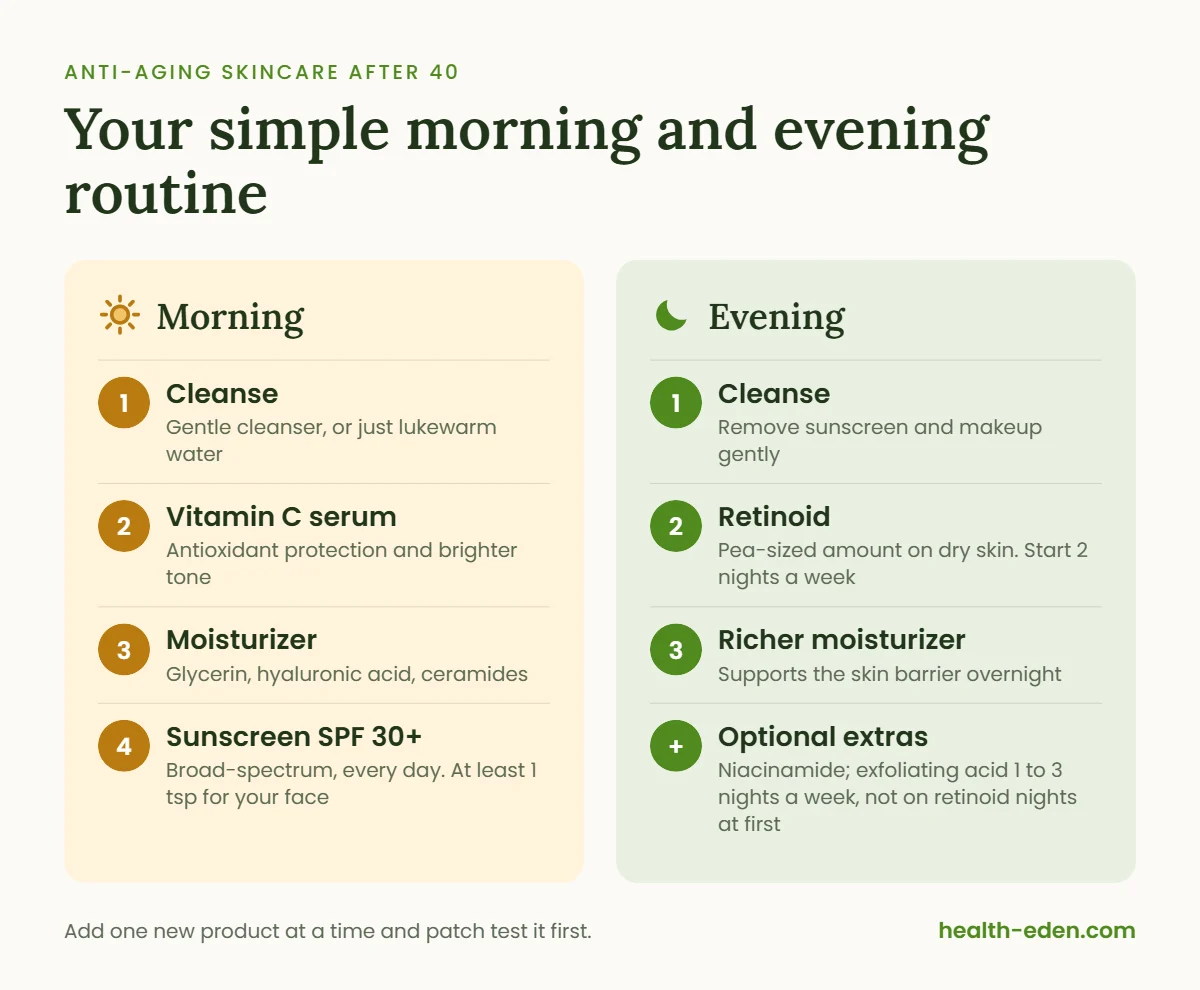
Here is the whole routine. It splits into a short morning routine that protects your skin, and a short evening routine that repairs it.
| Step | Morning | Evening | Why it matters |
|---|---|---|---|
| 1. Cleanse | Gentle cleanser or just water | Gentle cleanser | Removes sunscreen, makeup and oil without stripping your skin |
| 2. Treat | Vitamin C serum | Retinoid (retinol, retinal or tretinoin) | The “active” step that targets lines and spots |
| 3. Moisturize | Light or rich moisturizer | Richer moisturizer | Supports the skin barrier and softens fine lines |
| 4. Protect | Broad-spectrum SPF 30+ | Skip | Prevents new damage and protects your other products’ results |
| 5. Extras (optional) | Eye cream, niacinamide | Niacinamide, exfoliating acid 1 to 3 nights a week | Fine-tunes the routine for your concerns |
Step 1: Cleanse gently
Cleansing sounds basic, but harsh cleansers are one of the most common reasons mature skin feels tight and irritated. The American Academy of Dermatology (AAD) recommends washing your face no more than twice a day and after sweating, using a gentle, non-abrasive cleanser that doesn’t contain alcohol. Use lukewarm water and your fingertips rather than a washcloth or brush, then pat dry with a soft towel.
If your skin is very dry, a cream or milky cleanser in the evening and just a splash of water in the morning is perfectly fine.
Step 2: Treat with a targeted serum
This is where you put your “active” ingredients, the ones that actually change how your skin looks over time.
- Morning: vitamin C. Vitamin C is an antioxidant that helps protect against damage from sunlight and pollution and can brighten uneven tone. Pure vitamin C (L-ascorbic acid) is unstable and breaks down when exposed to light, heat or air, so look for an opaque, airtight bottle and throw it out if it turns dark orange or brown. Research on pig skin found that absorption peaks at a concentration of about 20%, so a stronger percentage isn’t automatically better. Lab research also found that adding vitamin E and ferulic acid made a vitamin C solution more stable and more protective against UV, which is why many dermatologists like this combination.
- Evening: a retinoid. Retinoids are the family of vitamin A ingredients, and they are the best-studied topical treatment for fine lines. More on how to start one below.
Step 3: Moisturize
A moisturizer won’t erase wrinkles, but it holds water in the skin, which makes fine lines look softer, and it supports a barrier that gets weaker around menopause. Look for these ingredients:
- Humectants that draw water into the skin: glycerin and hyaluronic acid.
- Barrier repair ingredients that seal it in: ceramides, cholesterol and fatty acids.
- Soothing ingredients if you are sensitive: niacinamide, panthenol, colloidal oatmeal.
Many women over 40 do well with a lighter moisturizer in the morning under sunscreen and a richer cream at night, especially on retinoid nights.
Step 4: Protect with sunscreen, every single day
If you only do one thing from this guide, make it this. The AAD recommends a sunscreen that is broad-spectrum (protects against both UVA and UVB rays), SPF 30 or higher, and water-resistant, applied every day, including on cloudy days and in winter, because UV rays still reach your skin. Mayo Clinic notes that even sun shining through a window can speed up skin aging.
Two details make a big difference:
- Use enough. The AAD recommends at least 1 teaspoon of sunscreen for your face, which is roughly the length of your index and middle fingers. Most people use far less, which gives them much lower protection than the SPF on the label.
- Don’t forget your neck, ears and the backs of your hands. These areas age visibly and are often skipped.
If you are outdoors, reapply every two hours and straight after swimming or sweating.
Step 5: Add extras only if you need them
Once the four core steps are a habit, you can add one targeted extra:
- Niacinamide for redness, dullness and uneven tone.
- An exfoliating acid (AHA such as glycolic or lactic acid) one to three nights a week for rough texture. Keep it on different nights from your retinoid at first.
- An eye cream if your under-eye area is dry. A gentle moisturizer works too.
The key anti-aging ingredients, ranked by evidence
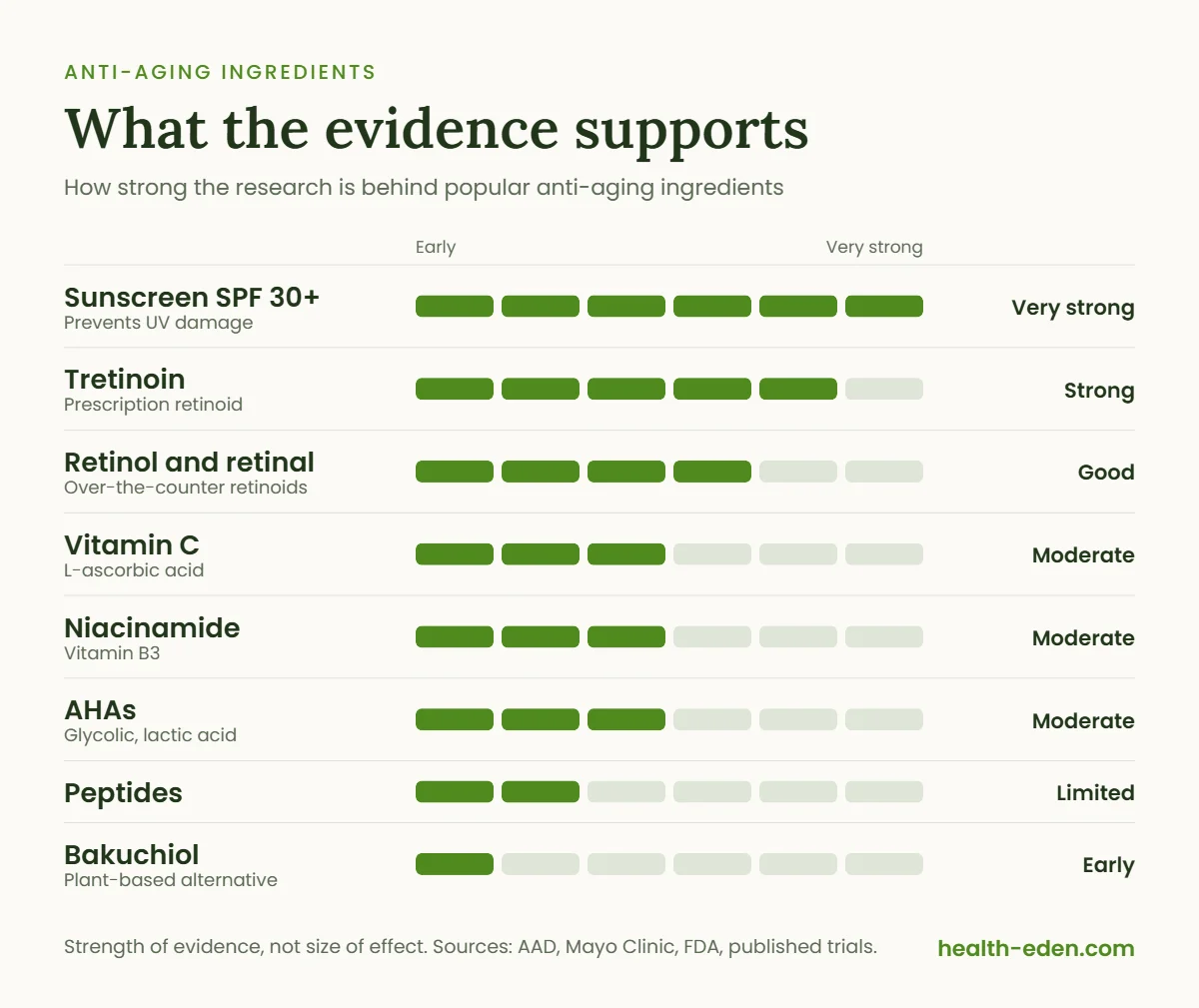
The skincare aisle is full of exciting claims. This table shows what the research actually supports. Keep in mind that the US Food and Drug Administration regulates over-the-counter wrinkle creams as cosmetics, not medicines, so they don’t have to prove they work before they go on sale. Mayo Clinic notes that these products usually make only small improvements.
| Ingredient | What it does | Strength of evidence | Good to know |
|---|---|---|---|
| Sunscreen (SPF 30+) | Prevents UV damage that causes most visible aging | Very strong | Works only if you use enough, every day |
| Tretinoin (prescription) | Smooths fine lines, fades spots, improves texture | Strong | Needs a prescription; most irritating |
| Retinol and retinal | Gentler, over-the-counter versions of tretinoin | Good | Retinal is one conversion step closer to the active form than retinol |
| Vitamin C (L-ascorbic acid) | Antioxidant protection, brighter tone | Moderate | Unstable; absorption plateaus at about 20% |
| Niacinamide (vitamin B3) | Improves tone, redness, dullness and fine lines | Moderate | Very well tolerated |
| AHAs (glycolic, lactic acid) | Exfoliate for smoother, brighter skin | Moderate | Increase sun sensitivity |
| Peptides | May support firmness | Limited | Mostly small, often industry-funded studies |
| Bakuchiol | Plant-based retinol alternative | Early but promising | Gentler; limited safety data, including in pregnancy |
A few results worth knowing about:
- Retinal sits one step closer to the active form. Your skin converts retinol into retinal, then into retinoic acid (the active form, which is what tretinoin is). That’s why retinal tends to work a little faster than retinol, and tretinoin faster still.
- Retinol works even on very old skin. In a 2007 study in Archives of Dermatology, researchers at the University of Michigan applied a 0.4% retinol lotion to one arm of 36 older adults (average age 87; 23 completed the study) up to three times a week for 24 weeks. The treated skin had significantly fewer fine wrinkles, and biopsies showed it was making more collagen.
- Niacinamide helped women over 40. In a 2005 split-face trial published in Dermatologic Surgery, 50 women aged 40 to 60 with signs of facial aging applied 5% niacinamide to one side of the face and a plain moisturizer to the other, twice a day for 12 weeks. The niacinamide side showed fewer fine lines, fewer dark spots, less red blotchiness, less yellowing and better elasticity. The study was funded by Procter & Gamble, a skincare manufacturer, which is common in this field.
How to start a retinoid without irritation
Retinoids are the most effective anti-aging ingredient you can buy, and also the most likely to irritate. Redness, dryness and flaking in the first few weeks are common and usually ease as your skin adjusts. Going slowly makes the difference between sticking with a retinoid and giving up on it.
Worked example: a 12-week retinol plan. This is a practical, cautious schedule rather than an official protocol; adjust it to how your skin responds.
| Weeks | How often | What to do |
|---|---|---|
| 1 to 2 | 2 nights a week (for example, Monday and Thursday) | Apply a pea-sized amount to dry skin, then moisturizer |
| 3 to 4 | 3 nights a week | Keep the same amount. If you’re flaky, go back a step |
| 5 to 8 | Every other night | Most people are comfortable by now |
| 9 to 12 | Most nights, if your skin is happy | Many women stay at every other night long-term, and that’s fine |
A few tips that help:
- Use a pea-sized amount for the whole face. More doesn’t work faster; it just irritates more.
- Apply to dry skin, avoiding the corners of your nose, mouth and eyes.
- Try the “sandwich” method if you’re sensitive: moisturizer, then retinoid, then moisturizer again.
- Wear sunscreen every morning. This is non-negotiable when you’re using a retinoid or an exfoliating acid.
- Introduce only one new active at a time. A practical rule is to wait a couple of weeks before adding another, so you know what’s causing any reaction.
Expect to wait. Mayo Clinic says many products need to be used once or twice a day for up to six weeks before you notice a difference, and the retinol study above measured its results after 24 weeks. If you stop, your skin will gradually go back to how it looked before.
Worked example: how long should your sunscreen last?
This quick calculation shows whether you’re using enough sunscreen.
- The AAD recommends at least 1 teaspoon for your face. One teaspoon is about 5 ml.
- A typical facial sunscreen tube holds 50 ml (1.7 fl oz).
- 50 ml ÷ 5 ml a day = about 10 days of daily use for your face alone.
- Add your neck and the backs of your hands, and a 50 ml tube may last only a week.
If one tube lasts you two or three months, you’re probably using a fraction of the amount needed, and getting much less protection than the label promises. This is also why a sunscreen you can afford to use generously beats an expensive one you ration.
Adjusting your routine for menopause skin
Around perimenopause and menopause, the same routine often needs a few tweaks:
- Switch to a creamier cleanser if your skin feels tight after washing.
- Choose a richer moisturizer with ceramides and fatty acids, especially at night.
- Slow your retinoid down if your skin has become more sensitive, rather than stopping it.
- Cut back on exfoliating acids to once or twice a week.
- Watch for adult acne. Hormone shifts can cause breakouts at the same time as dryness. Ask a dermatologist before treating it, because some acne products can make dry menopausal skin worse.
Hormone therapy (HRT) has been shown to improve skin thickness, hydration and collagen in some studies, but it is a medical decision with benefits and risks beyond your skin. If you’re considering it for menopause symptoms, it’s a conversation for your doctor, not your skincare routine.
For more on aging well from the inside out, see our guide on how to age well. Good sleep matters for skin too, and our mindfulness techniques for better sleep can help if night sweats or a busy mind keep you up. If your routine keeps slipping because life is busy, these small self-care habits for busy women make it easier to stay consistent, and regular exercise such as our strength training guide for women over 50 supports healthy aging overall.
Honest pros and cons of an anti-aging routine
Pros
- The core steps (sunscreen and a retinoid) have strong, long-term evidence behind them.
- It can be affordable. Effective cleansers, moisturizers, sunscreens and retinols are available at drugstore prices.
- Sunscreen also lowers your risk of skin cancer, which matters far more than wrinkles.
- A simple routine takes about five minutes a day.
Cons
- Results are slow and modest. Over-the-counter products usually improve fine lines and tone, not deep wrinkles or sagging.
- Retinoids and acids can cause irritation, especially at the start.
- Results only last as long as you keep using the products.
- It’s easy to overspend. Mayo Clinic notes that a higher price doesn’t always mean better results.
Common mistakes to avoid
- Using too many actives at once. Retinol, vitamin C, acids and peptides all on the same night is a recipe for irritation.
- Skipping sunscreen on cloudy or indoor days. UVA rays pass through clouds and window glass.
- Scrubbing. The AAD warns that scrubbing irritates skin. Gentle chemical exfoliation is kinder than gritty scrubs.
- Judging a product too soon. Give it 6 to 12 weeks unless it irritates you.
- Forgetting your neck and hands. Extend your routine below the jawline.
- Not patch testing. The AAD suggests applying a new product to a quarter-sized spot on your inner arm twice a day for 7 to 10 days before using it on your face.
Who should be careful
- If you’re pregnant, trying to get pregnant or breastfeeding, don’t use retinoids, including retinol. Mayo Clinic advises against them in pregnancy. Azelaic acid and niacinamide are often suggested instead. Ask your doctor or midwife before using any active ingredient, including plant-based options like bakuchiol.
- If you have rosacea, eczema or very sensitive skin, start with the four core steps only and add actives very slowly, or ask a dermatologist first.
- If you take medicines that make you sensitive to the sun (some antibiotics, diuretics and acne treatments), be extra careful with retinoids, acids and sun protection. Your pharmacist can tell you if this applies to you.
- If you’re already using a prescription retinoid, don’t add an over-the-counter retinol on top of it.
- If you’ve had a cosmetic procedure such as a peel or laser, follow your provider’s instructions about when to restart actives.
When to see a dermatologist
Book an appointment with a dermatologist or your doctor if you notice:
- A new spot, or a mole or spot that is changing in size, shape or color, bleeding, itching or not healing. Skin cancer risk rises with age and sun exposure, so never assume a new spot is “just an age spot.”
- A rash, burning or swelling that doesn’t settle after you stop a product.
- Persistent acne, redness or flushing.
- No improvement after about three months of consistent use, if you’d like to discuss prescription tretinoin or professional treatments.
Frequently asked questions
What is the best anti-aging skincare routine for women over 40?
A gentle cleanser, a vitamin C serum in the morning, a moisturizer, daily broad-spectrum sunscreen of SPF 30 or higher, and a retinoid at night. Sunscreen and a retinoid have the strongest evidence; the other steps support them.
At what age should I start using retinol?
There’s no single right age to start, and it’s never too late. In a 2007 study, retinol significantly reduced fine wrinkles in people with an average age of 87. Start slowly, two nights a week, and build up.
Can I use vitamin C and retinol together?
Yes, but most people find it easiest to use vitamin C in the morning and retinol at night. This lets vitamin C add antioxidant protection during the day and avoids irritation from applying both at once.
How long does it take for anti-aging products to work?
Mayo Clinic says many products need up to six weeks of daily use before you notice a difference, and retinoid studies usually measure results at 12 to 24 weeks. Give each new product at least 6 to 12 weeks unless it irritates your skin.
Do expensive anti-aging creams work better than cheap ones?
Not necessarily. Mayo Clinic notes that a higher price doesn’t always mean better results. Look for well-researched ingredients such as retinoids, niacinamide and vitamin C, and a sunscreen you’ll happily use every day.
Do I need a separate eye cream?
Not always. The skin around your eyes is thinner and drier, but a gentle, fragrance-free moisturizer can work just as well. An eye cream is worth it mainly if your regular products irritate your eye area.
The bottom line
The most effective anti-aging skincare routine for women over 40 is a simple one you’ll actually stick to: cleanse gently, use vitamin C in the morning, moisturize, wear sunscreen every day, and add a retinoid at night, slowly. Adjust for drier, more sensitive skin around menopause, give each product time to work, and save your money for the steps with real evidence behind them.
Sources
- American Academy of Dermatology. How to apply sunscreen.
- American Academy of Dermatology. Face washing 101.
- American Academy of Dermatology. How to test skin care products.
- Mayo Clinic. Wrinkle creams: Your guide to younger looking skin.
- US Food and Drug Administration. Alpha hydroxy acids.
- DeGiovanni C. Managing menopausal skin: a clinician’s review. EMJ Dermatology, 2025. Read the review (PDF).
- Kafi R, et al. Improvement of naturally aged skin with vitamin A (retinol). Archives of Dermatology, 2007;143(5):606-612. Summary.
- Bissett DL, et al. Niacinamide: a B vitamin that improves aging facial skin appearance. Dermatologic Surgery, 2005;31(7 Pt 2):860-865. PubMed.
- Lin FH, et al. Ferulic acid stabilizes a solution of vitamins C and E and doubles its photoprotection of skin. Journal of Investigative Dermatology, 2005;125(4):826-832.
- Telang PS. Vitamin C in dermatology. Indian Dermatology Online Journal, 2013;4(2):143-146. PMC.
Information checked as of October 2026. Read how we research and update articles in our editorial policy.
This article is for general information and isn’t a substitute for personal medical advice. Talk to your doctor or dermatologist before starting a new treatment. See our full medical disclaimer.

I'm Noah Orono, founder and editor of Health Eden. I write about skincare and healthy aging, strength and weight management, and women's health from your 30s into midlife and beyond. Every guide starts with published research and guidance from dermatologists, doctors and certified trainers, then turns it into clear, practical steps. I'm not a medical professional, so I'll always tell you when something is worth raising with your doctor.
More about Health Eden →