Self-Care for Busy Women: 12 Small Habits That Make a Real Difference
 Noah Orono
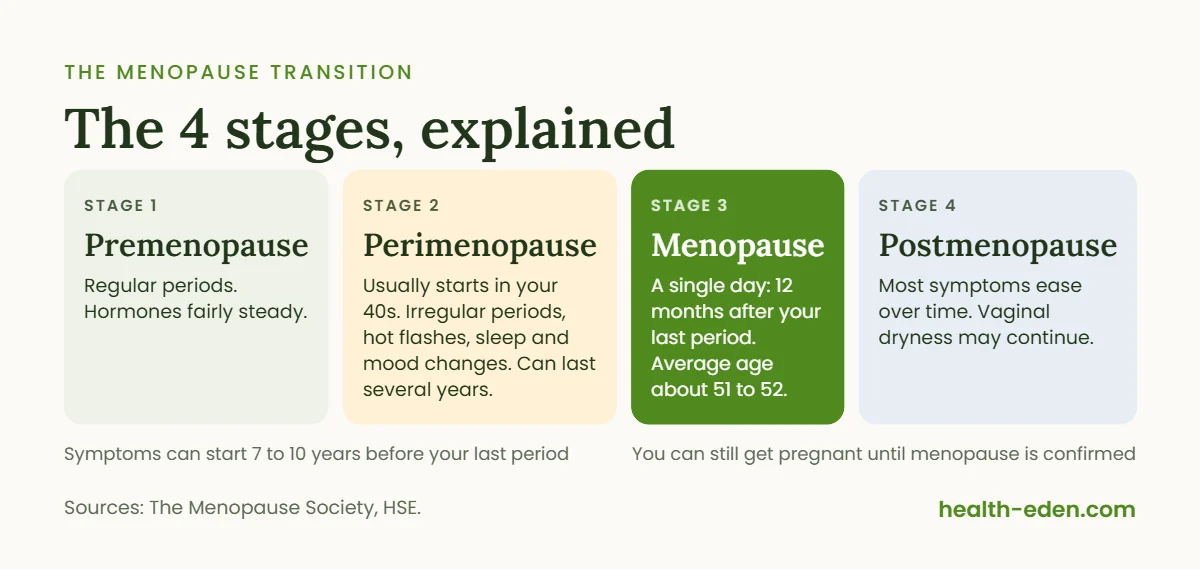
Perimenopause is the transition before menopause, when your ovaries’ hormone production becomes irregular. It usually starts in your 40s, and the most common symptoms are changes to your periods, hot flashes and night sweats, poor sleep, mood changes, brain fog, vaginal dryness and joint aches. Symptoms can begin several years before your last period and often ease after menopause, and there are effective treatments if they’re affecting your life.
Key takeaways
- Perimenopause is the run-up to menopause. Menopause itself is confirmed once you’ve gone 12 months without a period.
- The average age of menopause is about 51 to 52, and symptoms can start up to 7 to 10 years before your last period.
- Changing periods are often the first sign: cycles get shorter, then longer and more irregular, with heavier or lighter bleeding.
- Hot flashes and night sweats affect up to 80% of women at some point during the transition.
- You can still get pregnant during perimenopause, so keep using contraception until menopause is confirmed.
- Hormone therapy, newer non-hormonal medicines, CBT and lifestyle changes can all help. You don’t have to put up with them.
What is perimenopause?
Perimenopause means “around menopause”. It’s the time before your periods stop for good, when your ovaries produce estrogen and progesterone in an increasingly erratic way and you ovulate less often. Those hormone swings, rather than simply low hormones, are behind many of the symptoms.
Menopause is a single point in time: the day that marks 12 months since your last period. After that, you’re postmenopausal.
How long does it last and when does it start?
- Average age of menopause: about 51 to 52 (about 51 in the UK, according to the NHS). Most women reach menopause between 45 and 55.
- When symptoms start: Ireland’s health service (HSE) says symptoms can begin 7 to 10 years before your periods stop, which means many women notice changes in their early to mid-40s.
- Earlier than expected: if your periods stop or symptoms start before 45, and especially before 40, see a doctor. Early menopause has its own health considerations and is worth checking.
Common perimenopause symptoms
Not everyone gets every symptom, and some women barely notice the transition. Here are the most common signs, grouped by type.
Period changes
Changing periods are usually the first sign. The Menopause Society describes a typical pattern:
- Early on: cycles often become a little shorter, and bleeding may be heavier or lighter.
- Later: cycle length starts to vary by 7 days or more, and you may skip periods for 60 days or longer.
Any change in bleeding is worth tracking, and some changes need checking by a doctor (see below).
Hot flashes and night sweats
Hot flashes are a sudden, intense feeling of heat in the face, neck and chest, often with sweating, chills, anxiety or a racing heart. They typically last 1 to 5 minutes. Night sweats are hot flashes that happen while you sleep. According to The Menopause Society, up to 80% of women have them at some point during the menopause transition.
Sleep problems
Trouble falling asleep, waking in the night (often with night sweats) and waking too early are all common. Poor sleep then makes mood, concentration and energy worse, so treating sleep problems can improve several symptoms at once. Our guide to mindfulness for better sleep has simple techniques to try.
Mood changes, anxiety and low mood
Many women notice irritability, mood swings, anxiety, low mood or lower self-esteem. The large hormone swings of perimenopause may play a role, and women who have had depression before are at higher risk of it returning. These feelings are common, real and treatable.
Brain fog
Forgetfulness, losing your train of thought and trouble concentrating are common. The Menopause Society says brain fog is very common during perimenopause, and that dementia at midlife is very rare, so these lapses usually aren’t a sign of something serious.
Headaches and migraines
Headaches can become more frequent, and migraines may change as estrogen levels rise and fall.
Vaginal dryness, lower libido and painful sex
Falling estrogen can cause vaginal dryness, burning, irritation and discomfort during sex. These genitourinary symptoms can start in perimenopause but often appear or worsen after menopause, and unlike hot flashes, they tend not to go away on their own.
Bladder changes
Needing to pass urine more urgently and recurring urinary tract infections (UTIs) are more common as estrogen falls.
Joint aches and muscle loss
Mild joint aches and pains are common around menopause. Muscle mass also declines more quickly, which is one reason strength training matters so much at this stage. Our beginner’s guide to strength training for women over 50 is a good place to start.
Weight gain
Many women gain weight, especially around the middle. The Menopause Society notes that diet and physical activity can help limit midlife weight gain.
Skin and hair changes
Skin often becomes drier and thinner, and hair may thin. See our anti-aging skincare routine for women over 40 and our guide to hair thinning in women for what helps.
Other symptoms
Heart palpitations, breast tenderness, worse PMS, dry eyes and a dry mouth are also reported.
| Symptom | How common | What often helps |
|---|---|---|
| Irregular periods | Very common | Tracking cycles; see a doctor about unusual bleeding |
| Hot flashes and night sweats | Up to 80% of women | Layers, cooling, HRT, non-hormonal medicines, CBT |
| Sleep problems | Common | Sleep routine, treating night sweats, CBT |
| Mood changes and anxiety | Common | Exercise, talking therapy, HRT, antidepressants if needed |
| Brain fog | Common, usually mild | Sleep, lists and routines; often improves after menopause |
| Vaginal dryness | Common, often later | Vaginal moisturizers, lubricants, vaginal estrogen |
| Joint aches | Common | Staying active, strength training |
| Weight gain | Common | Strength training, protein, gradual calorie control |
How long do perimenopause symptoms last?
It varies a lot from woman to woman:
- Most symptoms: the HSE says most symptoms last around 4 years from your last period, but about 1 in 10 women have them for up to 12 years.
- Hot flashes: in the large US SWAN study of 1,449 women with frequent hot flashes or night sweats, published in JAMA Internal Medicine in 2015, symptoms lasted a median of 7.4 years in total. Women whose hot flashes started early, before or early in perimenopause, had them for longest, a median of more than 11.8 years.
- Differences between groups: in the same study, the median duration was 10.1 years for African American women, 8.9 years for Hispanic women, 6.5 years for non-Hispanic white women, 5.4 years for Chinese women and 4.8 years for Japanese women.
The Menopause Society notes that most symptoms improve after menopause even without treatment. Vaginal dryness is the main exception, as it often persists or gets worse.
Worked example: tracking your cycles
Because irregular periods are the clearest sign of perimenopause, tracking them is one of the most useful things you can do. It also gives your doctor real information instead of guesswork. Here’s an example of six months of cycle lengths for a 46-year-old woman:
| Month | Cycle length | What it suggests |
|---|---|---|
| January | 28 days | Her usual pattern |
| February | 24 days | Slightly shorter: common early in perimenopause |
| March | 25 days | Still shorter than usual |
| April | 34 days | Varies by 9 days from March: 7 days or more suggests the transition is underway |
| May | 29 days | Back to normal, which is typical of the ups and downs |
| June | 63 days | A skipped period of 60 days or more: often a sign of the later transition |
How to do it:
1. Note the first day of each period in a calendar or app. 2. Count the days from the first day of one period to the first day of the next. 3. Note how heavy the bleeding was, any spotting between periods, and symptoms such as hot flashes or poor sleep. 4. Take the record to your appointment.
Remember: a missed period in your 40s could also be pregnancy. If there’s any chance, take a pregnancy test.
Is it perimenopause or something else?
Several other conditions can look like perimenopause, so it’s worth seeing a doctor rather than assuming:
- Thyroid problems can cause tiredness, weight changes, mood changes, hair thinning and period changes.
- Pregnancy is still possible during perimenopause.
- Depression and anxiety can occur on their own, not only because of hormones.
- Iron deficiency from heavy periods can cause tiredness and brain fog.
- Unusual bleeding sometimes has other causes, such as fibroids or polyps, which need checking.
If you’re 45 or over, NICE says perimenopause can usually be diagnosed from your symptoms alone, without blood tests. Tests can still help rule out other causes, especially in younger women.
Contraception during perimenopause
You can still get pregnant during perimenopause, even if your periods are irregular, because you may still ovulate occasionally. The Menopause Society advises women who don’t want to become pregnant to keep using birth control until menopause is confirmed, one year after the final period. In the UK, women under 50 are usually advised to wait two years after their last period. Ask your doctor before stopping contraception, as the right timing can depend on your age and the method you use.
What helps with perimenopause symptoms?
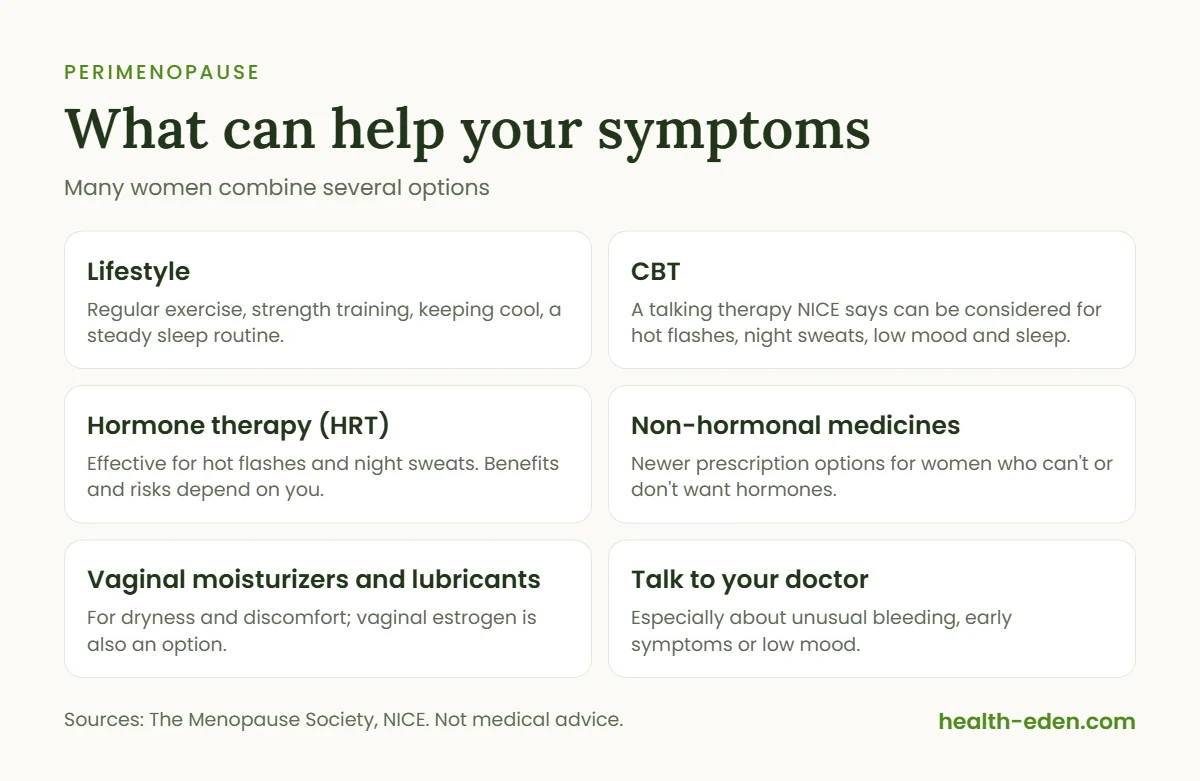
You don’t have to just put up with symptoms. Options range from simple lifestyle changes to prescription treatments, and many women use a combination.
Lifestyle changes
- Move regularly. In a survey of more than 1,800 Flo app users in 87 countries, presented at The Menopause Society’s 2026 meeting, women who exercised more often reported lower overall symptom burden, especially for low mood, irritability and anxiety. This shows an association rather than proof that exercise caused the improvement, but staying active has many other benefits too. A brisk daily walk is a great start; see our 4-week walking plan.
- Build strength to protect muscle and bones.
- Keep cool with layers, a fan by the bed and breathable bedding.
- Protect your sleep with a regular bedtime and a cool, dark bedroom.
- Look after your mental health. Our small self-care habits for busy women are a realistic place to start.
Talking therapy
The UK’s National Institute for Health and Care Excellence (NICE) says in its 2024 menopause guideline that cognitive behavioral therapy (CBT) can be considered for hot flashes, night sweats, low mood and sleep problems, alongside hormone therapy or for women who can’t or prefer not to take it.
Hormone therapy (HRT)
The Menopause Society describes hormone therapy as effective for bothersome hot flashes and night sweats. It has benefits and risks that depend on your age, health and the type of hormones used, so it’s a decision to make with your doctor.
Non-hormonal prescription medicines
For women who can’t or don’t want to take hormones, newer non-hormonal medicines are available. The FDA approved fezolinetant in 2023 and elinzanetant in 2025 to treat moderate to severe hot flashes and night sweats caused by menopause. Some other medicines, including certain antidepressants, are also used. Your doctor can explain which might suit you.
Vaginal dryness
The Menopause Society recommends regular vaginal moisturizers, water-, silicone- or oil-based lubricants for sex, and avoiding soap, bath oils and bubble baths around the vulva. Low-dose vaginal estrogen, which your doctor can prescribe, is another option.
Honest pros and cons of the main treatment options
| Option | Pros | Cons |
|---|---|---|
| Lifestyle changes | Free, safe, help mood, sleep, weight and long-term health | Effects on hot flashes are modest; takes consistency |
| CBT | No medication; helps hot flashes, mood and sleep | Takes several sessions; access varies |
| Hormone therapy (HRT) | Effective for hot flashes and night sweats; helps several symptoms | Not suitable for everyone; risks depend on your health and the type used |
| Non-hormonal medicines | Option for women who can’t or don’t want hormones | Prescription only; possible side effects; newer, with less long-term data |
| Vaginal moisturizers and lubricants | Available without a prescription; easy to use | Treat dryness only |
Who should be careful
- Hormone therapy isn’t suitable for everyone. The Menopause Society says it’s generally not recommended for women with a history of breast or uterine cancer, unexplained vaginal bleeding or liver disease, and that taking estrogen by mouth raises the risk of blood clots. Your doctor will weigh this against your symptoms.
- If you’ve had blood clots, a stroke or heart disease, discuss every treatment option, including non-hormonal medicines, with your doctor.
- If you take other medicines or supplements, check with a pharmacist before adding anything for menopause symptoms, as some interact.
- If you’re still having periods, remember that pregnancy is possible, and some treatments aren’t contraceptives.
When to see a doctor
See your doctor or a menopause specialist if:
- Your symptoms are affecting your work, relationships, sleep or quality of life.
- You have very heavy periods, periods lasting much longer than usual, bleeding between periods or after sex.
- You have any bleeding after menopause, even spotting. The Menopause Society warns not to assume abnormal bleeding is simply part of menopause.
- Your periods stop or symptoms start before age 45.
- You feel persistently low, anxious or hopeless.
- You have palpitations with chest pain, breathlessness or dizziness.
If you ever have thoughts of harming yourself, get help right away: in the US, call or text 988 (Suicide and Crisis Lifeline); in the UK, call 111 or Samaritans on 116 123.
It can help to look for a clinician with menopause training. In the US, The Menopause Society lists Menopause Society Certified Practitioners (MSCP).
Frequently asked questions
What are the first signs of perimenopause?
Changes to your periods are usually the first sign: cycles often get a little shorter at first, with heavier or lighter bleeding, then become more irregular. Hot flashes, poor sleep and mood changes are also common early signs.
At what age does perimenopause start?
It usually starts in your 40s. The average age of menopause is about 51 to 52, and symptoms can begin 7 to 10 years before your final period. See a doctor if your periods stop or symptoms start before 45.
How long does perimenopause last?
It varies. Most symptoms last around 4 years after your last period, but about 1 in 10 women have them for up to 12 years. In the US SWAN study, hot flashes lasted a median of 7.4 years in total.
Can you get pregnant during perimenopause?
Yes. You may still ovulate occasionally, so The Menopause Society advises using birth control until menopause is confirmed, one year after your final period, if you don’t want to become pregnant.
Can perimenopause cause anxiety?
Yes. Anxiety, irritability, mood swings and low mood are common during perimenopause, likely linked to hormone swings. They’re treatable, so talk to your doctor if they’re affecting your life.
Do I need a blood test to diagnose perimenopause?
Not usually. If you’re 45 or over, NICE says perimenopause can usually be diagnosed from your symptoms alone, without blood tests. Tests may be used to rule out other causes, such as thyroid problems, or in younger women.
The bottom line
Perimenopause symptoms usually begin in your 40s with changing periods, and can include hot flashes, night sweats, poor sleep, mood changes, brain fog, vaginal dryness and joint aches. Track your cycles and symptoms, keep using contraception until menopause is confirmed, and talk to your doctor if symptoms are getting in the way of your life. Between lifestyle changes, CBT, hormone therapy and newer non-hormonal medicines, there are more effective options than ever.
Sources
- The Menopause Society. Perimenopause.
- The Menopause Society. Symptoms.
- The Menopause Society. Higher physical activity frequency associated with lower symptom burden in perimenopause. October 2026.
- HSE (Ireland’s health service). Menopause symptoms.
- Avis NE, et al. Duration of menopausal vasomotor symptoms over the menopause transition. JAMA Internal Medicine, 2015. Summary.
- National Institute for Health and Care Excellence (NICE). Menopause: identification and management (NG23). Updated November 2024.
- Pharmacy Times. FDA approves elinzanetant for menopause vasomotor symptoms. October 2025.
Information checked as of October 2026. Read how we research and update articles in our editorial policy.
This article is for general information and isn’t a substitute for personal medical advice. Talk to your doctor about your symptoms and before starting or stopping any treatment or contraception. See our full medical disclaimer.

I'm Noah Orono, founder and editor of Health Eden. I write about skincare and healthy aging, strength and weight management, and women's health from your 30s into midlife and beyond. Every guide starts with published research and guidance from dermatologists, doctors and certified trainers, then turns it into clear, practical steps. I'm not a medical professional, so I'll always tell you when something is worth raising with your doctor.
More about Health Eden →