Self-Care for Busy Women: 12 Small Habits That Make a Real Difference
 Noah Orono

A vitamin C serum for mature skin can help with fine lines, dullness and uneven tone, and it adds a second layer of defense under your sunscreen. Look for 10% to 20% L-ascorbic acid at a low pH, or a gentler derivative if your skin is sensitive, use it in the morning, and give it about three months.
Key takeaways
- Vitamin C is an antioxidant that helps neutralize damage from UV light and pollution, and it plays a part in making collagen, the protein that keeps skin firm.
- The best-studied form is L-ascorbic acid at 10% to 20%, in a formula with a pH below 3.5. Below 10% it is likely too weak; above 20% it adds irritation without extra benefit.
- The evidence is real but modest: mostly small trials lasting 3 to 6 months, showing softer fine lines and brighter, more even skin.
- Use it in the morning after cleansing, then moisturizer and sunscreen. It doesn’t replace sunscreen.
- Pairing it with retinol is fine. The simplest way is vitamin C in the morning and retinol at night.
- Vitamin C breaks down in air, heat and light. A serum that has turned dark orange or brown has oxidized and is past its best.
What vitamin C does for mature skin
Vitamin C (ascorbic acid) is one of the skin’s main antioxidants. Antioxidants mop up free radicals, the unstable molecules that sunlight and pollution create in your skin, which damage collagen and other structures over time. Your body can’t make vitamin C, and sun exposure depletes it in the skin.
On the skin, vitamin C has three jobs that matter after 40:
- Collagen support. Vitamin C is needed by the enzymes that build collagen. “As you age, your skin produces less collagen,” Cleveland Clinic dermatologist Melissa Piliang, MD, explains, and that loss shows up as wrinkles and sagging.
- Backup sun defense. Sunscreen blocks most UV light but not all of it. Vitamin C helps deal with the damage from the rays that get through. Dr. Piliang says vitamin C and sunscreen “work in synergy.”
- Brightening. Vitamin C slows tyrosinase, the enzyme that makes pigment, so it can fade dark spots and give a more even tone over time.
If you already follow a simple anti-aging skincare routine, vitamin C is the optional morning extra that fits between cleanser and moisturizer. The essentials are still sunscreen, moisturizer and a nightly retinoid.
What the evidence actually shows
The research on topical vitamin C is encouraging, but most of it is small. Here are the main human studies and what they found.
| Study | Who and how long | What they used | What happened |
|---|---|---|---|
| Fitzpatrick and Rostan, 2002 | 10 people, 12 weeks, half-face, compared with the base gel | 10% ascorbic acid plus 7% THD in a gel | Wrinkles and overall photoaging scores improved on the treated side, and biopsies in 4 people showed new collagen |
| Humbert and colleagues, 2003 | 20 women, 6 months, placebo-controlled, on the neck and arms | 5% vitamin C cream | Better-looking skin, fewer deep furrows on skin-surface imprints, and signs of elastic tissue repair on biopsy |
| Lin and colleagues, 2005 | Pig skin (a lab model close to human skin) | 15% vitamin C, 1% vitamin E, 0.5% ferulic acid | Adding ferulic acid roughly doubled the protection against UV redness compared with vitamins C and E alone |
A 2017 review in the Journal of Clinical and Aesthetic Dermatology summed it up fairly: vitamin C has a good safety record and a clear role against photoaging, but clinical data are still limited and the hard part is making a product that is stable and actually gets into the skin.
A newer systematic review, published in the same journal in 2026, looked at 44 studies. It found that stable, low-pH L-ascorbic acid formulas, especially those combined with vitamin E and ferulic acid, consistently improved sun damage and signs of aging. It also flagged that many studies were small, short, open-label (everyone knew what they were using) or funded by industry.
So the honest summary: vitamin C is one of the better-supported over-the-counter ingredients for aging skin, but expect gentle, gradual change, not the dramatic results some ads promise. Retinoids still have the strongest evidence for wrinkles. Our guide to retinol vs retinal vs tretinoin explains why.
Types of vitamin C in serums
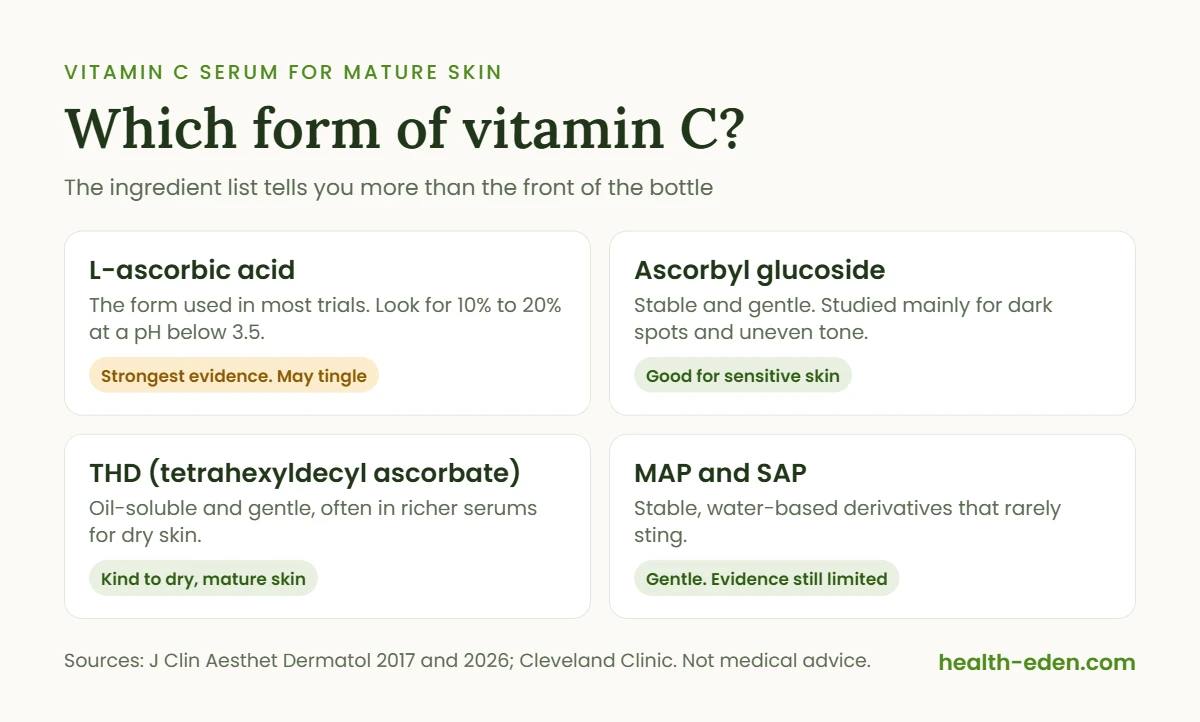
The label might say vitamin C, but the ingredient list will name a specific form. They differ in strength, stability and how gentle they are.
| Form on the label | Strength of evidence | Gentle? | Good for |
|---|---|---|---|
| L-ascorbic acid (ascorbic acid) | Strongest. Most trials used this form | Can tingle or sting, because it needs a low pH | Normal and oily skin that tolerates actives |
| Ascorbyl glucoside | Moderate, mainly for dark spots | Yes | Sensitive skin, uneven tone |
| Magnesium ascorbyl phosphate (MAP) | Limited | Yes | Dry or sensitive skin |
| Sodium ascorbyl phosphate (SAP) | Limited | Yes | Sensitive or breakout-prone skin |
| Tetrahexyldecyl ascorbate (THD, also called ascorbyl tetraisopalmitate) | Limited but growing | Yes, often in oil-based serums | Dry, mature skin |
| Ascorbyl palmitate | Weak | Yes | Usually a minor extra in a formula |
The trade-off is simple. L-ascorbic acid is the form with the most proof, but it is unstable and works best at a low pH, which can sting. The derivatives are more stable and kinder to sensitive skin, but they have to be converted in the skin, and the research behind them is thinner. One study cited in the 2017 review found that applying some derivatives every day did not raise vitamin C levels in the skin.
If your skin has become drier and more reactive since menopause, a derivative such as THD or ascorbyl glucoside is a reasonable place to start. If your skin copes well with actives, L-ascorbic acid is the better-studied choice.
How to choose a vitamin C serum for mature skin
You don’t need the most expensive bottle. These are the details that matter:
- Strength. For L-ascorbic acid, look for 10% to 20%. Cleveland Clinic says that under 10% won’t give you the benefits you’re looking for, and that above 20% risks irritating your skin. If your skin is sensitive, start nearer 10%.
- pH. L-ascorbic acid serums work best below pH 3.5. Brands don’t always print the pH, but well-formulated ones often mention it.
- Helpers. Vitamin E and ferulic acid make vitamin C more stable and boost its protection. This is the best-studied trio.
- Packaging. Choose a dark or opaque bottle, ideally airless or with a dropper, and a size you’ll finish in a few months. Vitamin C breaks down with air, heat and light.
- Texture. Water-based serums sink in fast. Oil-based ones with THD feel richer, which many drier skins prefer.
- Fragrance. Skip added perfume and essential oils if your skin reacts easily.
A higher price doesn’t guarantee a better result. A mid-priced serum with the right form, strength and packaging can work as well as a luxury one, as long as you finish it before it oxidizes.
How to use vitamin C serum
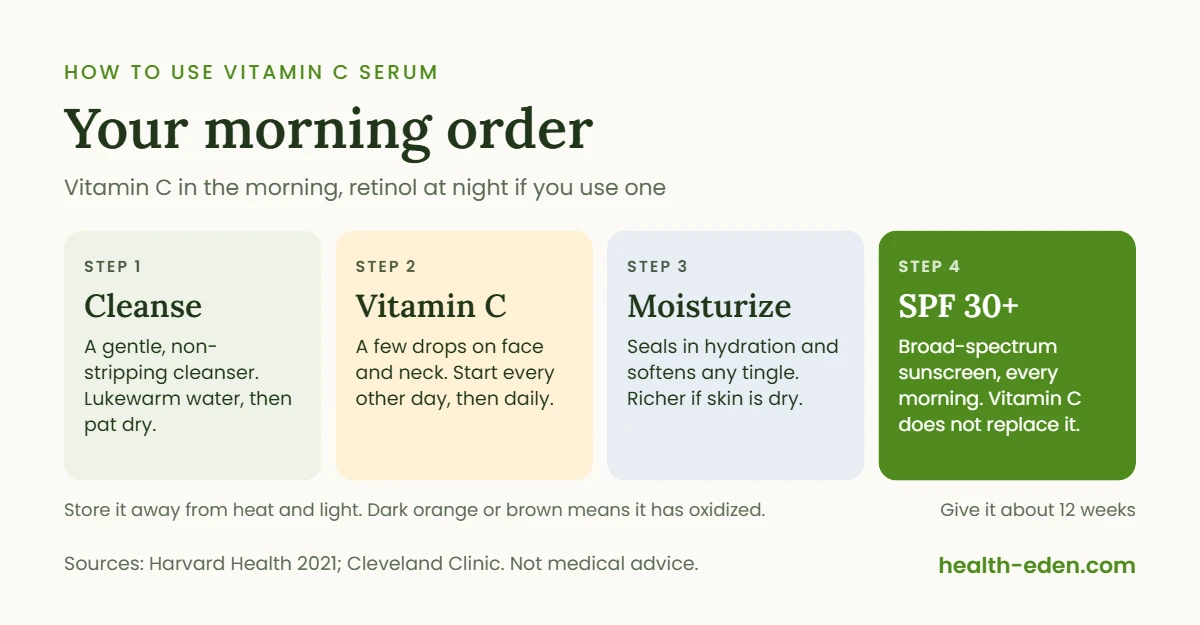
Morning is the best time, because vitamin C works alongside your sunscreen during the day. Harvard Health suggests this order:
1. Cleanse gently. 2. Apply a few drops of vitamin C serum to your face and neck. 3. Follow with moisturizer. 4. Finish with sunscreen (we suggest broad-spectrum, SPF 30 or higher).
Start every other morning for the first week or two, then move to daily if your skin is happy. A light tingle with L-ascorbic acid is common. Real burning, lasting redness or a rash means stop.
A worked example: your first 12 weeks
This is a sample plan for someone adding vitamin C to a routine that already includes moisturizer and sunscreen.
| Weeks | Morning | Evening | What to watch for |
|---|---|---|---|
| Before you start | Patch test: a little serum on your jawline for 2 to 3 days | Usual routine | Itching, redness or bumps mean it isn’t for you |
| 1 to 2 | Vitamin C every other morning, then moisturizer and SPF | Usual routine (retinol if you use it) | Mild tingling is normal and should fade |
| 3 to 4 | Vitamin C every morning | Usual routine | Dryness: add a richer moisturizer |
| 5 to 12 | Daily vitamin C, moisturizer, SPF | Retinoid 2 to 7 nights a week, as tolerated | Take a photo in the same light once a month |
| Week 12 | Compare your photos | Keep going if you see brighter, more even skin | No change? Try a different form or formula |
Dr. Piliang says it takes about three months to really see the effects, and she suggests taking a bare-faced photo once a month so you can compare.
Using vitamin C with retinol and other ingredients
Vitamin C and retinol. You can use both. The easiest approach is vitamin C in the morning and retinol at night. Using them at different times means less chance of irritation, and it suits how each works: vitamin C for daytime protection, retinol for overnight renewal. If you’re new to retinoids, read how to start retinol over 50 without irritation and introduce one new product at a time, a few weeks apart.
Vitamin C and exfoliating acids (AHAs, BHAs). Both are acidic and can sting together on thinner skin. Use them at different times of day, or on different days.
Vitamin C and niacinamide. Most people can use these together. If the combination makes your skin flush or tingle, use them at different times.
Vitamin C and sunscreen. Always together. Harvard Health says plainly that vitamin C doesn’t replace sunscreen or sun-protective clothing.
Vitamin C and at-home devices. If you use an at-home device such as an LED face mask, check the device instructions, and avoid applying strong actives right before a session unless the maker says it’s fine.
Storage and shelf life
L-ascorbic acid is fragile. Once it oxidizes, it turns from clear or pale yellow to dark orange and then brown, and it works less well. A few habits help it last:
- Keep the cap tightly closed and store the bottle away from sunlight and heat. A bathroom windowsill is the worst spot.
- Buy a smaller bottle you’ll use up in about three months rather than a large one that sits open for six.
- Check the color. If it’s turned dark orange or brown, replace it.
A slight yellow tint is normal for many formulas. If you’re not sure, compare it with how it looked when you opened it.
Pros and cons of vitamin C serum
| Pros | Cons |
|---|---|
| Antioxidant protection that adds to sunscreen | Results are gradual and modest |
| Can soften fine lines and brighten dull skin | Best-studied form can tingle or sting |
| Can help fade dark spots over time | Breaks down with air and light, so goes off |
| Works alongside retinol and most routines | Good formulas can be costly |
| Generally well tolerated | Many studies are small or industry-funded |
Who should be careful
- Sensitive or reactive skin, rosacea or eczema. Low-pH L-ascorbic acid can sting and flare symptoms. Start with a gentle derivative at a low strength, and patch test first.
- Very dry, thin skin after menopause. Apply it under a rich moisturizer, and skip it on days your skin feels raw.
- If you use prescription skin treatments. Ask your doctor or pharmacist before adding vitamin C to tretinoin or other prescription creams.
- Allergies. Check the full ingredient list. Some serums contain fragrance, essential oils or plant extracts.
- Pregnancy and breastfeeding. Check with your doctor or midwife before starting any new skincare product.
Harvard Health notes that topical vitamin C has only been studied in adults, so it isn’t recommended for children.
When to see a doctor
A serum can’t treat a skin condition. See a doctor or dermatologist if:
- you get burning, swelling, blistering or a rash that doesn’t settle after you stop the product
- a dark spot is new, growing, changing shape or color, bleeding or itching
- a patch of skin is rough, scaly or sore and won’t heal
- dark patches appear suddenly or spread, especially on your face, as this could be melasma or another condition that needs proper treatment
Any spot that looks different from your others, or is changing, should be checked to rule out skin cancer.
Frequently asked questions
Is vitamin C serum good for skin over 50?
Yes. Vitamin C can help at any age, and the main trials were in adults with sun-damaged skin. Choose a formula your skin tolerates, use it every morning under sunscreen, and expect gradual improvement in brightness and fine lines over about three months.
What percentage of vitamin C is best for mature skin?
For L-ascorbic acid, 10% to 20% is the range most dermatologists recommend. Start around 10% if your skin is sensitive. Concentrations above 20% tend to irritate without adding benefit. Derivatives such as ascorbyl glucoside or THD are labeled differently and are gentler.
Should I use vitamin C in the morning or at night?
Morning is usually best, because vitamin C backs up your sunscreen against daytime UV and pollution. Using it at night is also safe. Many people use vitamin C in the morning and retinol at night.
Can I use vitamin C and retinol together?
Yes. The simplest way is to keep them apart: vitamin C in the morning and retinol in the evening. This lowers the chance of irritation, which matters more as skin gets thinner and drier with age.
How do I know if my vitamin C serum has gone bad?
Look at the color. Fresh L-ascorbic acid serums are clear to pale yellow. If yours has turned dark orange or brown, it has oxidized and is less effective, so replace it. Store it away from heat and light, and use it within a few months of opening.
How long does vitamin C serum take to work?
Most people need around 12 weeks of daily use to see a clear difference. Cleveland Clinic dermatologist Melissa Piliang, MD, suggests taking a photo once a month so you can compare.
The bottom line
A good vitamin C serum is a sensible morning addition for mature skin. It adds antioxidant protection under your sunscreen and can slowly brighten tone and soften fine lines. Choose 10% to 20% L-ascorbic acid if your skin tolerates it, or a gentler derivative if it doesn’t, keep it away from light and heat, and give it three months. It won’t replace sunscreen or a retinoid, but it works well alongside both. For the bigger picture on aging well, see our guide on how to age well.
Sources
- Al-Niaimi F, Chiang NYZ. Topical vitamin C and the skin: mechanisms of action and clinical applications. Journal of Clinical and Aesthetic Dermatology. 2017.
- Boghosian T, et al. Clinical applications of vitamin C in dermatology: a systematic review. Journal of Clinical and Aesthetic Dermatology. 2026.
- Cleveland Clinic. Vitamin C serum: benefits and how to use it. Accessed 2026.
- Nathan N, Patel P. Why is topical vitamin C important for skin health? Harvard Health Publishing. 2021.
- Lin FH, et al. Ferulic acid stabilizes a solution of vitamins C and E and doubles its photoprotection of skin. Journal of Investigative Dermatology. 2005.
- DermNet. Topical vitamin C. Accessed 2026.
Information checked as of November 2026. Read how we research and update articles in our editorial policy.
This article is for general information and isn’t a substitute for personal medical advice. Talk to your doctor or a dermatologist before starting a new treatment, especially if you have a skin condition or use prescription skincare. See our full medical disclaimer.

I'm Noah Orono, founder and editor of Health Eden. I write about skincare and healthy aging, strength and weight management, and women's health from your 30s into midlife and beyond. Every guide starts with published research and guidance from dermatologists, doctors and certified trainers, then turns it into clear, practical steps. I'm not a medical professional, so I'll always tell you when something is worth raising with your doctor.
More about Health Eden →