Self-Care for Busy Women: 12 Small Habits That Make a Real Difference
 Noah Orono
LED face masks can work, but the results are modest and take time. Red and near-infrared light have small studies showing softer fine lines, smoother texture and more collagen after several weeks of regular use, and blue light has reasonable evidence for mild to moderate acne. Home masks are weaker than the devices dermatologists use, so expect subtle changes over 8 to 12 weeks rather than a dramatic transformation, and use eye protection every time.
Key takeaways
- LED masks use red, blue or near-infrared light, not UV, so they don’t tan the skin or carry UV’s skin cancer risk.
- Red and near-infrared light have the best evidence for fine lines and texture; blue light is used for acne.
- Most studies are small and often funded by manufacturers, and results are subtle to noticeable rather than dramatic.
- Home masks are lower-powered than in-office devices, so consistent use for 8 to 12 weeks matters.
- If the instructions call for eye protection, wear it every time, and check with a doctor first if you take light-sensitizing medicines or have a darker skin tone.
- Choose an FDA-cleared mask that lists its wavelengths and power output.
How LED light therapy works
LED (light-emitting diode) masks shine specific colors of light onto your skin. Unlike sunlight or tanning beds, they don’t use ultraviolet (UV) light and don’t rely on heat. Instead, the light is absorbed by skin cells and is thought to trigger biological changes, a process called photobiomodulation. Red light, for example, appears to boost the activity of fibroblasts, the cells that make collagen.
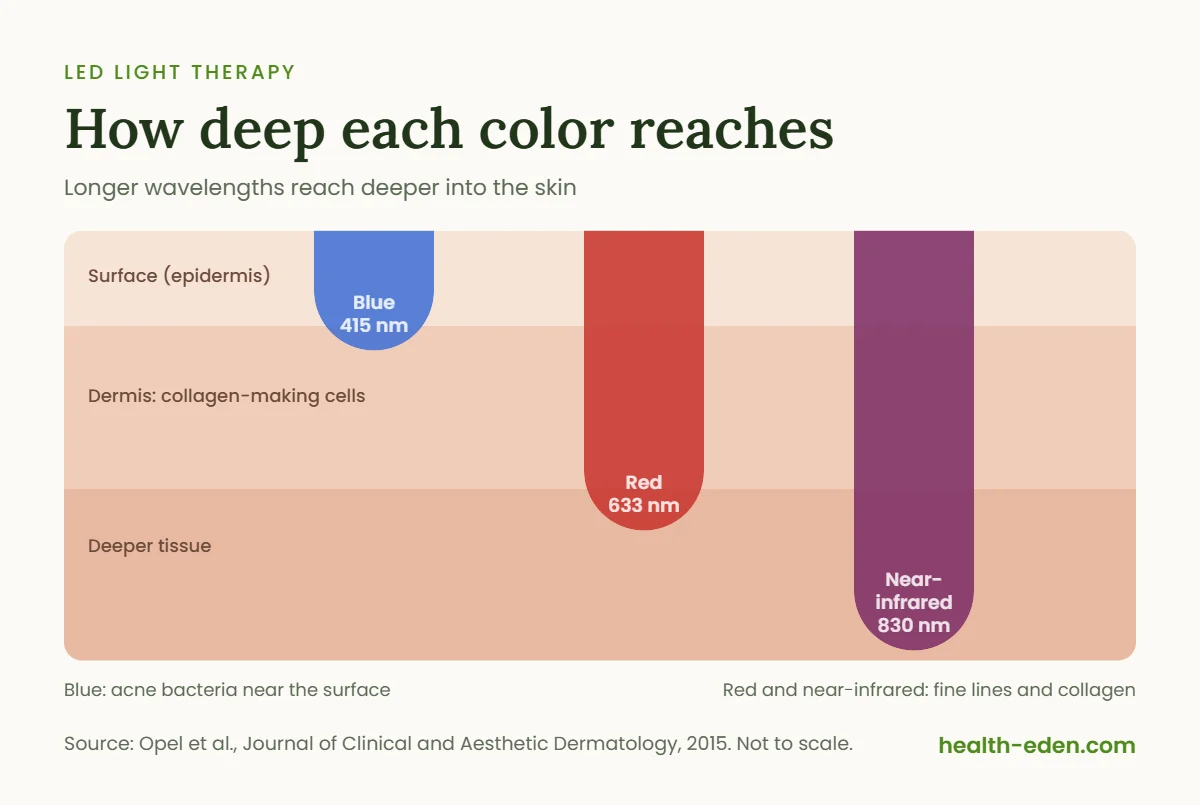
Different colors reach different depths. According to a 2015 review in the Journal of Clinical and Aesthetic Dermatology:
- Blue light (about 415 nm) penetrates only about 1 mm, so it acts on the surface of the skin.
- Red light (about 633 nm) penetrates deepest of the visible colors.
- Near-infrared light (about 830 nm) is invisible and goes deeper still, about 5 to 10 mm.
“nm” stands for nanometers, the unit used to measure the wavelength (color) of light. Good masks tell you exactly which wavelengths they use.
What each LED color does
| Light color | Wavelength | Used for | Strength of evidence |
|---|---|---|---|
| Red | About 630 to 660 nm | Fine lines, texture, collagen | Moderate: several small trials |
| Near-infrared | About 830 nm | Wrinkles, deeper skin repair | Moderate: often combined with red |
| Blue | About 415 nm | Mild to moderate acne | Moderate for inflamed spots |
| Yellow or amber | About 590 nm | Redness, calming skin | Limited |
| Green, purple and other colors | Various | Marketing claims vary | Very limited |
If your main goal is anti-aging, look for a mask with red and near-infrared light. If you get adult breakouts, a mask with both blue and red light may help.
Do LED face masks work? What the research shows
For fine lines and wrinkles
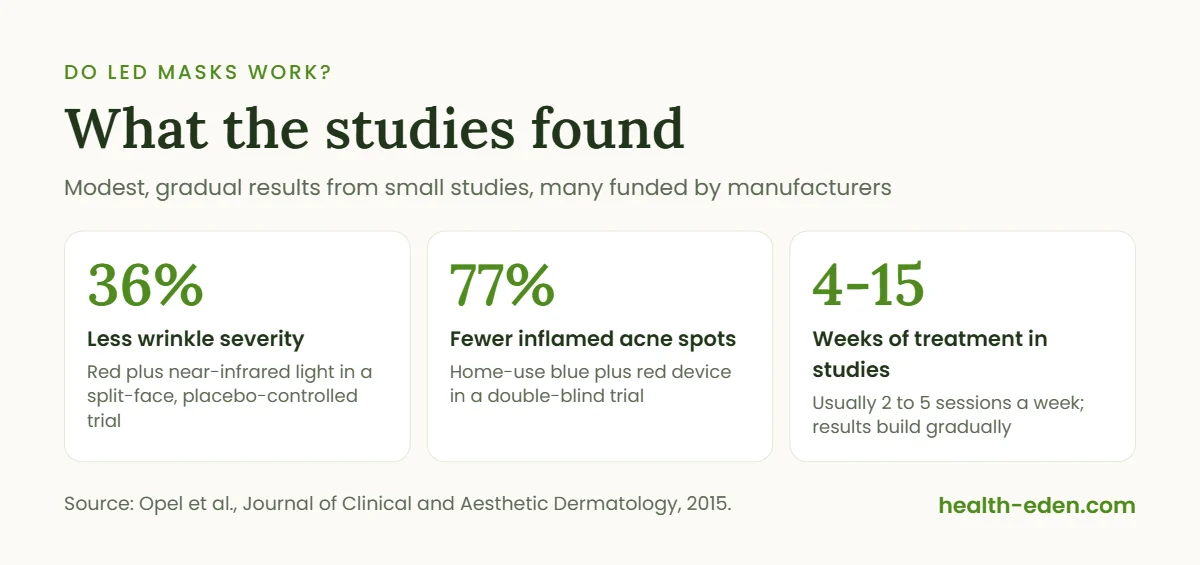
- Red and near-infrared in a clinical trial: in a split-face, placebo-controlled trial reviewed in the Journal of Clinical and Aesthetic Dermatology, wrinkle severity fell by 26% with red light, 33% with near-infrared and 36% with both combined, and skin elasticity improved.
- Large light panels: a 2014 controlled trial in Photomedicine and Laser Surgery treated 113 volunteers twice a week for 30 sessions and compared them with 23 untreated controls. The treated groups had smoother skin, better complexion and higher collagen scores on ultrasound scans.
- Home masks: the Center for Science in the Public Interest (CSPI) reviewed the evidence in 2026 and described it as “not great.” One manufacturer-funded trial in 59 middle-aged adults, mostly women, found a slight reduction in crow’s feet in 86% of mask users after 12 weeks, compared with 17% of those using a weaker placebo mask.
The American Academy of Dermatology (AAD) sums it up this way: some studies indicate that red-light LED devices “can produce subtle to noticeable results on the face,” but researchers still don’t fully understand the effects of red light on the skin.
For acne
Blue light targets the bacteria involved in acne and calms inflammation. In one small study of 30 people summarized in the 2015 review, blue light cut inflamed spots by 25% at week 5 and 60% by week 12, with little effect on blackheads and whiteheads. A double-blind trial of a home-use device combining blue and red light found a 77% reduction in inflamed spots. LED is best seen as an add-on to standard acne treatment rather than a replacement.
The honest summary
LED masks probably do help a little, the short-term safety record is good, and results build slowly. But the studies are small, the devices vary widely, and long-term effects are still unknown.
Home LED masks vs in-office treatment
The AAD notes that the red light dermatologists use is more powerful than the light in devices sold for home use. That means:
- In-office treatment may give results more quickly, under professional supervision. CSPI reports sessions can cost more than $100 each.
- Home masks are cheaper over time (often $400 or more upfront, according to CSPI) and convenient, but they need consistent use over many weeks.
Dermatologists usually suggest red light as an add-on to well-established skincare rather than a replacement. Daily sunscreen and a retinoid still do more for aging skin, as we explain in our anti-aging skincare routine for women over 40. For how LED compares with radiofrequency, microcurrent and other tools, see our guide to at-home beauty devices.
Worked example: how to read an LED mask’s specs
Light therapy studies measure the “dose” of light as energy per area, in joules per square centimeter (J/cm²). Some manufacturers publish their mask’s power output (irradiance, in mW/cm²), which lets you work out the dose yourself:
Dose (J/cm²) = irradiance (mW/cm²) × time (seconds) ÷ 1,000
For example, if a mask delivers 30 mW/cm² and you use it for 10 minutes (600 seconds):
- 30 × 600 = 18,000
- 18,000 ÷ 1,000 = 18 J/cm² per session
For comparison, the 2014 light-panel study used a red-light dose of about 9 J/cm² per session, twice a week. Home masks differ a lot, which is why it helps when a brand publishes these numbers.
Two important points:
- More isn’t always better. Light therapy seems to work within a range, and very high doses can irritate. In two safety trials of high-dose red light on the forearm, published in the Journal of Biophotonics in 2020, blistering and prolonged redness appeared only at very high doses (480 J/cm² and above), many times higher than a home mask session. The researchers also found that darker skin was more sensitive to red light.
- Follow the manufacturer’s instructions for session length and frequency, and don’t use a mask longer or more often than recommended.
How to use an LED face mask
1. Start with clean, dry skin. Remove makeup and sunscreen so the light reaches your skin. 2. Put on eye protection if the instructions call for it. The AAD says to wear the recommended type every time and not to substitute sunglasses. 3. Use it for the recommended time, usually a few minutes per session. 4. Be consistent. Studies have used two to five sessions a week for anywhere from 4 to 15 weeks, and results build gradually. 5. Apply your usual skincare afterward, such as a moisturizer or serum. 6. Track your progress with photos taken in the same light every 4 weeks. 7. Clean the mask as the manufacturer recommends, especially if you use it for acne.
Many women find a short, quiet LED session becomes a calming part of their evening. If you’re looking for more small ways to make time for yourself, see our self-care habits for busy women.
How to choose an LED face mask
- Look for FDA clearance (or UKCA or CE marking in the UK). The AAD says clearance means a device is generally considered safe, but “FDA cleared doesn’t tell you anything about how effective the device is.” Be wary of “FDA-approved” or “FDA-certified” claims, which don’t apply to these devices.
- Check the wavelengths. For anti-aging, look for red (around 630 to 660 nm) and near-infrared (around 830 nm).
- Look for published power output (irradiance) so you know the dose.
- Check for eye protection and a comfortable fit.
- Look for real studies on the device itself, ideally with a placebo or sham comparison.
- Check the return policy, since results take months to judge.
LED caps and helmets for hair loss use similar technology. The AAD says they may help some people but won’t regrow a full head of hair; we cover them in our guide to hair thinning in women.
Honest pros and cons of LED face masks
Pros
- No UV light, no downtime and a good short-term safety record.
- Some evidence for fine lines, texture and acne.
- Convenient and cheaper than repeated in-office sessions over time.
- Easy to fit into an evening routine.
Cons
- Results are modest and take 8 to 12 weeks or more.
- Most studies are small and often manufacturer-funded.
- High upfront cost, and cheap masks may not deliver an effective dose.
- You need ongoing use to maintain results.
- Long-term effects are unknown.
Who should be careful
- If you take medicines that make you sensitive to light, or have a light-sensitive condition such as lupus, the AAD advises talking to a dermatologist first, as red light may not be recommended.
- If you have a darker skin tone, you may be more sensitive to visible light and at higher risk of lasting dark spots, according to the AAD. Ask a dermatologist before starting.
- If you have an eye condition, ask your eye doctor first and always use eye protection. In 2019, Neutrogena recalled its Light Therapy Acne Mask in the US, Canada, the UK and Ireland over a theoretical risk of eye injury for people with certain eye conditions or taking medicines that increase light sensitivity.
- If you’re pregnant or breastfeeding, LED masks haven’t been well studied, so ask your doctor.
- If you’ve had a recent cosmetic procedure such as a peel or laser, check with your provider before using a mask.
When to see a dermatologist
Stop using the mask and see a dermatologist or doctor if you notice:
- Redness, burning or irritation that lasts more than a day.
- New dark patches or uneven color.
- Eye pain, discomfort or changes in your vision.
- A new or changing mole or spot. Never treat it with a device; get it checked.
A dermatologist can also advise on stronger in-office options if home results aren’t enough, and on treating acne that doesn’t respond to over-the-counter care.
Frequently asked questions
Do LED face masks actually work?
They can help modestly. Small studies show red and near-infrared light can soften fine lines and improve texture and collagen over several weeks, and blue light can reduce inflamed acne spots. The AAD describes results as subtle to noticeable, not dramatic.
How long does it take to see results from an LED mask?
Studies have used two to five sessions a week for 4 to 15 weeks before measuring results. Changes build gradually, and you need ongoing use to maintain them.
Which LED color is best for wrinkles?
Red light (around 630 to 660 nm) and near-infrared light (around 830 nm) have the best evidence for fine lines and collagen. Blue light is mainly used for acne.
Are LED face masks safe for your eyes?
Use the eye protection your mask recommends every time, and don’t substitute sunglasses. Talk to your doctor first if you have an eye condition or take medicines that make you sensitive to light.
Can I use an LED mask every day?
Follow the manufacturer’s instructions. Home masks are usually used for a few minutes per session, several times a week (one study used 9 minutes a day, five days a week). Using a mask longer or more often than recommended won’t speed up results and may irritate your skin.
Are at-home LED masks as good as professional treatments?
No. The AAD says the red light dermatologists use is more powerful than home devices. Home masks can still help with consistent use, but results are subtler and slower.
The bottom line
Do LED face masks work? Yes, modestly. Red and near-infrared light can gently improve fine lines and texture, and blue light can help mild acne, but only with consistent use over months. Choose an FDA-cleared mask that lists its wavelengths and power, protect your eyes, check with a dermatologist if you’re light-sensitive or have darker skin, and keep sunscreen and a retinoid at the center of your routine.
Sources
- American Academy of Dermatology. Is red light therapy right for your skin?
- Opel DR, et al. Light-emitting diodes: a brief review and clinical experience. Journal of Clinical and Aesthetic Dermatology, 2015;8(6):36-44. Read the review.
- Wunsch A, Matuschka K. A controlled trial to determine the efficacy of red and near-infrared light treatment. Photomedicine and Laser Surgery, 2014;32(2):93-100. PubMed.
- Jagdeo J, et al. Safety of light emitting diode-red light on human skin: two randomized controlled trials. Journal of Biophotonics, 2020;13(3):e201960014. PubMed.
- Center for Science in the Public Interest. Can red-light therapy reverse skin aging? September 2026.
- Health Canada. Neutrogena Light Therapy Acne Mask recall. July 2019.
- Association of Optometrists. Eye injury risk prompts recall of Neutrogena light therapy acne mask. July 2019.
- Cosmetics Business. Neutrogena recalls Light Therapy Acne Mask in the US. July 2019.
Information checked as of October 2026. Read how we research and update articles in our editorial policy.
This article is for general information and isn’t a substitute for personal medical advice. Talk to your doctor or dermatologist before using a light therapy device, especially if you take regular medicines or have a skin or eye condition. See our full medical disclaimer.

I'm Noah Orono, founder and editor of Health Eden. I write about skincare and healthy aging, strength and weight management, and women's health from your 30s into midlife and beyond. Every guide starts with published research and guidance from dermatologists, doctors and certified trainers, then turns it into clear, practical steps. I'm not a medical professional, so I'll always tell you when something is worth raising with your doctor.
More about Health Eden →