Self-Care for Busy Women: 12 Small Habits That Make a Real Difference
 Noah Orono

Minoxidil for women is the best-studied over-the-counter treatment for female pattern hair loss. In trials, women using it were about twice as likely to see regrowth as those using a placebo. Results take at least 3 to 6 months, some extra shedding can happen early on, and you need to keep using it to keep the gains.
Key takeaways
- Topical minoxidil is approved for female pattern hair loss in the US and UK, and you can buy it without a prescription.
- A 2016 Cochrane review of 47 trials found that women using minoxidil were about twice as likely to report moderate or marked regrowth as women using a placebo.
- The same review found no clear difference in results between the 2% and 5% strengths. The 5% foam is used once a day, which many women find easier.
- Expect to wait at least 3 months for results, and up to 6 months or more. New hairs are often finer at first.
- If you stop, the regrowth is usually lost within about 3 to 4 months.
- Minoxidil is toxic to cats and dogs, so let it dry fully and wash your hands before touching pets.
What minoxidil is and how it works
Minoxidil started life as a blood pressure tablet in the 1970s. Doctors noticed that patients taking it grew extra hair, and it was later developed as a lotion for hair loss. Today the topical version (applied to the scalp) is sold over the counter as a solution or foam, under brands such as Women’s Rogaine and Regaine for Women, and as cheaper store-brand versions.
Nobody knows exactly how it works. It widens small blood vessels, and it seems to lengthen the growth phase of the hair cycle and enlarge shrinking hair follicles. In female pattern hair loss, follicles gradually shrink and produce thinner, shorter hairs. Minoxidil can slow that process and, for some women, thicken hair back up.
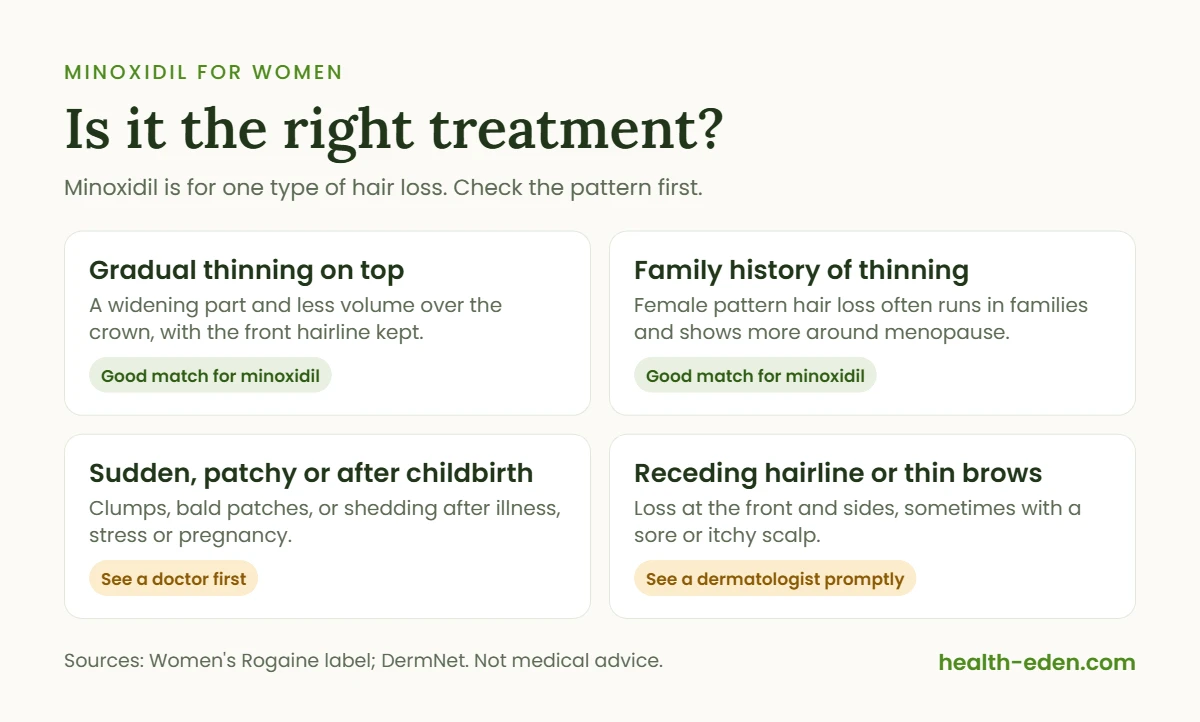
Minoxidil works best for female pattern hair loss (also called androgenetic alopecia): gradual thinning over the top of the head and a widening part, usually with the front hairline kept. It’s the most common type of hair loss in women, and it often becomes more noticeable around menopause. Our guide to hair thinning in women explains the other causes, which need different treatment.
Does minoxidil work for women? The evidence
Yes, for many women, though the effect is moderate rather than dramatic. The best summary is a 2016 Cochrane review, which pooled 47 randomized trials with 5,290 participants.
| Outcome | What the review found | Quality of evidence |
|---|---|---|
| Women reporting moderate or marked regrowth | 26% on minoxidil (157 of 593) vs 14% on placebo (77 of 555), about twice as likely | Moderate |
| Investigators rating regrowth | Minoxidil users about 2.4 times as likely to show regrowth | Moderate |
| Hair count | About 13 more hairs per square centimeter than placebo | Low |
| 2% vs 5% strength | No meaningful difference in regrowth or hair count | Low to moderate |
| Side effects | No significant difference from placebo in overall side effects (2% studies) | Low |
A separate 2016 trial of 322 women compared once-daily 5% foam with twice-daily 2% solution for a year. Both increased hair counts by about 24 hairs per square centimeter at 24 weeks, and both were well tolerated. Technically, the study didn’t meet its formal test for showing the foam was “non-inferior,” but the results were almost identical.
What does that mean in real life? Most women who respond see less shedding and a thicker-looking part, rather than a full head of new hair. Around three in four women in the trials didn’t report moderate or marked regrowth, so it’s worth going in with realistic expectations. Minoxidil also tends to work better at slowing loss early than at restoring hair that’s been gone for many years.
2% vs 5% minoxidil for women
Both strengths are sold for women, and the Cochrane review found no clear difference in how well they work. The bigger practical difference is the format and how often you use it.
| 2% solution | 5% foam | |
|---|---|---|
| How often | Twice a day | Once a day |
| Texture | Liquid with a dropper | Light foam |
| Contains propylene glycol? | Usually, which can irritate some scalps | Usually not |
| Good for | Women who don’t mind a twice-daily routine | Busy routines; sensitive scalps |
| Unwanted facial hair | Possible if it drips onto the face | Possible; some reports suggest it’s more common with higher strengths |
The once-daily 5% foam is often the easier choice because it’s simpler to stick with, and using it consistently matters more than the strength. Follow the directions on the pack you buy. Using more, or using it more often, doesn’t speed up results.
How to use minoxidil for best results
Read the leaflet in your pack, as instructions differ slightly between products. These are the general steps:
1. Start with a dry scalp, or towel-dried hair if the product allows it. 2. Part your hair in the thinning area so the product reaches your scalp, not just your hair. 3. Apply the amount stated on the pack to the thinning area and massage it in with your fingertips. 4. Wash your hands well afterwards. 5. Let it dry fully before you go to bed, style your hair or touch your pets. This helps it stay on your scalp and off your pillow and face.
A few practical tips:
- Keep it off your face. Unwanted facial hair is usually caused by product running onto the forehead or temples, or transferring from your pillow.
- Hair dye and styling. You can still color and style your hair. Many people apply minoxidil after washing and drying, and avoid applying it right before swimming or showering.
- Don’t double up. If you miss a dose, just carry on with the next one.
A worked example: your first year on minoxidil
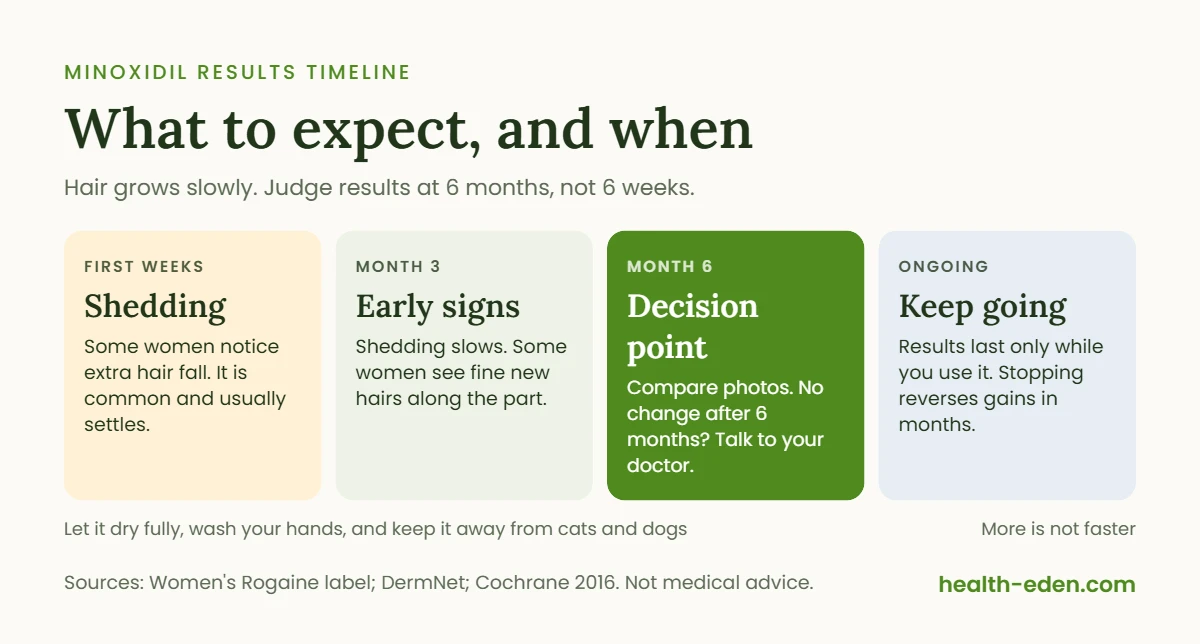
Hair grows slowly, so it helps to know what to expect and when.
| Time | What often happens | What to do |
|---|---|---|
| Before you start | Hair loss diagnosed as female pattern hair loss | Take photos of your part and crown in the same light |
| First few weeks | Some women notice extra shedding | Keep going. Early shedding is common and usually settles |
| Month 3 | Shedding slows; some women see early regrowth | Take a second set of photos |
| Month 6 | The point to judge whether it’s working | Compare photos. No change? Talk to your doctor |
| Months 6 to 12 | Fine new hairs may thicken and darken | Keep using it daily to maintain results |
| Ongoing | Results last only while you use it | Stopping usually brings back the old pattern within months |
The Women’s Rogaine label says results may appear at 3 months with once-daily use, but some women need at least 6 months. DermNet advises using it for a minimum of 6 months before deciding.
Side effects and safety
Topical minoxidil is generally well tolerated. In the Cochrane review, side effects were no more common than with a placebo overall. The ones to know about:
- Itching, dryness or flaking of the scalp. The most common problem. With the solution, it’s often caused by propylene glycol. Switching to a foam can help.
- Allergic contact dermatitis. Rare, but it causes a red, itchy, sometimes weeping rash. Stop and see a doctor.
- Unwanted hair growth. Usually fine hair on the forehead, cheeks or upper lip, often from product spreading. It generally fades after stopping.
- Changes in hair color or texture. Reported in some users.
- Effects on the heart and blood pressure. Rare with topical use, because little is absorbed. The label tells you to stop and see a doctor if you have chest pain, a rapid heartbeat, faintness, dizziness, sudden unexplained weight gain or swollen hands or feet.
A warning if you have cats or dogs
Minoxidil is highly toxic to cats, and vets warn it can also poison dogs. In 2026, the UK charity Cats Protection warned that cats can become seriously ill from licking it off an owner’s skin, grooming it from their fur, or lying on bedding with residue on it. Effects include dangerously low blood pressure, fluid on the lungs and collapse. Apply it away from your pets, wash your hands, let it dry fully before cuddles, and keep pets off your pillow. If your pet licks or touches it, call a vet straight away.
What about oral minoxidil?
You may have read about low-dose oral minoxidil, a prescription tablet some dermatologists now use off-label (outside its official license) for hair loss. A 2024 international consensus statement from hair specialists set out how doctors should decide who might suit it. It isn’t sold over the counter, it isn’t suitable for everyone, and it needs medical supervision, because side effects can include unwanted body and facial hair, fluid retention, a fast heartbeat and dizziness. If topical minoxidil isn’t working or irritates your scalp, it’s a reasonable question to ask a dermatologist.
Pros and cons of minoxidil for women
| Pros | Cons |
|---|---|
| The best-studied over-the-counter treatment for female pattern hair loss | Works for some women, not all |
| Available without a prescription | Takes 3 to 6 months or more to show results |
| Once-daily foam option | Early shedding can be alarming |
| Generic versions keep costs down | You need to use it indefinitely to keep results |
| Can be combined with other treatments a doctor recommends | Toxic to cats and dogs |
Who should be careful
The label says not to use topical minoxidil, or to ask a doctor first, if:
- you’re pregnant or breastfeeding. The label says it may be harmful, and DermNet advises avoiding it.
- your hair loss is sudden, patchy, started after childbirth, or has no known cause. These patterns point to other conditions.
- you have no family history of hair loss, or your hair loss doesn’t look like the pattern on the pack.
- your scalp is red, inflamed, infected, irritated or painful.
- you have heart disease. Ask your doctor first.
- you’re under 18.
- you use other medicines on your scalp.
If you’re going through menopause or perimenopause, minoxidil can be used alongside other menopause treatments, but mention it to your doctor so they have the full picture.
When to see a doctor
It’s worth seeing a doctor before starting minoxidil, to confirm the cause of your hair loss. Book an appointment sooner if:
- your hair is falling out in clumps or patches
- your hairline is moving back at the front and sides, or your eyebrows are thinning, which can be a sign of frontal fibrosing alopecia
- your scalp is itchy, sore, scaly or scarred
- you have other symptoms, such as tiredness, weight changes, irregular periods, acne or new facial hair, which can point to thyroid problems, low iron or hormone conditions
- you’ve used minoxidil for 6 months without any improvement
A blood test can check iron, thyroid function and vitamin D, and a dermatologist can confirm the diagnosis. For more on the causes, see our guide to hair thinning in women.
Frequently asked questions
How long does minoxidil take to work for women?
Most women need at least 3 months of daily use to see a change, and 6 months to judge properly. The Women’s Rogaine label says results may appear at 3 months with once-daily use, but some women need 6 months or longer. New hairs are often fine and light at first.
Is 2% or 5% minoxidil better for women?
A 2016 Cochrane review found no clear difference in regrowth between 2% and 5% minoxidil in women. The 5% foam is used once a day instead of twice, which many women find easier to stick with. Unwanted facial hair may be more common with higher strengths.
Is minoxidil shedding normal?
Yes. Some women notice extra hair fall in the first few weeks. It’s commonly explained as older resting hairs being pushed out as the follicles start a new growth cycle. It usually settles within a couple of months. If heavy shedding continues, talk to your doctor.
What happens if I stop using minoxidil?
The regrowth gradually stops being maintained. According to DermNet, your hair usually returns to how it looked before treatment within about 3 to 4 months of stopping. That’s why minoxidil works best as a long-term treatment.
Can I use minoxidil during menopause?
Yes. Female pattern hair loss often becomes more noticeable around menopause, and topical minoxidil is one of the main over-the-counter options. Tell your doctor if you also use hormone therapy or other medicines, and see them first if your hair loss is sudden or patchy.
Does minoxidil cause facial hair in women?
It can. Fine hair on the forehead, cheeks or upper lip is a known side effect, usually caused by the product spreading beyond the scalp. Applying it carefully, letting it dry before bed and washing your hands help. The extra hair usually fades after stopping.
The bottom line
Minoxidil is the most proven over-the-counter treatment for female pattern hair loss. It roughly doubles your chances of noticeable regrowth compared with a placebo, and the once-daily 5% foam appears to work about as well as the twice-daily 2% solution. Give it at least 6 months, expect some early shedding, keep it away from your face and your pets, and plan to use it long term. Check the cause of your hair loss with a doctor first, so you’re treating the right thing. For a wider look at looking after yourself in midlife, see our guide on how to age well.
Sources
- van Zuuren EJ, Fedorowicz Z, Schoones J. Interventions for female pattern hair loss. Cochrane Database of Systematic Reviews. 2016.
- Blume-Peytavi U, et al. Efficacy and safety of once-daily minoxidil foam 5% versus twice-daily minoxidil solution 2% in female pattern hair loss. Journal of Drugs in Dermatology. 2016.
- DermNet. Minoxidil solution. Accessed 2026.
- Drugs.com. Women’s Rogaine 5% minoxidil foam: drug facts. Accessed 2026.
- Cats Protection. Warning over hidden danger of hair-loss treatment on cats. 2026.
- Practical Dermatology. PSA: Vets warn that minoxidil may be deadly to pets. Accessed 2026.
- Akiska YM, et al. Low-dose oral minoxidil initiation for patients with hair loss: an international modified Delphi consensus statement. JAMA Dermatology. 2024.
Information checked as of November 2026. Read how we research and update articles in our editorial policy.
This article is for general information and isn’t a substitute for personal medical advice. Talk to your doctor or a dermatologist before starting a hair loss treatment, especially if you’re pregnant, breastfeeding or have a heart condition. See our full medical disclaimer.

I'm Noah Orono, founder and editor of Health Eden. I write about skincare and healthy aging, strength and weight management, and women's health from your 30s into midlife and beyond. Every guide starts with published research and guidance from dermatologists, doctors and certified trainers, then turns it into clear, practical steps. I'm not a medical professional, so I'll always tell you when something is worth raising with your doctor.
More about Health Eden →