Self-Care for Busy Women: 12 Small Habits That Make a Real Difference
 Noah Orono
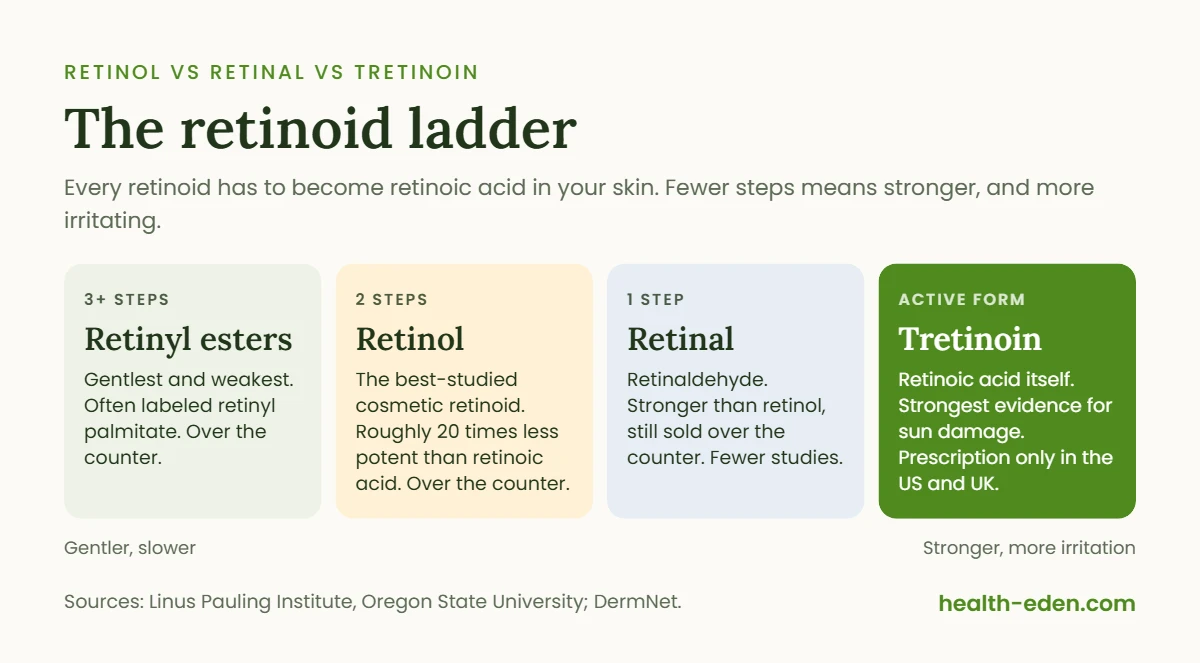
Retinol, retinal and tretinoin are all forms of vitamin A that work by turning into retinoic acid in your skin. Tretinoin is retinoic acid itself and needs a prescription. Retinal is one step away and tends to work faster than retinol, which is two steps away and the gentlest. For most mature skin, the best retinoid is the one you can use consistently without irritation.
Key takeaways
- All three are retinoids, the family of vitamin A ingredients that smooth fine lines, even out tone and boost collagen over months.
- Tretinoin (retinoic acid) is the strongest and best studied for sun-damaged skin, but it is prescription-only in the US and UK.
- Retinal (retinaldehyde) converts to retinoic acid in one step, so it is generally stronger than retinol while still sold over the counter.
- Retinol needs two conversion steps. Research suggests it is roughly 20 times less potent than retinoic acid, but also less irritating.
- A 2007 study found 0.4% retinol improved fine wrinkles even in people with an average age of 87.
- Avoid all retinoids if you are pregnant or trying to conceive, and wear sunscreen daily whichever you choose.
What are retinoids?
Retinoids are compounds related to vitamin A. In the skin, they act on receptors that switch on genes involved in cell turnover and collagen production. Over months of regular use, that can mean fewer fine lines, smoother texture, more even pigmentation and fewer clogged pores.
The confusing part is the names. “Retinoid” is the umbrella term. Underneath it sit several ingredients that differ mainly in how many chemical steps your skin needs to turn them into the active form, all-trans retinoic acid.
According to the Linus Pauling Institute at Oregon State University, skin cells convert retinol first to retinaldehyde (retinal) and then to retinoic acid. The more steps an ingredient needs, the less of it ends up as retinoic acid, which generally means a gentler but slower effect.
| Ingredient | Also called | Steps to retinoic acid | Where to get it (US and UK) |
|---|---|---|---|
| Retinyl esters (e.g. retinyl palmitate) | “Vitamin A” on some labels | Three or more | Over the counter |
| Retinol | Vitamin A alcohol | Two | Over the counter |
| Retinal | Retinaldehyde | One | Over the counter |
| Tretinoin | All-trans retinoic acid | None, it is the active form | Prescription only |
| Adapalene | A synthetic retinoid | Works directly on receptors | Over the counter in the US for acne; prescription in the UK |
If you are new to building a routine, our anti-aging skincare routine for women over 40 shows where a retinoid fits alongside cleansing, moisturizer and sunscreen.
Retinol vs retinal: the key differences
Retinol and retinal are the two retinoids most people over 40 will meet on a shop shelf. They are close relatives, but they behave differently.
Retinol
Retinol is the most widely used over-the-counter retinoid and the one with the most research behind it outside of prescription products. Because your skin has to convert it twice, a smaller share becomes retinoic acid. In a small study described by the Linus Pauling Institute, it took 1.6% retinol to match the effects of a low-strength prescription retinoic acid cream, which made retinol roughly 20 times less potent. The retinol also caused the same skin changes without the redness.
That lower potency is not a weakness for everyone. It makes retinol a sensible starting point if your skin is dry, thin or sensitive, which is common after menopause.
The evidence that it works on older skin is encouraging. A 2007 University of Michigan study, published in Archives of Dermatology, applied 0.4% retinol lotion to one inner arm of 36 elderly volunteers (average age 87) up to three times a week for 24 weeks. Fine wrinkles and roughness improved significantly compared with the other arm, which was treated with the same lotion without retinol, and biopsies showed more procollagen, a building block of collagen.
Retinal (retinaldehyde)
Retinal sits one step closer to retinoic acid, so it is generally considered stronger than retinol at the same concentration. It is less common, partly because it is harder to keep stable in a formula.
The best-known trial compared a 0.05% retinaldehyde cream with a prescription retinoic acid cream and a plain cream in 125 people with sun-damaged facial skin. After 18 weeks, both active creams had reduced wrinkles and roughness, while the plain cream did nothing measurable. Retinaldehyde was well tolerated throughout, while retinoic acid caused more irritation and more people struggled to keep using it.
That is one trial from 1998, and the benefits had faded somewhat by week 44, so it doesn’t prove retinal is as strong as tretinoin for everyone. It does suggest retinal can be a useful middle ground.
Which is better for mature skin?
| Feature | Retinol | Retinal |
|---|---|---|
| Strength | Gentler | Stronger, works faster for many people |
| Irritation risk | Lower | Moderate |
| Research on older skin | Good, including a trial in people with an average age of 87 | Smaller body of evidence |
| Price | Wide range, many budget options | Usually costs more |
| Best for | First-time users, dry or sensitive skin | Retinol users who want more effect |
Where tretinoin fits
Tretinoin is retinoic acid itself. It doesn’t need converting, so it is the most potent of the three and the most thoroughly studied for photoaging, the skin damage caused by years of sun exposure.
According to DermNet, long-term tretinoin use (over six months) may reduce fine wrinkles, freckles, sun spots and rough, precancerous patches called actinic keratoses. Long-term trials summarized by the Linus Pauling Institute also show improvements in fine wrinkling, roughness and patchy pigmentation.
The trade-off is irritation. Redness, peeling, dryness and stinging, often called retinoid dermatitis, are common in the first weeks. Tretinoin is a prescription medicine in both the US and UK, so your doctor or dermatologist will choose the strength and explain how to use it. We don’t give prescription doses here.
What about adapalene?
Adapalene is a synthetic retinoid. In July 2016, the US FDA approved adapalene gel 0.1% (Differin) for over-the-counter use to treat acne. It is approved for acne rather than wrinkles, and in the UK it is prescription-only. If you have adult acne as well as aging concerns, ask a pharmacist or doctor about it.
How retinoids compare at a glance
| Retinol | Retinal | Tretinoin | |
|---|---|---|---|
| Needs a prescription? | No | No | Yes (US and UK) |
| Potency | Lowest of the three | Middle | Highest |
| Typical irritation | Mild | Mild to moderate | Moderate to strong at first |
| Strength of evidence for wrinkles | Moderate | Limited but promising | Strong |
| Time to see changes | About 3 to 6 months | Often a little sooner than retinol | Visible changes usually take months; DermNet notes benefits for photoaging with use over six months |
| Good first choice? | Yes, for most people | Yes, if retinol hasn’t irritated you | Ask your doctor |
A note for readers in the UK and EU
New EU rules (Regulation 2024/996) limit retinol and two of its esters (retinyl acetate and retinyl palmitate) in cosmetics to 0.05% retinol equivalent in body lotions and 0.3% in other products, including face creams and serums. Products that don’t comply could no longer be placed on the EU market from 1 November 2025, and from 1 May 2027 non-compliant products can no longer be sold at all. The rules don’t cover retinal or prescription retinoids. The rule doesn’t apply in Great Britain, which has its own cosmetics regulations, though Northern Ireland follows EU rules. Many brands sell the same formulas in both markets.
In practice, this means you may see fewer high-strength retinol products on European shelves. For most mature skin, 0.3% or less is plenty to start with.
A worked example: a 12-week retinoid ladder
Here is one way to start a retinoid and move up only if you need to. It assumes you already use a gentle cleanser, a moisturizer and daily sunscreen.
| Weeks | Product | How often | What to watch for |
|---|---|---|---|
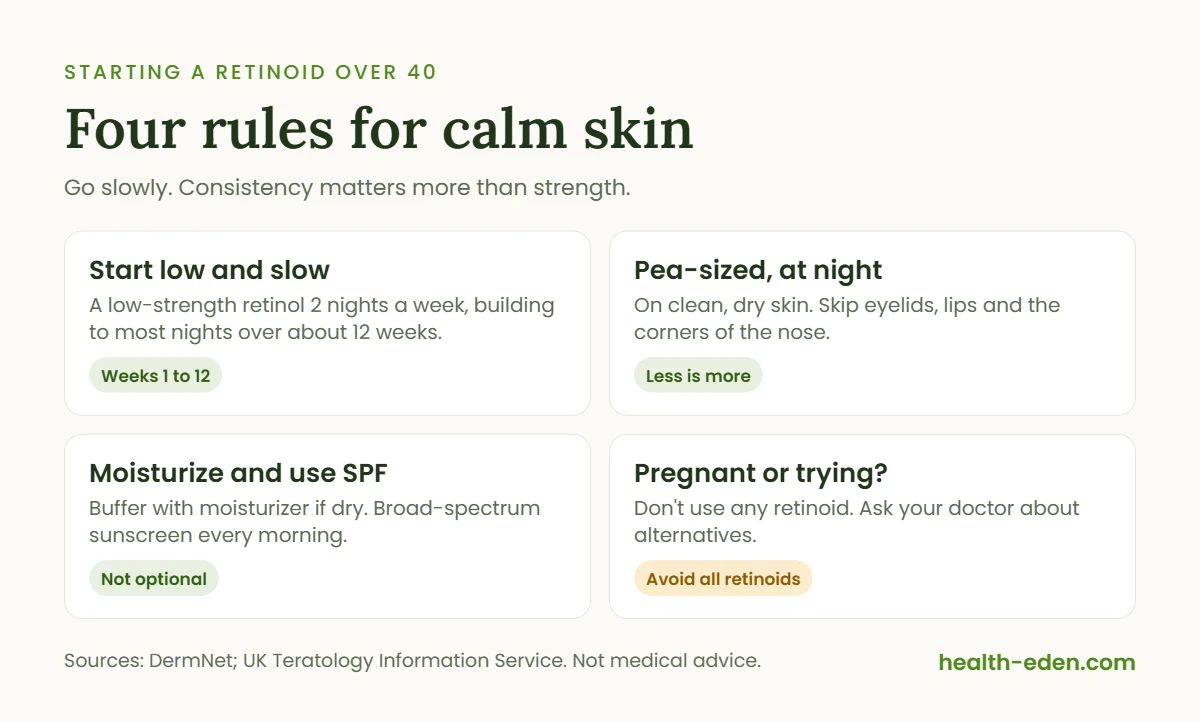
| 1 to 2 | Low-strength retinol (about 0.1% to 0.3%) | 2 nights a week | Mild dryness is normal; stinging that lasts is not |
| 3 to 4 | Same retinol | 3 nights a week | Add a richer moisturizer if flaky |
| 5 to 8 | Same retinol | Every other night | Skin should feel calm most days |
| 9 to 12 | Same retinol | Most nights, if comfortable | Look for smoother texture by the end |
| After 12 weeks | Consider a retinal or a higher retinol strength | Start at 2 nights a week again | Or ask your doctor about tretinoin |
A pea-sized amount for the whole face is enough. Apply it to clean, dry skin at night, avoiding the corners of the nose, the eyelids and the lips. If your skin is very dry, you can apply moisturizer first to buffer it.
Cost matters too. As of November 2026, drugstore retinol serums often cost around $10 to $25, while retinal serums tend to cost more, from around $20 for budget brands to $70 or more for premium ones. Prescription tretinoin costs vary widely depending on insurance in the US and on whether you see an NHS or private prescriber in the UK.
Honest pros and cons
| Retinoid | Pros | Cons |
|---|---|---|
| Retinol | Easy to buy, many budget options, gentle, evidence in older skin | Slower; quality varies between products |
| Retinal | Stronger than retinol without a prescription | Fewer studies, often pricier, can still irritate |
| Tretinoin | Strongest evidence for sun damage and wrinkles | Needs a prescription, most irritating, more care needed |
Whichever you choose, the results only last while you keep using it. The Linus Pauling Institute notes that skin changes returned to baseline after treatment stopped.
DermNet lists sun sensitivity as a side effect of retinoids. Daily broad-spectrum sunscreen is not optional when you use one. If menopause has left your skin drier than it used to be, our guide to menopause skin changes explains how to adjust your routine.
Who should be careful
- Pregnancy and breastfeeding: The UK Teratology Information Service advises that retinoid creams and gels should not be used in pregnancy. Doctors generally advise the same caution with over-the-counter retinol and retinal. If you are trying to conceive, pregnant or breastfeeding, talk to your doctor before using any retinoid.
- Eczema and rosacea: Retinoids can worsen eczema and may sting rosacea-prone skin. Ask a dermatologist first.
- Very dry or thin skin: Start with retinol at a low frequency, and buffer it with moisturizer.
- Other active ingredients: Avoid layering retinoids with exfoliating acids (AHAs, BHAs) or benzoyl peroxide on the same night unless a professional has advised it.
- Procedures: Tell your practitioner you use a retinoid before waxing, peels or laser treatments; many advise stopping it for several days beforehand.
When to see a doctor
See a doctor or dermatologist if:
- redness, burning or peeling lasts more than a couple of weeks even after cutting back
- you develop swelling, hives or a rash that spreads, which could be an allergic reaction
- you want stronger results than over-the-counter products give, and want to discuss tretinoin
- you have a new, changing or bleeding spot, which needs checking whatever products you use
- you have adult acne, melasma or rosacea alongside aging concerns
Frequently asked questions
Is retinal stronger than retinol?
Generally, yes. Retinal needs only one conversion step to become retinoic acid, while retinol needs two, so retinal tends to work faster at similar strengths. It can also be a little more irritating.
Is tretinoin better than retinol for wrinkles?
Tretinoin has the strongest evidence for treating sun-damaged skin and wrinkles, but it is also the most irritating and needs a prescription. Retinol is gentler and still has good evidence, including in people with an average age of 87.
Can I use retinol over 50?
Yes. A 2007 study found 0.4% retinol improved fine wrinkles in elderly volunteers with an average age of 87. Start slowly, two nights a week, and use moisturizer and sunscreen.
How long does it take for retinol to work?
Most people need about three to six months of regular use to see smoother texture and softer fine lines. Changes depend on the product, strength and how often you use it.
Can I switch from retinol to retinal?
Yes. If retinol no longer irritates you after a few months, you can move to retinal. Start again at two or three nights a week and build up slowly.
Are retinoids safe during pregnancy?
No. The UK Teratology Information Service advises against retinoid creams and gels in pregnancy, and doctors generally extend that caution to retinol and retinal. Ask your doctor about alternatives.
The bottom line
Retinol, retinal and tretinoin all end up as retinoic acid in your skin; they differ in how quickly and how strongly they get there. For most women over 40, a low-strength retinol used a few nights a week is the safest place to start. Move up to retinal once your skin is comfortable, and talk to your doctor about tretinoin if you want the strongest, best-studied option. Whatever you use, give it at least three months, wear sunscreen daily and remember that the benefits last only as long as you keep going. For more on keeping skin healthy as you age, see our guide on how to age well, and if you are curious about devices that can sit alongside a retinoid, read our honest look at at-home beauty devices.
Sources
- Linus Pauling Institute, Oregon State University. Vitamin A and skin health.
- DermNet. Topical retinoids.
- Kafi R, et al. Improvement of naturally aged skin with vitamin A (retinol). Archives of Dermatology. 2007. Summary: ScienceDaily.
- Creidi P, et al. Profilometric evaluation of photodamage after topical retinaldehyde and retinoic acid treatment. Journal of the American Academy of Dermatology. 1998;39(6):960-965.
- Galderma. FDA approves prescription-strength Differin Gel for over-the-counter use. 2016.
- Obelis. New EU restrictions on retinol and retinol equivalents. Regulation (EU) 2024/996.
- UK Teratology Information Service. Retinoid gels and creams in pregnancy.
Information checked as of November 2026. Read how we research and update articles in our editorial policy.
This article is for general information and isn’t a substitute for personal medical advice. Talk to your doctor or dermatologist before starting a new skincare treatment, especially if you have a skin condition or are pregnant. See our full medical disclaimer.

I'm Noah Orono, founder and editor of Health Eden. I write about skincare and healthy aging, strength and weight management, and women's health from your 30s into midlife and beyond. Every guide starts with published research and guidance from dermatologists, doctors and certified trainers, then turns it into clear, practical steps. I'm not a medical professional, so I'll always tell you when something is worth raising with your doctor.
More about Health Eden →