Self-Care for Busy Women: 12 Small Habits That Make a Real Difference
 Noah Orono
Menopause weight gain is common, but it is not inevitable. Most women gain weight gradually through midlife because of aging, muscle loss and lifestyle changes, while falling estrogen shifts where fat is stored, toward the belly. Strength training, enough protein, steady daily movement and better sleep are the changes with the best evidence behind them.
Key takeaways
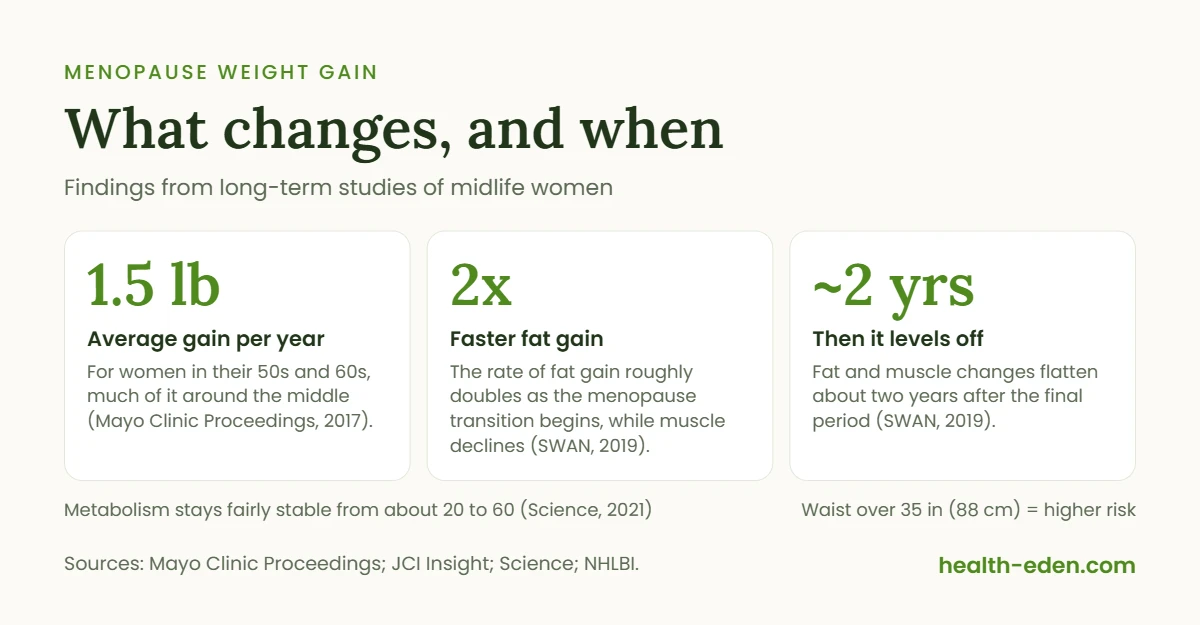
- Women in their 50s and 60s gain about 1.5 lb (0.7 kg) a year on average, according to a 2017 Mayo Clinic Proceedings review.
- Falling estrogen during perimenopause shifts fat from the hips and thighs toward the waist, even if the scale barely moves.
- A large 2021 study suggests metabolism stays fairly stable from about age 20 to 60, so muscle loss and lower activity matter more than a “broken” metabolism.
- Strength training twice a week plus 150 minutes of moderate activity is the standard recommendation for adults.
- Protein of roughly 1.0 to 1.2 g per kg of body weight a day is the expert target for older adults, about 68 to 82 g for a 150 lb woman.
- Hormone therapy does not appear to cause weight gain, but it is a symptom treatment, not a weight-loss drug.
Why menopause weight gain happens
Weight gain in midlife usually has several causes working together. Menopause itself is only one of them, which is good news, because several of the others are things you can change.
Hormones change where fat goes
Estrogen helps decide where your body stores fat. Before menopause, more fat tends to sit on the hips and thighs. As estrogen falls during perimenopause, the years of irregular cycles before your final period, storage shifts toward the abdomen. Cleveland Clinic gynecologist Pelin Batur, MD, puts it simply: “Hormonal shifts can affect the way your body stores fat.”
This is why many women notice their waistband getting tighter even when their weight changes very little. If you are still working out whether your symptoms are hormonal, our guide to perimenopause symptoms covers the full picture.
Fat gain speeds up and muscle declines during the transition
The Study of Women’s Health Across the Nation (SWAN), which has followed a large group of US women for many years, gives the clearest picture. A 2019 analysis led by Gail Greendale of UCLA, published in JCI Insight, found that the rate of fat gain roughly doubled at the start of the menopause transition, while lean mass (mostly muscle) began to decline. Both changes continued until about two years after the final period and then leveled off.
Total body weight in that analysis did not suddenly jump at menopause. It rose steadily through the premenopause years and flattened after the transition. What changed was the body’s makeup: more fat, less muscle.
Your metabolism probably isn’t the main culprit
Many women are told their metabolism “crashes” at menopause. The evidence is more reassuring. A 2021 study in Science measured daily calorie burn in more than 6,600 people aged from one week to 95 years across 29 countries. Once body size was taken into account, energy use stayed remarkably stable from about age 20 to 60, then declined by about 0.7% a year after 60.
What does fall in midlife is muscle, and muscle burns more energy than fat. Add a busier, more seated life, and a small daily calorie surplus can build up into steady gain over years.
Sleep, stress and other conditions
Hot flashes and night sweats can wreck sleep, and poor sleep makes it harder to manage appetite, energy and motivation. Cleveland Clinic also notes that conditions such as diabetes, sleep apnea, thyroid problems and depression can cause weight gain and should be ruled out with your doctor, especially if the change is fast or unexplained.
How much weight is typical?
The numbers vary between studies, but they point the same way: gradual gain, not a sudden jump.
| Source | What it found |
|---|---|
| Mayo Clinic Proceedings review, 2017 | Women in their 50s and 60s gain about 1.5 lb (0.7 kg) a year on average, much of it around the middle |
| International Menopause Society review, Climacteric, 2012 | Midlife women gain about 1 lb (0.45 kg) a year on average; menopause shifts fat to the abdomen rather than causing the gain itself |
| SWAN, JCI Insight, 2019 | Fat gain roughly doubles and lean mass declines during the transition, then both level off about two years after the final period |
A pound or so a year sounds small. Over a decade it can add up to 10 to 15 lb (about 4.5 to 7 kg), which is why small, steady habits matter more than dramatic diets.
Why belly fat matters for health
Fat stored deep in the abdomen, around the organs, is linked to a higher risk of type 2 diabetes and heart disease. The National Heart, Lung, and Blood Institute (NHLBI) uses a waist size above 35 inches (about 88 cm) as a marker of higher risk for women.
You don’t need a scan to keep an eye on this. Measure your waist at the level of your belly button, standing relaxed, once a month. A shrinking waist is often a better sign of progress than the scale, because you may be gaining muscle while losing fat.
This isn’t about appearance or hitting a particular size. It is one simple number that helps you and your doctor judge risk.
What works to manage menopause weight gain
There is no special “menopause diet” with strong evidence behind it. The approaches below are the ones with the best support, and they work together.
1. Lift something, twice a week
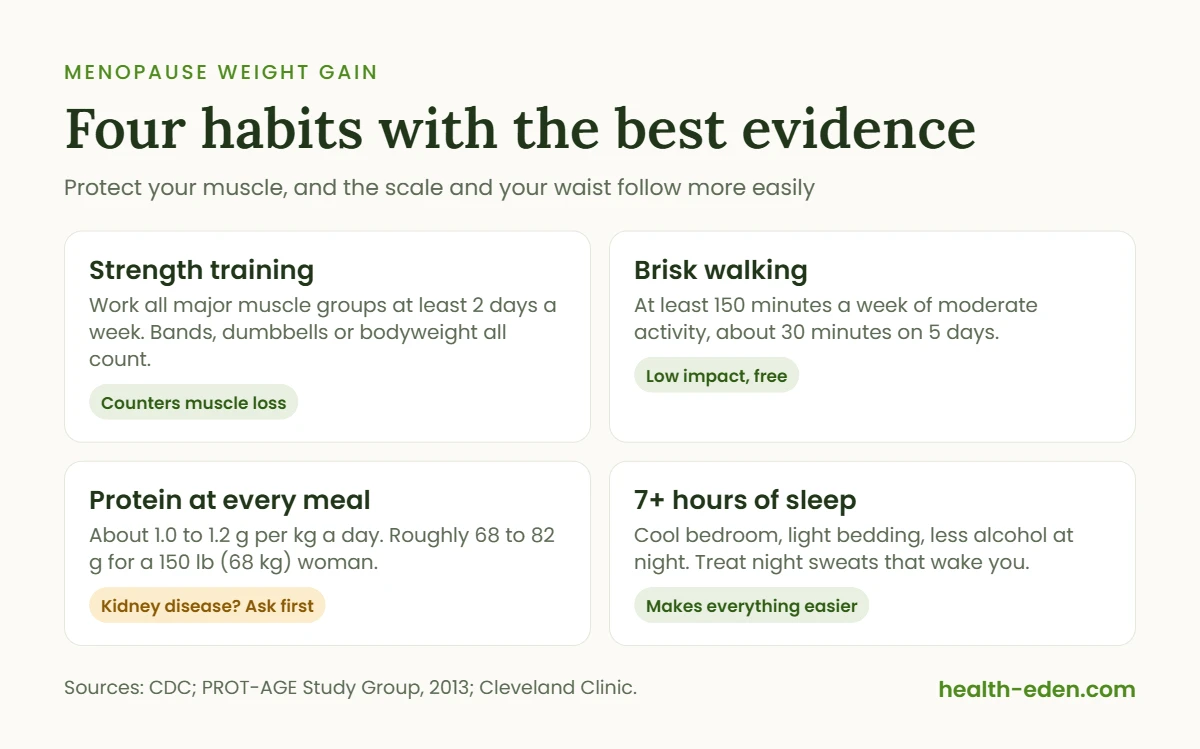
Strength training is the most direct answer to losing muscle. Adults are advised to do muscle-strengthening activity that works all major muscle groups at least two days a week, according to the CDC’s physical activity guidelines. That can be dumbbells, resistance bands, machines or bodyweight moves such as squats and push-ups against a wall.
If you’re new to it, our guide to strength training for women over 50 walks through the basics, and our home strength training guide shows how to do it without a gym.
2. Move more, every day
The same CDC guidelines recommend at least 150 minutes a week of moderate activity, such as brisk walking. That is about 30 minutes, five days a week. Walking is one of the easiest places to start, and our guide to walking for weight loss has simple routines to build up from.
Everyday movement counts too: taking the stairs, standing for phone calls, gardening and short walks after meals all add to the calories you burn.
3. Get enough protein at every meal
Protein helps you hold on to muscle and keeps you fuller for longer. An international expert group, the PROT-AGE Study Group, recommended in 2013 that healthy adults over 65 aim for 1.0 to 1.2 g of protein per kg of body weight a day. Some researchers suggest similar targets may suit midlife women, though the evidence for this age group is more limited. Spreading it across meals, rather than loading it all at dinner, is a practical way to get there.
Good sources include eggs, Greek yogurt, cottage cheese, fish, chicken, tofu, beans and lentils. If you have kidney disease, check with your doctor before raising your protein intake.
4. Eat mostly whole foods, and watch the extras
A modest, sustainable calorie reduction works better than a crash diet, which can cost you muscle. Building meals around vegetables, fruit, whole grains, protein and healthy fats, and cutting back on sugary drinks, ultra-processed snacks and alcohol, is the approach most clinicians recommend. Our guides to sustainable weight loss nutrition and meal prep for weight loss make this easier to stick with day to day.
Alcohol deserves a special mention. It adds calories, may worsen hot flashes for some women and often disrupts sleep.
5. Protect your sleep
Adults generally need at least seven hours of sleep a night. If night sweats are waking you, simple steps such as a cooler bedroom, lighter bedding and avoiding alcohol close to bedtime can help. If symptoms are severe, it is worth discussing treatment with your doctor, because better sleep makes every other change easier.
A worked example: one week for a 150 lb woman
Here is what the advice above can look like in a real week. It is an example, not a prescription, so adjust it to your schedule and fitness.
Protein target: 150 lb is about 68 kg. At 1.0 to 1.2 g per kg, that is roughly 68 to 82 g of protein a day, or about 25 g at each of three meals.
| Day | Movement | Protein ideas (part of the day’s total) |
|---|---|---|
| Monday | 30-minute brisk walk + 25-minute full-body strength session | Greek yogurt with berries (about 17 g), chicken salad (about 30 g), lentil soup with an egg (about 20 g) |
| Tuesday | 30-minute brisk walk | Two-egg omelet (about 13 g) with cottage cheese on the side (about 12 g) |
| Wednesday | 20-minute walk + 10 minutes of stretching | Salmon fillet (about 25 g) at dinner |
| Thursday | 30-minute brisk walk + 25-minute strength session | Tofu stir-fry (about 20 g) |
| Friday | 30-minute brisk walk | Tuna and bean salad (about 30 g) |
| Saturday | Longer walk or bike ride, 45 to 60 minutes | Protein-rich breakfast plus a balanced lunch and dinner |
| Sunday | Rest or gentle yoga | Plan and prep meals for the week |
That adds up to about 185 to 200 minutes of walking or cycling and two strength sessions, comfortably meeting the CDC guidelines. Protein figures are approximate and vary by portion and brand.
Does hormone therapy help or hurt?
Many women worry that hormone therapy (HT, also called HRT) will make them gain weight. The evidence doesn’t support that. A 2012 review by the International Menopause Society, published in Climacteric, found that estrogen therapy does not cause weight gain, and suggested it may help limit the buildup of belly fat after menopause.
That said, hormone therapy is a treatment for menopause symptoms such as hot flashes, not a weight-loss treatment. It isn’t right for everyone, and the decision depends on your symptoms, age, health history and personal risks. If symptoms are disrupting your sleep and daily life, it is a reasonable conversation to have with your doctor.
What about weight-loss medicines?
Newer prescription medicines, such as GLP-1 receptor agonists, are now widely used for weight management. They can be appropriate for some women, but they need a prescription and medical supervision, and some of the weight lost can be muscle, which makes protein and strength training even more important. Your doctor can tell you whether you qualify and what the trade-offs are for you.
Honest pros and cons of common approaches
| Approach | Pros | Cons |
|---|---|---|
| Strength training | Preserves muscle, supports bone health, improves strength for daily life | Takes a few weeks to learn good form; results on the scale are slow |
| Brisk walking | Free, low impact, easy to fit in | On its own, it does little to protect muscle |
| Higher-protein eating | Helps fullness and muscle maintenance | Can cost more; not suitable for everyone with kidney disease |
| Strict low-calorie diets | Fast early weight loss | Hard to sustain, can cost muscle, often regained |
| Hormone therapy | Treats hot flashes and sleep problems; doesn’t appear to cause weight gain | Not a weight-loss treatment; not suitable for everyone |
| “Menopause” supplements for weight | Easy to take | Little good evidence for weight loss; can interact with medicines |
Who should be careful
Some women should get advice before changing their diet or exercise routine:
- If you have heart disease, high blood pressure or diabetes, check with your doctor before starting a new exercise plan.
- If you have osteoporosis or joint problems, ask a physical therapist or trainer about safe strength exercises.
- If you have kidney disease, don’t raise your protein intake without medical advice.
- If you have a history of disordered eating, avoid restrictive diets and calorie tracking, and work with a professional.
- If you take medicines, check before using any weight-loss supplement, as some interact with prescription drugs.
When to see a doctor
Talk to your doctor if:
- you are gaining weight quickly without any obvious change in eating or activity
- you have other symptoms, such as extreme tiredness, feeling cold, hair loss, swelling or very heavy periods, which can point to thyroid or other conditions
- your waist measures above 35 inches (about 88 cm) and you have a family history of diabetes or heart disease
- hot flashes, night sweats or low mood are affecting your sleep and daily life
- you are considering weight-loss medicine or hormone therapy and want to understand your options
Frequently asked questions
Why am I gaining weight in menopause when I eat the same?
Muscle mass tends to fall in midlife, and many women become less active, so the same meals can create a small calorie surplus. Falling estrogen also shifts fat toward the belly, which makes the change more noticeable.
How much weight do women gain during menopause?
A 2017 Mayo Clinic Proceedings review found women in their 50s and 60s gain about 1.5 lb (0.7 kg) a year on average. Individual experiences vary widely.
Does menopause slow your metabolism?
Not as much as people think. A 2021 study of more than 6,600 people found calorie burn stays fairly stable from about 20 to 60 once body size is accounted for. Muscle loss and lower activity play a bigger role.
What is the best exercise for menopause weight gain?
A combination works best: strength training at least twice a week to protect muscle, plus about 150 minutes of moderate activity such as brisk walking each week.
Does HRT cause weight gain?
Research suggests it doesn’t. A 2012 International Menopause Society review found estrogen therapy does not cause weight gain and may help limit belly fat, but it is a symptom treatment, not a weight-loss drug.
Is menopause weight gain permanent?
No. Changes in fat and muscle tend to level off about two years after the final period, and regular strength training, enough protein and an active routine can help you lose fat and build muscle, even later in life.
The bottom line
Menopause weight gain is real, but it is mostly the result of gradual changes you can influence. Falling estrogen moves fat toward the middle, and muscle declines through the transition, so the most useful response is to protect your muscle: lift twice a week, walk most days, eat protein at every meal and look after your sleep. Expect slow, steady progress rather than quick results, and talk to your doctor if your weight changes fast or other symptoms appear. For more on aging well overall, see our guide on how to age well.
Sources
- Greendale GA, et al. Changes in body composition and weight during the menopause transition. JCI Insight. 2019.
- UCLA Health. Study links perimenopause to accelerated fat mass gains, lean mass losses. 2019.
- Mayo Clinic News Network. Researchers review risks, recommendations for weight gain management in midlife women. 2017.
- University of Aberdeen. Metabolism changes with age, just not when you think it does (Pontzer H, et al. Science). 2021.
- HealthDay. Menopause won’t spur weight gain, but may boost belly fat: review (International Menopause Society, Climacteric). 2012.
- Cleveland Clinic. Menopause weight gain.
- American Heart Association News. Waist size predicts heart attacks better than BMI, especially in women. 2019.
- CDC. Adult activity: an overview.
- CDC. About sleep.
- Bauer J, et al. Evidence-based recommendations for optimal dietary protein intake in older people (PROT-AGE). J Am Med Dir Assoc. 2013.
Information checked as of November 2026. Read how we research and update articles in our editorial policy.
This article is for general information and isn’t a substitute for personal medical advice. Talk to your doctor before starting a new supplement, medication or exercise plan. See our full medical disclaimer.

I'm Noah Orono, founder and editor of Health Eden. I write about skincare and healthy aging, strength and weight management, and women's health from your 30s into midlife and beyond. Every guide starts with published research and guidance from dermatologists, doctors and certified trainers, then turns it into clear, practical steps. I'm not a medical professional, so I'll always tell you when something is worth raising with your doctor.
More about Health Eden →