Self-Care for Busy Women: 12 Small Habits That Make a Real Difference
 Noah Orono

Microcurrent facial devices send a very low electrical current through the skin, and many users report a temporarily lifted, more toned look. But the scientific evidence is thin: most of it comes from lab studies and a handful of small, short trials. Microcurrent may give a modest, short-lived lift with regular use. It won’t replace a facelift, and results fade when you stop.
Key takeaways
- Microcurrent uses a tiny electrical current, much weaker than the muscle-contracting electrical muscle stimulation (EMS) used in physical therapy.
- Lab studies suggest electrical stimulation can boost collagen-related activity in cells, but good human trials are few, small and short.
- In the US, some devices are FDA cleared for “facial stimulation” and over-the-counter cosmetic use, which is not the same as proof that they lift or tighten skin.
- Results, if you see them, tend to be subtle and depend on using the device several times a week, indefinitely.
- Don’t use one if you have a pacemaker or other implanted electronic device, epilepsy, active cancer or a suspected heart problem, or if you are pregnant.
- At-home devices typically cost a few hundred dollars, so weigh the price against the limited evidence.
What is microcurrent?
Microcurrent is a very low-level electrical current, measured in millionths of an amp (microamps). Facial devices deliver it through two metal spheres or prongs that you glide over your skin, usually over a water-based conductive gel that helps the current travel.
It is different from the electrical muscle stimulation (EMS) used in physical therapy or some “face toning” gadgets, which uses stronger currents that make muscles visibly contract. Microcurrent is usually too weak to feel as more than a faint tingle, and some people feel nothing at all.
The idea started in medicine, where low-level electrical stimulation has been studied for wound healing and pain. Facial microcurrent has been offered in salons for many years and is now sold as handheld devices for home use. If you are weighing up gadgets more generally, our honest guide to at-home beauty devices compares the main types.
How is it supposed to work?
Brands usually describe two effects:
- “Exercising” facial muscles: the current is said to stimulate the small muscles of the face, so they look more toned and lifted, a bit like a workout.
- Boosting skin cells: the current is said to increase cellular energy (ATP) and encourage collagen and elastin, the proteins that keep skin firm and springy.
There is some laboratory support for the second idea. A 2020 study in the journal Cells found that microcurrent stimulation triggered signaling pathways and released a growth factor (TGF-beta 1) linked to collagen production in mouse fibroblasts and bone-like cells grown in the lab.
The catch is that lab results in cells don’t automatically translate to visible changes in a human face. The “exercise” idea is also harder to test, because microcurrent is usually too weak to make muscles contract.
Does microcurrent work? What the evidence says
Here is an honest summary of where the research stands as of November 2026.
| Type of evidence | What it shows | How strong |
|---|---|---|
| Lab (cell) studies | Electrical stimulation can boost collagen-related activity in lab-grown cells | Early, not proof of visible results |
| Small human trials | Some report measurable lifting (for example, of the eyebrows) over several weeks, often with devices that combine microcurrent with other technology | Limited: small and short |
| Long-term studies | Very few; the longest follow-up in studies reviewed in a 2026 safety analysis was 12 weeks | Lacking |
| Expert opinion | Generally considered low risk, with scant evidence for real lifting | Mixed |
One of the better-known trials, published in the Journal of Cosmetic and Laser Therapy in 2016, was a double-blind, randomized study of a home-use device that combined radiofrequency with microcurrent. Blinded assessors found measurable eyebrow lifting compared with a placebo device. Because it combined two technologies, it can’t tell us how much was due to microcurrent alone.
Dermatologists tend to be cautious. San Francisco dermatologist Dana Feigenbaum, MD, summed up the evidence to W Magazine: “There is scant evidence to support use, but it is definitely not harmful.” A 2026 letter in the dermatology journal Cutis noted that short-term studies suggest possible benefits, but said small samples and short follow-up make it hard to judge long-term safety.
What FDA clearance does and doesn’t mean
In the US, several at-home microcurrent devices have FDA 510(k) clearance. For example, the FDA clearance letter for one popular handheld device states that it is “intended for facial stimulation and is indicated for over-the-counter cosmetic use.” Clearance means the FDA judged the device substantially equivalent to similar devices already on the market, including on safety. It is not the same as proof that it lifts, firms or reduces wrinkles.

Microcurrent results: what to expect
If microcurrent works for you, the effect is usually described as a subtle, temporary “lift,” most noticeable around the cheekbones, jawline and brows, and often right after a session. It is not the same as the tightening from a surgical facelift, and it won’t remove deep wrinkles or significant sagging.
Realistic expectations:
- Right after a session: some people see a slightly more defined, “awake” look that lasts hours to a day or so.
- After several weeks of regular use: small trials report modest changes in some people, though not everyone sees a difference.
- If you stop: any benefit fades. Device makers and estheticians recommend ongoing maintenance sessions, which tells you the effect isn’t permanent.
Before-and-after photos online are hard to judge. Lighting, angle, makeup and expression can all make a face look more lifted.
How microcurrent compares with other options
| Option | Evidence for lifting or firming | Typical cost (as of November 2026) | Commitment |
|---|---|---|---|
| At-home microcurrent device | Limited; small, short trials | Roughly $100 to $400 or more for the device | 5 to 10 minutes, several times a week, ongoing |
| Professional microcurrent facial | Limited | Often $150 to $300 or more per session | Repeat sessions, often monthly |
| Topical retinoids | Good evidence for fine lines and texture | Often under $25 for a drugstore retinol that lasts a couple of months | Nightly or most nights, for months |
| LED light therapy | Some evidence for fine lines, mainly red and near-infrared light | Masks often $100 to $500 or more | Several times a week |
| In-office treatments (such as radiofrequency, ultrasound, fillers) | Stronger evidence for some | Hundreds to thousands per treatment | Varies |
If you are deciding where to spend money, a daily sunscreen and a retinoid usually give better value than a device. Our anti-aging skincare routine for women over 40 covers the basics, and our guide to LED face masks looks at another popular gadget.
A worked example: a realistic routine and cost
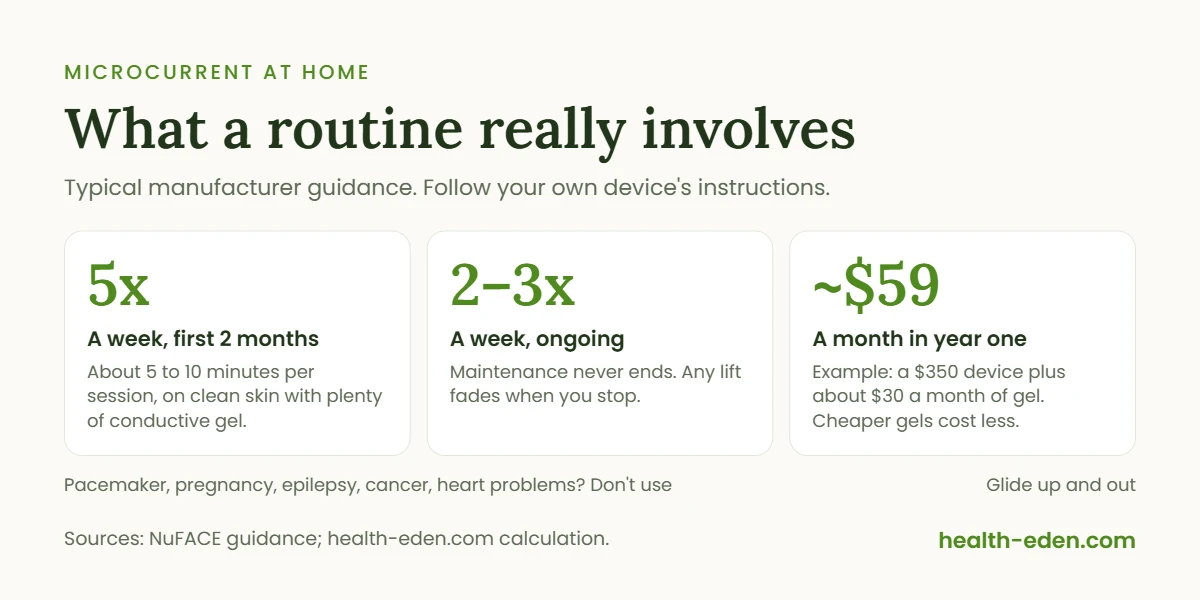
Here is what using an at-home device might look like, based on typical manufacturer guidance. Always follow the instructions that come with your device.
| Phase | How often | Time per session |
|---|---|---|
| Weeks 1 to 8 (intro) | 5 days a week | About 5 to 10 minutes |
| From week 9 (maintenance) | 2 to 3 days a week | About 5 to 10 minutes |
A typical session: cleanse and dry your face, apply a generous layer of conductive gel, then glide the device upward and outward along the jaw, cheeks and forehead, following the pattern in the instructions. Rinse off the gel and moisturize afterward.
The cost over a year: if a device costs $350 and a basic conductive gel costs about $30 a bottle and lasts around a month (branded gels can cost more), the first year comes to roughly $350 + (12 x $30) = $710. That works out at about $59 a month, before any replacement device. Using a cheaper generic conductive gel can bring this down.
Honest pros and cons
Pros
- Generally considered low risk for healthy adults when used as directed.
- Painless for most people, and some find the routine relaxing.
- May give a subtle, temporary lift, particularly before an event.
- Can be done at home, at your own pace.
Cons
- Limited, short-term evidence from small studies.
- Results are subtle at best and fade if you stop.
- Requires regular sessions and a steady supply of conductive gel.
- Expensive for what the evidence shows.
- Not suitable for some people with certain medical conditions (see below).
Who should be careful
Device makers list several groups who shouldn’t use microcurrent. NuFACE, for example, advises against use by anyone who:
- is pregnant
- has a pacemaker, defibrillator or other implanted electronic device
- has epilepsy or is prone to seizures
- has active cancer or tumors
- has a suspected heart problem
- is under 18
You should also check with your doctor first if you have metal implants or fillers in your face, recent facial surgery or injectables, broken or irritated skin, or a skin condition such as active acne or rosacea flaring. A 2026 analysis of US FDA adverse event reports, published in Cutis, found 28 reports linked to three brands of microcurrent devices between 2013 and early 2025, including heart rhythm problems, pain, dizziness and headaches. The reports can’t prove the devices caused these problems, but they are a reminder to follow the safety guidance.
When to see a doctor
Stop using the device and seek medical advice if you notice:
- chest pain, palpitations or an irregular heartbeat during or after use
- dizziness, fainting or a severe headache
- burns, blisters or lasting redness on your skin
- facial numbness, twitching or weakness that doesn’t go away
- any change in your vision
If you are bothered by sagging or deep wrinkles, a dermatologist can explain which treatments have stronger evidence for your goals.
Frequently asked questions
Does microcurrent really lift your face?
It may give a subtle, temporary lift for some people, but the evidence is limited. Most research is in the lab or in small, short human trials, and results fade when you stop.
How long does it take to see microcurrent results?
Some people notice a slightly lifted look right after a session. Small studies have reported modest changes after several weeks of regular use, but not everyone sees a difference.
Is microcurrent safe?
It is generally considered low risk for healthy adults when used as directed. Don’t use it if you are pregnant, have a pacemaker or other implanted device, have epilepsy, active cancer or a suspected heart problem.
How often should you use a microcurrent device?
Most manufacturers suggest about 5 days a week for the first couple of months, then 2 to 3 times a week to maintain. Follow your device’s instructions.
Is microcurrent FDA approved?
Some at-home devices are FDA cleared for facial stimulation and over-the-counter cosmetic use. Clearance is based on similarity to existing devices and is not proof that a device lifts or firms skin.
Is microcurrent better than retinol?
For fine lines and skin texture, topical retinoids have much stronger evidence and cost less. Some people use both, but a retinoid and daily sunscreen are the better starting point.
The bottom line
Does microcurrent work? It might give a subtle, short-lived lift, but the science is still thin, and the effect fades without regular sessions. If you enjoy the ritual, can afford it and have no medical reasons to avoid it, it is low risk to try. If you want the best return for your money, start with daily sunscreen and a retinoid, and talk to a dermatologist about treatments with stronger evidence. For more on how skin changes in midlife, read our guide to menopause skin changes, and for the bigger picture, see how to age well.
Sources
- Kadam P, Lipner SR. Adverse events associated with at-home microcurrent facial devices. Cutis. 2026;117(4):131-132.
- US Food and Drug Administration. 510(k) clearance K240564: NuFACE FIX+. 2024.
- Konstantinou E, et al. Microcurrent stimulation triggers MAPK signaling and TGF-beta 1 release in fibroblast and osteoblast-like cell lines. Cells. 2020.
- Nobile V, et al. A home-based eyebrows lifting effect using a novel device that emits electrostatic pulses containing RF energy, resulting in high frequency, low level transdermal microcurrent pulsations: double blind, randomized clinical study of efficacy and safety. Journal of Cosmetic and Laser Therapy. 2016;18(4):234-238.
- W Magazine. Are microcurrent devices worth it?.
- NuFACE Help Center. What are the contraindications for use?.
Information checked as of November 2026. Read how we research and update articles in our editorial policy.
This article is for general information and isn’t a substitute for personal medical advice. Talk to your doctor before using an electrical skincare device, especially if you have a heart condition, an implanted device or are pregnant. See our full medical disclaimer.

I'm Noah Orono, founder and editor of Health Eden. I write about skincare and healthy aging, strength and weight management, and women's health from your 30s into midlife and beyond. Every guide starts with published research and guidance from dermatologists, doctors and certified trainers, then turns it into clear, practical steps. I'm not a medical professional, so I'll always tell you when something is worth raising with your doctor.
More about Health Eden →