Self-Care for Busy Women: 12 Small Habits That Make a Real Difference
 Noah Orono
Weighted vest walking means wearing a vest loaded with extra weight while you walk. It makes an ordinary walk a little harder, so you burn somewhat more energy and put more load through your legs and hips. The evidence is modest: small studies show extra calories burned, but a vest isn’t a proven fix for bone loss. Start light, at about 5% of your body weight.
Key takeaways
- A vest adds load to your walk. In a small 2014 study for the American Council on Exercise, a vest of 10% to 15% of body weight raised calorie burn by about 12% to 13% in some conditions.
- For a 150 lb (68 kg) woman, a starting vest of about 5% of body weight is 7.5 lb (3.4 kg); most experts suggest staying at or below 10% to 15%.
- A large 2025 trial found that wearing a vest during weight loss did not stop hip bone loss in older adults, so a vest is not a replacement for strength training.
- Older research suggests vests combined with jumping exercises may help postmenopausal women hold on to hip bone density, but the evidence is limited.
- Fit matters: choose a snug vest that spreads weight evenly across your front and back.
- Check with your doctor first if you have osteoporosis, back problems, arthritis, heart or lung disease, or balance problems.
What is weighted vest walking?
A weighted vest is a fitted vest with pockets or built-in weights that sit across your chest, back and shoulders. You wear it during a normal walk, on a treadmill or around the house. Unlike holding dumbbells or wearing ankle weights, a vest keeps the extra load close to your center of gravity, so it changes the way you walk much less.
The idea isn’t new. Soldiers and hikers have carried loads for centuries, and researchers have tested vests in bone health studies since at least the 1990s. What is new is the popularity. Weighted vests have recently become a popular fitness trend for women in midlife, often with big promises attached.
If walking is already part of your routine, our guide to walking for weight loss covers the basics a vest can build on.
Weighted vest walking benefits: what the evidence says
Here is what the research does and doesn’t show. Most studies are small, and many were done in younger people or older adults with obesity, so the results may not apply directly to every woman over 40.
More calories burned (a little)
In a 2014 study commissioned by the American Council on Exercise (ACE), researchers at the University of New Mexico had 13 untrained women aged 18 to 55 walk at 2.5 mph with no vest, a vest of 10% of body weight or a vest of 15% of body weight.
| Condition | Change in calories burned vs no vest |
|---|---|
| Flat walking, vest of 15% of body weight | About 12% more |
| Flat walking, vest of 10% of body weight | No significant difference |
| Walking on a 5% or 10% incline, vest of 10% of body weight | About 13% more |
| Walking on an incline, vest of 15% instead of 10% | No significant extra benefit |
So a vest raises the effort of a walk, but not dramatically. If a 30-minute walk burns about 150 calories, an increase of 12% adds roughly 18 more. Over weeks, that adds up, but it is not a shortcut to fast weight loss.
Bone health: promising, but not proven
Bones respond to load. That is the logic behind using a vest for bone health, and it is why many women in menopause are interested.
A small study published in The Journals of Gerontology in 2000 followed 18 postmenopausal women. The nine who did a five-year program of jumping exercises while wearing a weighted vest avoided significant hip bone loss, while the nine who didn’t take part lost bone at the hip. It is a frequently cited result, but it was small, it wasn’t randomized and it combined the vest with jumping, not walking alone.
The largest recent trial is less encouraging. The INVEST in Bone Health trial, led by Kristen Beavers at Wake Forest University School of Medicine and published in JAMA Network Open in 2025, followed 150 older adults with obesity (average age 66) for 12 months as they lost weight. Participants were randomly assigned to weight loss alone, weight loss plus wearing a weighted vest during daily activities (an average of about 7 hours a day) to replace the weight they lost, or weight loss plus resistance training. All three groups lost similar amounts of hip bone density. In Beavers’ words, “these strategies alone may not be enough.”
Experts interviewed by Healio in 2026 described the research on vests and bone as limited, and noted there is no definitive evidence that a vest works better than resistance training. If protecting your bones is your main goal, strength training remains the best-supported option, and a vest is at most an extra.
Strength, stamina and confidence
A vest makes everyday movements, such as climbing stairs or walking uphill, a little harder. That can build leg strength and stamina over time, especially for women who find unweighted walking too easy but aren’t ready for running. A physical therapist interviewed by Healio, speaking for the American Physical Therapy Association, said vests may help when they are used within a structured, progressive exercise plan.
What weight vest should a woman use?
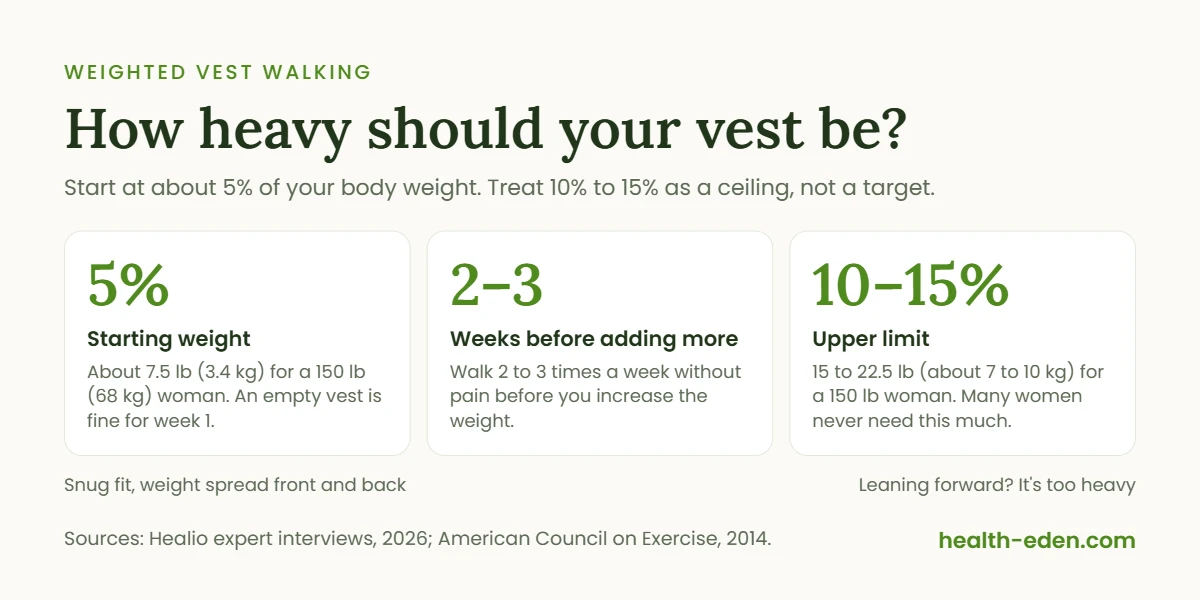
Start lighter than you think. Experts quoted by Healio suggest beginning at around 5% of your body weight, or even with an empty vest to check the fit, and generally staying at or below 10% to 15% of body weight.
| Your body weight | Starting vest (about 5%) | Upper limit (about 10% to 15%) |
|---|---|---|
| 130 lb (59 kg) | 6.5 lb (about 3 kg) | 13 to 19.5 lb (about 6 to 9 kg) |
| 150 lb (68 kg) | 7.5 lb (about 3.4 kg) | 15 to 22.5 lb (about 7 to 10 kg) |
| 170 lb (77 kg) | 8.5 lb (about 3.9 kg) | 17 to 25.5 lb (about 8 to 11.5 kg) |
| 200 lb (91 kg) | 10 lb (about 4.5 kg) | 20 to 30 lb (about 9 to 13.5 kg) |
The upper limit is a ceiling, not a target. Many women get all the benefit they want from a vest of around 10% of body weight or less. Adjustable vests, with removable weights, let you start low and add weight gradually.
What to look for in a vest
- Even weight distribution: weight spread across your front and back, not just hanging at the front.
- A snug fit: the vest shouldn’t bounce or shift when you walk. Many vests aren’t designed for women’s bodies, so check sizing carefully, especially if you buy online.
- Adjustability: removable weights let you progress slowly.
- Comfort: padded shoulders and breathable fabric make longer walks more pleasant.
- Your posture: if you find yourself leaning forward or hunching, the vest is too heavy.
How to start: a 6-week plan
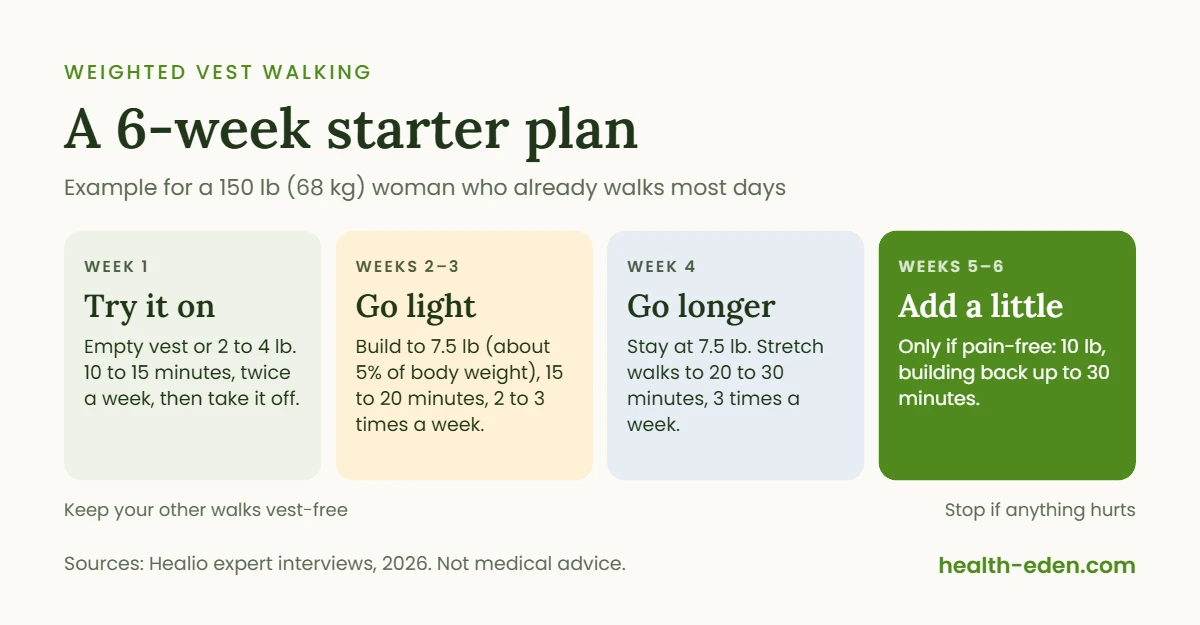
This plan is based on the general progression experts describe: start empty or light, walk for short periods, and add weight only after a few weeks without pain. Adjust it to your fitness, and stop if anything hurts.
Example: a 150 lb (68 kg) woman who already walks 30 minutes most days.
| Week | Vest weight | Walks with vest | Walk length with vest |
|---|---|---|---|
| 1 | Empty vest, or 2 to 4 lb (1 to 2 kg) | 2 a week | 10 to 15 minutes, then remove it and keep walking |
| 2 | 5 lb (about 2.3 kg) | 2 a week | 15 minutes |
| 3 | 7.5 lb (about 3.4 kg), about 5% of body weight | 2 to 3 a week | 15 to 20 minutes |
| 4 | 7.5 lb | 3 a week | 20 to 30 minutes |
| 5 | 10 lb (about 4.5 kg), if weeks 3 and 4 felt fine | 3 a week | 20 minutes |
| 6 | 10 lb | 3 a week | 30 minutes |
Keep your other walks vest-free. After six weeks, you can carry on at this level, add small amounts of weight every few weeks or add gentle hills, but stay within about 10% to 15% of body weight. The ACE researchers suggested beginners keep treadmill inclines below 15% and build intensity gradually over the first four to six weeks.
Tips for a safe walk
- Stand tall, with your shoulders back and your core gently braced.
- Keep your normal stride. Don’t shorten your steps or shuffle.
- Walk on even ground at first, and add hills later.
- Drink water, especially in warm weather, since you will work harder than usual.
- Don’t run or jump in a vest unless a trainer or physical therapist has given you a specific plan.
Weighted vest vs other options
| Option | Pros | Cons |
|---|---|---|
| Weighted vest walking | Easy to add to existing walks, keeps load close to your body | Modest extra calories, limited bone evidence, can strain back or joints if too heavy |
| Walking uphill or on an incline | Raises effort without extra load on your spine | Needs hills or a treadmill |
| Ankle or wrist weights | Cheap | Can change your gait and strain joints; not recommended for walking by many trainers |
| Rucking (backpack with weight) | Cheap if you already have a sturdy backpack | All the load sits on your back, so you may lean forward to balance it |
| Strength training | Best evidence for muscle and bone | Takes time to learn, needs equipment or a gym |
If you are deciding between a treadmill and other cardio equipment for home walking, our comparison of treadmills vs ellipticals and our guide to home gym equipment can help.
Honest pros and cons
Pros
- Makes a walk harder without having to walk faster or longer.
- Burns somewhat more energy, about 12% to 13% more in some conditions in one small study.
- Adds load through your hips and legs, which may support bone health alongside other exercise.
- Fairly cheap compared with many home fitness tools.
Cons
- Evidence for bone benefits is limited, and a 2025 trial found no protection against hip bone loss during weight loss.
- Too much weight can strain your back, hips, knees and feet.
- Many vests don’t fit women’s bodies well.
- It doesn’t replace strength training, good nutrition or other healthy habits.
Who should be careful
Check with your doctor or a physical therapist before using a weighted vest if you have:
- osteoporosis or a history of fractures, since poorly distributed or excess weight can raise fall and fracture risk; you may need close supervision
- back problems, such as a spinal injury, disc degeneration or chronic back pain
- arthritis in the hips, knees or feet
- heart disease, high blood pressure or a lung condition such as COPD
- balance problems or a history of falls
- pelvic floor problems, which extra load can make worse for some women
- pregnancy
When to see a doctor
Stop using the vest and see a doctor if you notice:
- new or worsening pain in your back, hips, knees or feet that doesn’t settle with rest
- chest pain, unusual shortness of breath or dizziness during a walk
- numbness or tingling in your legs or feet
- a fall while wearing the vest, even if you feel fine
- leaking urine or a heavy, dragging feeling in your pelvis during or after walks
Frequently asked questions
What weight vest should a woman use for walking?
Experts suggest starting at around 5% of your body weight, or about 7.5 lb (3.4 kg) for a 150 lb woman, and generally staying at or below 10% to 15% of body weight.
Does walking with a weighted vest burn more calories?
Yes, a little. A small 2014 study for the American Council on Exercise found a vest of 10% to 15% of body weight increased calorie burn by about 12% to 13% in some walking conditions.
Can a weighted vest prevent osteoporosis?
It hasn’t been proven. A small 2000 study found vests combined with jumping helped postmenopausal women avoid hip bone loss, but a 2025 trial found a vest didn’t prevent hip bone loss during weight loss. Strength training has stronger evidence.
How long should I wear a weighted vest when walking?
Start with 10 to 15 minutes, two days a week, and build up to about 30 minutes over several weeks if you have no pain.
Is weighted vest walking safe for women over 50?
It can be for many women, if you start light and progress slowly. Talk to your doctor first if you have osteoporosis, back or joint problems, heart or lung disease, or balance issues.
Is a weighted vest better than strength training?
No. Experts say there is no definitive evidence that a vest beats resistance training for muscle or bone. Think of a vest as an extra, not a replacement.
The bottom line
Weighted vest walking is a simple way to make your daily walk more challenging. It burns slightly more energy and adds useful load to your lower body, but the bone benefits are not proven, and it won’t replace strength training. If you want to try it, choose a snug, adjustable vest, start at about 5% of your body weight and build up slowly over several weeks. Pair it with two strength sessions a week, as described in our guide to strength training for women over 50, for the best overall results. For the bigger picture of staying active as you get older, see our guide on how to age well.
Sources
- Wake Forest University School of Medicine. Weighted vests might help older adults meet weight loss goals, but solution for corresponding bone loss still elusive (INVEST in Bone Health trial, JAMA Network Open). 2025.
- American Council on Exercise. Improve walking workouts with weighted vests. 2014.
- Healio. Not just a fad: the impact of weighted vests on bone health. 2026.
- Snow CM, et al. Long-term exercise using weighted vests prevents hip bone loss in postmenopausal women. The Journals of Gerontology Series A. 2000;55(9):M489.
Information checked as of November 2026. Read how we research and update articles in our editorial policy.
This article is for general information and isn’t a substitute for personal medical advice. Talk to your doctor before starting a new exercise plan, especially if you have osteoporosis, joint problems or a heart or lung condition. See our full medical disclaimer.

I'm Noah Orono, founder and editor of Health Eden. I write about skincare and healthy aging, strength and weight management, and women's health from your 30s into midlife and beyond. Every guide starts with published research and guidance from dermatologists, doctors and certified trainers, then turns it into clear, practical steps. I'm not a medical professional, so I'll always tell you when something is worth raising with your doctor.
More about Health Eden →