Self-Care for Busy Women: 12 Small Habits That Make a Real Difference
 Noah Orono
There is no proven way to stop hot flashes naturally, but you can make them easier to live with. Simple cooling habits help many women feel more comfortable, and clinical hypnosis has good evidence for reducing hot flashes, and cognitive behavioral therapy (CBT) for making them less bothersome. For frequent or severe symptoms, hormone therapy and several nonhormone medicines work best, so talk to your doctor.
Key takeaways
- Hot flashes and night sweats can last years: a large US study found they continued for a median of 7.4 years.
- The Menopause Society recommends CBT and clinical hypnosis, which have the strongest nonhormone evidence, plus weight loss, which has more modest support.
- Fans, layers and a cool bedroom are low-risk comfort measures, but they haven’t been proven to reduce hot flashes in trials.
- The Menopause Society does not recommend supplements or herbal remedies, including black cohosh and soy, for hot flashes.
- Hormone therapy is the most effective treatment, and newer nonhormone prescription options are now available.
- See a doctor if night sweats come with fever, weight loss or other unusual symptoms, or if hot flashes disrupt your life.
What causes hot flashes and night sweats?
A hot flash is a sudden feeling of heat, usually across the face, neck and chest, often with flushing, sweating and a racing heart. Night sweats are hot flashes that happen while you sleep. Doctors call them both vasomotor symptoms.
They happen because falling estrogen affects the part of the brain that controls body temperature, the hypothalamus. It becomes more sensitive to small changes, so your body reacts as if you were overheating and tries to cool down fast by widening blood vessels and sweating. Many women then feel chilled once the flash passes.
Hot flashes often start during perimenopause, the years of irregular cycles before your last period. Our guide to perimenopause symptoms covers the full range of changes at this stage.
How long do hot flashes last?
Longer than many women expect. The Study of Women’s Health Across the Nation (SWAN) followed 1,449 US women with frequent hot flashes and night sweats. The results, published in JAMA Internal Medicine in 2015 and led by Nancy Avis of Wake Forest School of Medicine, found:
| Group | Median total duration |
|---|---|
| All women with frequent symptoms | 7.4 years |
| Symptoms started before or early in perimenopause | More than 11.8 years |
| Symptoms started after the final period | About 3.4 years after the final period |
| African American women | 10.1 years |
| Non-Hispanic white women | 6.5 years |
| Japanese women | 4.8 years |
A median means half of women had symptoms for less time and half for longer. If yours have gone on for years, you are not unusual, and it is reasonable to seek treatment rather than wait it out.
What the evidence says works
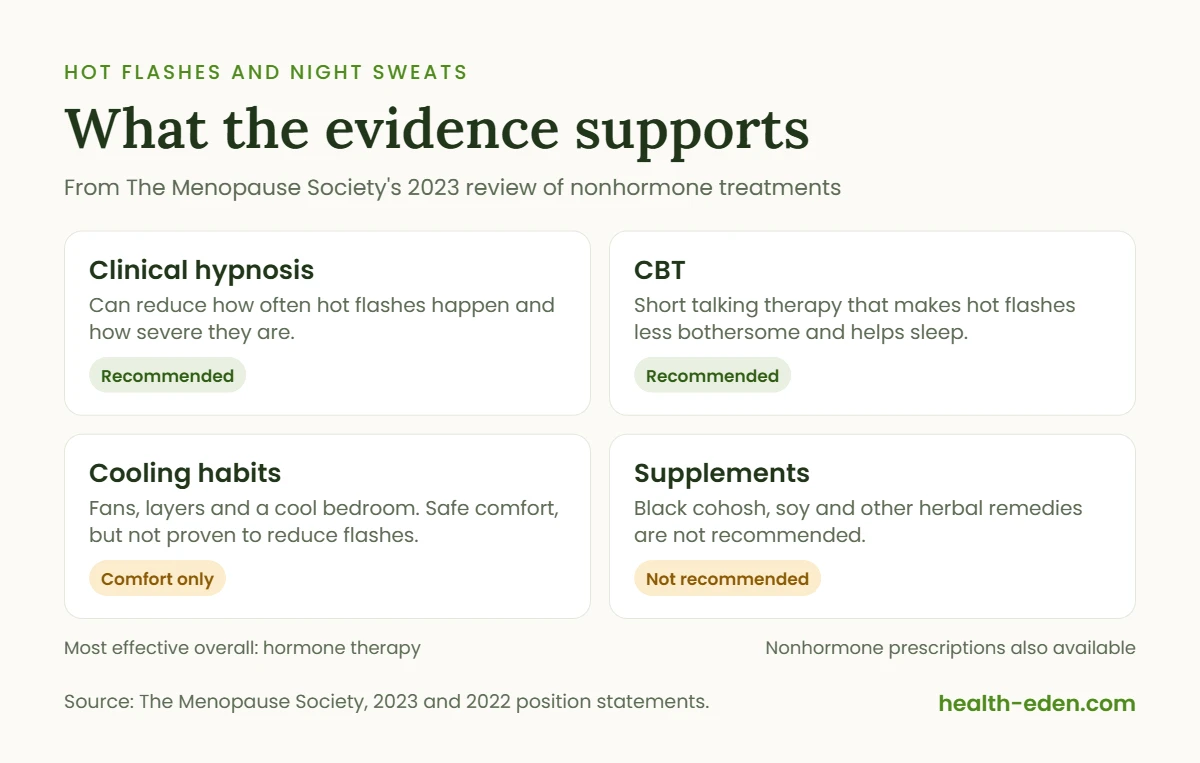
In 2023, The Menopause Society (formerly NAMS) published a review of nonhormone treatments for hot flashes. It sorted them into those with enough evidence to recommend and those without.
| Recommended by The Menopause Society | Not recommended (not enough evidence or not effective) |
|---|---|
| Cognitive behavioral therapy (CBT) | Cooling techniques and avoiding triggers |
| Clinical hypnosis | Paced breathing, relaxation, mindfulness, yoga |
| Weight loss | Exercise (for hot flashes specifically) |
| Some prescription medicines (see below) | Supplements and herbal remedies, soy products |
| Stellate ganglion block (a nerve injection) | Acupuncture, cannabinoids, dietary changes |
“Not recommended” doesn’t mean harmful. Exercise, sleep habits and a healthy diet are still good for your overall health; they just haven’t been shown to reduce hot flashes reliably.
Cognitive behavioral therapy (CBT)
CBT is a short course of talking therapy that helps you change how you think about and respond to symptoms. For hot flashes, it doesn’t necessarily reduce how often they happen, but it can make them less bothersome and improve sleep and mood. It is available in person, online and through self-help books and apps based on tested programs.
Clinical hypnosis
Clinical hypnosis uses guided relaxation and mental imagery, often of coolness, delivered by a trained practitioner or through recordings. The Menopause Society recommends it, noting that studies show it can reduce how often hot flashes happen and how severe they are.
Weight loss
For women carrying extra weight, losing some may reduce hot flashes. This is a recommendation with more modest evidence, and it also has other health benefits.
Practical ways to cool down
The tips below haven’t been proven in trials to reduce hot flashes, which is why The Menopause Society doesn’t formally recommend them. But they are cheap, safe and many women find them helpful for comfort in the moment. Think of them as ways to cope, alongside the treatments above.
During the day
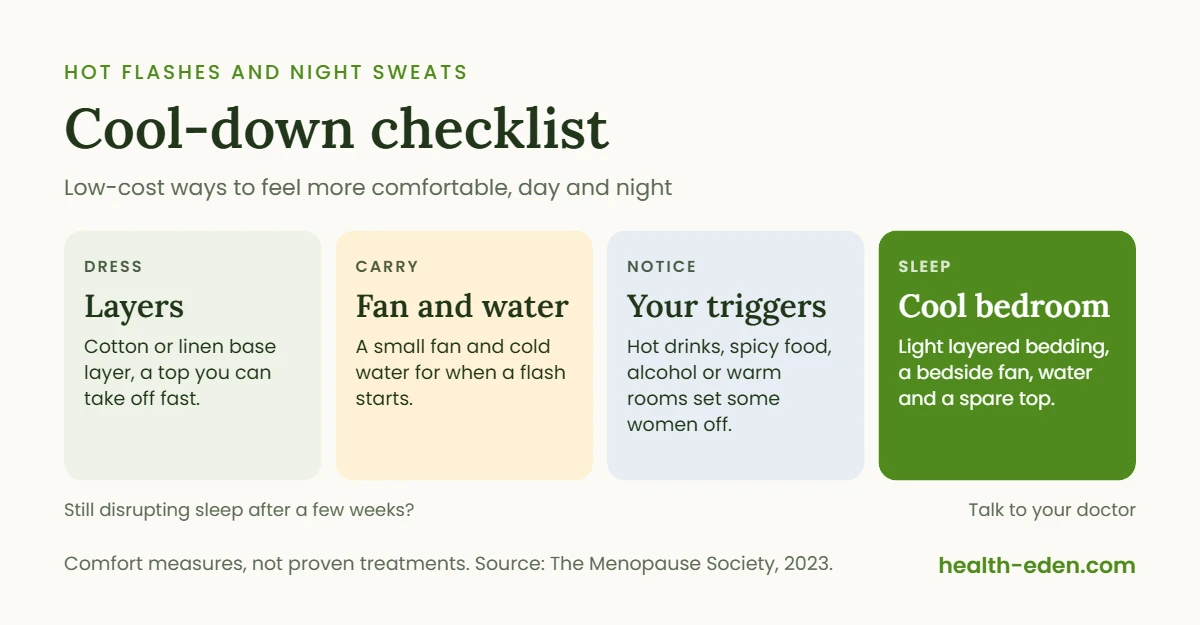
- Dress in layers you can remove quickly, in breathable fabrics such as cotton or linen.
- Carry a small fan or a cooling spray for when a flash starts.
- Sip cold water through the day.
- Keep rooms cool where you can, and sit near a window or fan at work.
- Notice your own triggers. Some women find that hot drinks, spicy food, alcohol or a warm room set off flashes. Trigger avoidance isn’t proven to help in studies, but if you notice a pattern, it is reasonable to cut back.
At night
- Keep your bedroom cool and well ventilated.
- Choose light, breathable bedding and use layers you can push off, rather than one heavy duvet.
- Keep cold water and a spare top by the bed.
- Avoid alcohol close to bedtime, which disrupts sleep for many people.
- Try a bedside fan that you can turn on easily.
If night sweats are wrecking your sleep, our guide to mindfulness for better sleep has techniques that may help you get back to sleep after waking.
A worked example: a cooler day and night
Here is how these ideas fit into a normal day. Adjust them to your own routine.
| Time | What to do | Why |
|---|---|---|
| Morning | Dress in a cotton or linen base layer with a cardigan on top | Easy to strip off when a flash starts |
| Commute or work | Carry a small fan and a bottle of cold water | Quick relief in the moment |
| Lunch | Notice whether spicy food or hot drinks are followed by flashes | Helps you spot personal triggers |
| Afternoon | Take a short walk outside | Good for mood and overall health |
| Evening | Keep alcohol to a minimum, especially within a few hours of bed | Alcohol disrupts sleep |
| Bedtime | Cool bedroom, layered light bedding, water and a spare top nearby | Easier to manage night sweats without fully waking |
| If you wake hot | Push off a layer, sip water, try slow breathing to settle back to sleep | Calms you down, even if it doesn’t stop the flash |
If you try this for a few weeks and hot flashes are still disrupting your sleep, work or mood, that is a good time to talk to your doctor about treatment.
Medical treatments to discuss with your doctor
We don’t give doses for prescription medicines, but it helps to know what exists before your appointment.
Hormone therapy
Hormone therapy (HT, also called HRT) is the most effective treatment for hot flashes and night sweats. Whether it is right for you depends on your age, how long it has been since menopause, your symptoms and your personal and family medical history. Your doctor can talk you through the benefits and risks.
Nonhormone prescription medicines
For women who can’t or don’t want to use hormone therapy, The Menopause Society recommends several prescription options, including certain antidepressants (SSRIs and SNRIs), gabapentin, oxybutynin and fezolinetant, a newer medicine that blocks a brain signal involved in temperature control. In October 2025, the US FDA also approved elinzanetant (Lynkuet), another hormone-free medicine for moderate to severe hot flashes and night sweats. Availability differs between the US, UK and Europe, so ask your doctor what is offered where you live.
What about supplements?
Supplements such as black cohosh, red clover, evening primrose oil and soy isoflavones are widely marketed for hot flashes. The Menopause Society’s 2023 review did not recommend supplements, herbal remedies or soy products, because the evidence doesn’t show they work reliably.
Some supplements can also interact with medicines, and black cohosh has been linked to rare cases of liver problems. If you want to try one, check with your doctor or pharmacist first, especially if you take other medicines or have a history of breast cancer.
Honest pros and cons
| Approach | Pros | Cons |
|---|---|---|
| Cooling habits (fans, layers, cool bedroom) | Cheap, safe, quick relief | Not proven to reduce hot flashes |
| CBT | Good evidence, no side effects, helps sleep and mood | Takes several sessions; access varies |
| Clinical hypnosis | Good evidence, drug-free | Needs a trained practitioner or tested recordings |
| Hormone therapy | Most effective treatment | Not suitable for everyone; needs medical advice |
| Nonhormone medicines | Options for women who can’t use hormones | Possible side effects; need a prescription |
| Supplements | Easy to buy | Not recommended; possible interactions |
Who should be careful
- Breast cancer survivors: talk to your oncologist before using hormone therapy or supplements, including soy and black cohosh.
- Women taking other medicines: check with a pharmacist before adding supplements, which can interact with prescriptions.
- Women with liver disease: avoid black cohosh unless your doctor advises otherwise.
- Anyone using fans or cold packs at night: avoid placing ice packs directly on the skin, and keep cords and heaters away from bedding.
When to see a doctor
See a doctor if:
- hot flashes or night sweats are affecting your sleep, work, relationships or mood
- night sweats come with fever, unexplained weight loss, a persistent cough or swollen glands, which can have other causes
- you have hot flashes but aren’t in the usual age range for perimenopause or menopause
- you have bleeding after menopause, which always needs checking
- you would like to discuss hormone therapy or nonhormone medicines
Frequently asked questions
How can I stop hot flashes naturally?
No natural method has been proven to stop hot flashes. Clinical hypnosis has good evidence for reducing them and CBT for making them less bothersome, and cooling habits like layers and fans can help you feel more comfortable.
How long do hot flashes last?
In a large US study, frequent hot flashes and night sweats lasted a median of 7.4 years. Women whose symptoms started early in perimenopause tended to have them for longer.
What helps night sweats at night?
A cool, well-ventilated bedroom, light layered bedding, a bedside fan and avoiding alcohol close to bedtime can make night sweats easier to manage. If they disrupt your sleep, ask your doctor about treatment.
Does black cohosh work for hot flashes?
The Menopause Society does not recommend black cohosh or other herbal supplements for hot flashes, because the evidence doesn’t show they work reliably. Black cohosh has also been linked to rare liver problems.
What is the most effective treatment for hot flashes?
Hormone therapy is the most effective treatment. For women who can’t or don’t want to use hormones, several nonhormone prescription medicines are available, so talk to your doctor.
Can exercise reduce hot flashes?
Exercise hasn’t been shown to reliably reduce hot flashes, so The Menopause Society doesn’t recommend it for that purpose. It is still very good for your heart, bones, mood and sleep.
The bottom line
Hot flashes and night sweats are common, can last for years and are nothing you just have to put up with. Cooling habits are a safe way to feel more comfortable, but the strongest nonhormone evidence is for CBT and clinical hypnosis, and hormone therapy remains the most effective treatment. Skip most supplements, and talk to your doctor if your symptoms are affecting your sleep or daily life. For more on looking after yourself through midlife, see our guides to self-care for busy women and how to age well.
Sources
- The Menopause Society. Press release: 2023 nonhormone therapy position statement. 2023.
- ScienceDaily. Hot flashes, night sweats last for seven or more years in many midlife women (Avis NE, et al. JAMA Internal Medicine). 2015.
- The North American Menopause Society. The 2022 hormone therapy position statement. Menopause. 2022.
- Pharmacy Times. FDA Approves Elinzanetant as First Nonhormonal Therapy for Menopause Vasomotor Symptoms. 2025.
Information checked as of November 2026. Read how we research and update articles in our editorial policy.
This article is for general information and isn’t a substitute for personal medical advice. Talk to your doctor before starting a new supplement, medication or treatment. See our full medical disclaimer.

I'm Noah Orono, founder and editor of Health Eden. I write about skincare and healthy aging, strength and weight management, and women's health from your 30s into midlife and beyond. Every guide starts with published research and guidance from dermatologists, doctors and certified trainers, then turns it into clear, practical steps. I'm not a medical professional, so I'll always tell you when something is worth raising with your doctor.
More about Health Eden →