Self-Care for Busy Women: 12 Small Habits That Make a Real Difference
 Noah Orono

The best sunscreen for mature skin is one you’ll happily wear every day: broad-spectrum, SPF 30 or higher, in a texture that suits your skin. For dry skin, that usually means a moisturizing cream; for sensitive skin, a mineral formula with zinc oxide. Apply enough, and reapply when you’re outdoors.
Key takeaways
- Daily sunscreen slows visible skin aging. In a 4.5-year Australian trial, adults under 55 who were assigned to use it daily showed no detectable increase in skin aging, and 24% less aging than the comparison group.
- The American Academy of Dermatology (AAD) recommends a broad-spectrum, water-resistant sunscreen with SPF 30 or higher. SPF 30 blocks about 97% of UVB rays.
- Most people apply too little. Use about half a teaspoon for your face and neck.
- Mineral (zinc oxide, titanium dioxide) and chemical sunscreens both work. Mineral tends to suit sensitive skin; chemical tends to feel lighter.
- Tinted sunscreens with iron oxides also block some visible light, which can help if you have dark spots or melasma.
- The best formula is the one you’ll use every morning, all year, including on cloudy days.
Why sunscreen matters more after 40
Sunlight causes most of the visible skin aging people notice in their 40s, 50s and beyond: fine lines, rough texture, sagging and dark spots. Dermatologists call this photoaging. Ultraviolet A (UVA) rays go deep and break down collagen and elastin, the fibers that keep skin firm and springy. Ultraviolet B (UVB) rays burn the surface and drive most skin cancers.
The best evidence that sunscreen slows aging comes from a randomized trial in Nambour, Australia, published in Annals of Internal Medicine in 2013. Around 900 adults under 55 were randomly assigned to daily or discretionary sunscreen use. The daily group applied a broad-spectrum SPF 15+ sunscreen to the face, arms and hands every day; the others used sunscreen as they normally would. After four and a half years, the daily group showed no detectable increase in skin aging, and 24% less aging overall than the comparison group.
That matters for mature skin in two ways. First, it’s never too late: the trial included people in their 40s and 50s. Second, around menopause, skin gets thinner and drier, as we explain in our guide to menopause skin changes, so it can be slower to recover from sun damage.
Sunscreen is also the step that protects the rest of your routine. Retinoids and exfoliating acids can make skin more sensitive to the sun, so if you follow our guide to starting retinol over 50, daily SPF isn’t optional.
How to read a sunscreen label
Labels differ between the US and UK, but they’re telling you the same two things: how well the product blocks UVB, and how well it blocks UVA.
| Label term | What it means | What to look for |
|---|---|---|
| SPF | Sun protection factor: how well it protects against UVB, the burning rays | 30 or higher for daily use |
| Broad spectrum (US) | Passed the FDA’s test for UVA protection as well as UVB | Always choose broad spectrum |
| UVA stars (UK) | UVA protection compared with the SPF, rated out of 5 | 4 or 5 stars |
| UVA circle logo (UK and EU) | UVA protection is at least a third of the SPF | Present on the pack |
| PA+ to PA++++ (Asia) | UVA protection rating used in Japan and Korea | PA+++ or PA++++ |
| Water resistant (40 or 80 minutes) | Stays effective for that long while swimming or sweating | Useful for exercise; still reapply |
The AAD says SPF 30 blocks about 97% of UVB rays. Higher numbers block a little more, but no sunscreen blocks 100%, and a high SPF doesn’t let you stay in the sun longer without reapplying.
Mineral vs chemical sunscreen
Both types protect your skin. The difference is in how they work and how they feel.
Mineral sunscreens (also called physical sunscreens) use zinc oxide, titanium dioxide or both. They sit on the skin and reflect and absorb UV light. Chemical sunscreens (also called organic or synthetic) use filters such as avobenzone, octocrylene or homosalate, which absorb UV light and release it as heat.
| Mineral | Chemical | |
|---|---|---|
| Active ingredients | Zinc oxide, titanium dioxide | Avobenzone, octocrylene, homosalate and others |
| Texture | Thicker; can leave a white cast | Thin, spreads easily, usually invisible |
| Sensitive skin | Less likely to irritate | More likely to sting, especially near the eyes |
| When it works | Straight away | About 20 minutes after applying, according to the British Skin Foundation |
| FDA status (US) | The only two filters the FDA proposed as “generally recognized as safe and effective” in 2019 | FDA asked makers for more safety data |
| Best for | Sensitive, reactive or rosacea-prone skin; around the eyes | People who dislike a heavy feel or white cast |
You may have seen headlines about chemical filters being absorbed into the blood. In a small 2019 study of 24 adults in JAMA, researchers found that some filters reached blood levels high enough that the FDA wants more safety testing. That’s not the same as showing harm. At the time, the FDA and the AAD both urged people to keep using sunscreen, because its benefits against skin cancer and aging are well established. If the uncertainty bothers you, a mineral sunscreen is a simple alternative.
There is also some newer news. In 2026, the FDA approved bemotrizinol, a broad-spectrum filter long used in Europe and Asia, for US sunscreens. It’s the first new sunscreen filter approved in the US in more than 20 years, so you may start to see it on ingredient lists.
Choosing the best sunscreen for your mature skin
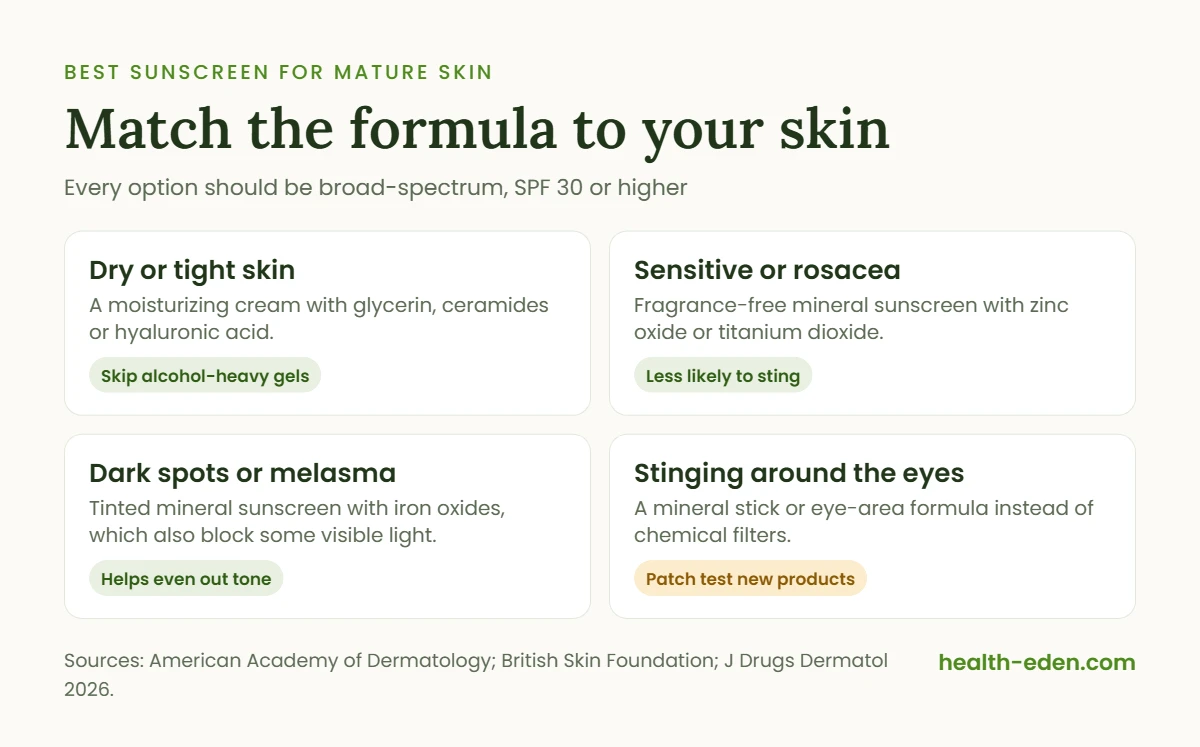
The right sunscreen depends on what your skin needs. Here’s a quick guide.
| If your skin is… | Look for | Avoid |
|---|---|---|
| Dry or tight | Cream or lotion texture; moisturizing ingredients such as glycerin, ceramides or hyaluronic acid | Alcohol-heavy gels and “mattifying” fluids |
| Sensitive or rosacea-prone | Mineral formula, fragrance-free | Added perfume, essential oils, alcohol |
| Prone to dark spots or melasma | Tinted mineral sunscreen with iron oxides | Untinted formulas alone, if pigment is your main concern |
| Oily or combination | Lightweight fluid or gel-cream labeled non-comedogenic | Heavy balms |
| Stinging around the eyes | Mineral stick or eye-area formula | Chemical filters near the eyes |
| Worn under makeup | A fluid that dries down without pilling | Very rich creams that slide |
Tinted sunscreens and visible light
Regular sunscreens protect against UV light. Visible light, the light you can see, can also deepen pigment, especially in people with melasma (patchy brown marks, often triggered by hormones) or darker skin. Iron oxides, the pigments that give tinted sunscreens their color, block some visible light.
A 2026 review in the Journal of Drugs in Dermatology found that tinted sunscreens with iron oxides gave better results for pigmentation than UV-only formulas. In one melasma study it included, a sunscreen that blocked both UV and high-energy visible light reduced severity scores by 75%, compared with 60% for a UV-only sunscreen. The authors also noted that most brands don’t say how much iron oxide their products contain.
If dark spots are your main concern, a tinted mineral sunscreen is worth trying. It also pairs well with a vitamin C serum in the morning.
Is a moisturizer with SPF enough?
It can be, if you apply enough of it and it’s broad-spectrum with SPF 30 or higher. The catch is the amount. Most people use a thin layer of moisturizer, far less than the half teaspoon needed for the labeled protection. The same goes for SPF in foundation and powder, which you’d need to pile on to get the SPF on the bottle. Use them as a top-up, not your only protection.
How much sunscreen to use and when to reapply
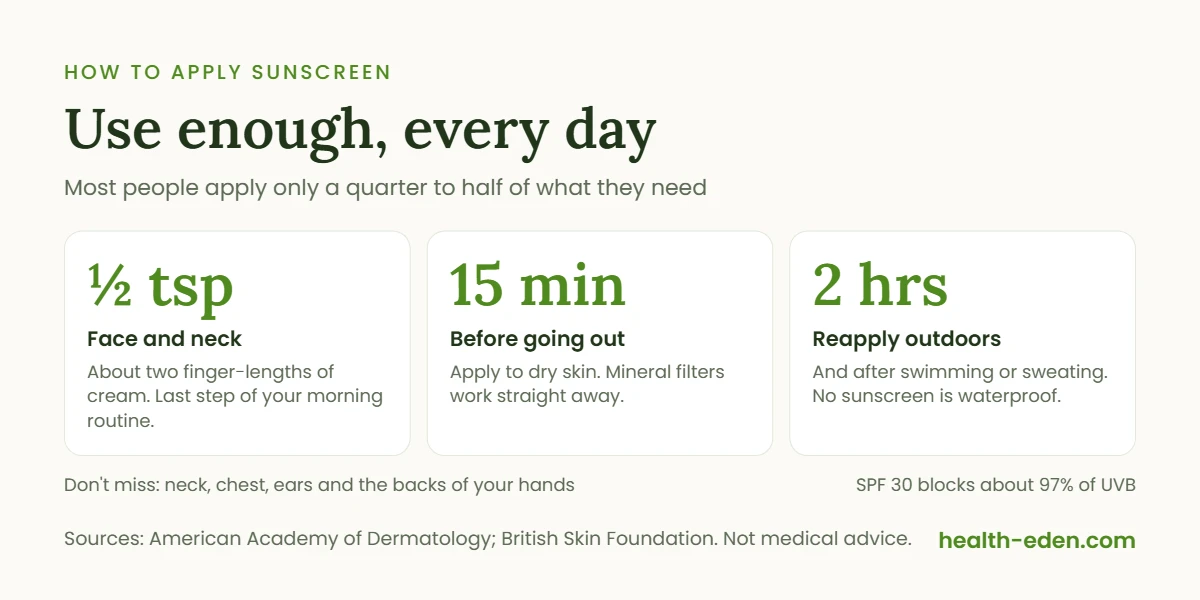
Getting the amount right matters as much as choosing the product. The AAD says most people apply only 25% to 50% of the amount needed to get the SPF on the label.
A worked example: your daily SPF routine
| Situation | How much | When | Reapply? |
|---|---|---|---|
| Normal workday, mostly indoors | Half a teaspoon for face and neck, plus the backs of your hands | Last step of your morning routine, after moisturizer | Not usually needed if you’re inside away from windows |
| Walking, gardening, school run | Half a teaspoon for face and neck; about a teaspoon per arm | 15 minutes before going out | Every 2 hours while outside |
| Beach, pool or a long hike | About 1 ounce (a shot glass) for exposed skin | 15 minutes before going out | Every 2 hours, and after swimming or sweating |
| Wearing makeup | As above, under makeup | Morning | Use a mineral powder or spray SPF over makeup as a top-up |
Two easy ways to measure for your face and neck: squeeze two finger-lengths of cream along your index and middle fingers, or fill half a teaspoon once to see what that looks like.
Don’t forget the areas that age fastest: the neck, chest (décolletage), ears and backs of the hands. If you walk outdoors regularly, as in our walking for weight loss guide, a hat and sunglasses add useful protection.
Pros and cons of daily sunscreen
| Pros | Cons |
|---|---|
| Strong evidence that it slows visible aging and lowers skin cancer risk | Has to be applied properly, every day, to work |
| Protects the results of retinoids, vitamin C and other actives | Some formulas pill, sting or feel greasy |
| Mineral options suit sensitive skin | Mineral formulas can leave a white cast |
| Tinted versions help with uneven tone | Good formulas can be pricey, and you get through a lot |
| Easy to fold into a morning routine | Needs reapplying when you’re outside for long periods |
Who should be careful
- Sensitive skin or rosacea. Choose a fragrance-free mineral formula, and patch test new products on your jawline for a few days.
- Allergies. Some people react to specific chemical filters, preservatives or fragrance. If you’ve reacted to a sunscreen before, a dermatologist can patch test you to find the cause.
- Eczema or very dry skin. Apply sunscreen over a moisturizer, or choose a moisturizing SPF cream.
- Low vitamin D. Daily sunscreen is unlikely to cause vitamin D deficiency for most people, but if you’re at risk or have low levels, ask your doctor about testing and supplements rather than skipping SPF.
- Medications that increase sun sensitivity. Some antibiotics, diuretics and other medicines make skin burn more easily. Ask your pharmacist if any of yours do.
When to see a doctor
Sunscreen prevents damage, but it can’t treat it. Make an appointment with your doctor or a dermatologist if you notice:
- a new mole or spot, or one that’s changing in size, shape or color
- a spot that bleeds, itches, crusts or doesn’t heal within a few weeks
- a rough, scaly patch that keeps coming back, especially on the face, scalp, ears or hands
- a rash, swelling or blistering after using a sunscreen
- sudden patches of darker skin on your face
Many dermatologists also suggest a regular skin check if you’ve had a lot of sun exposure or severe sunburns in the past.
Frequently asked questions
What SPF should I use on mature skin?
Use a broad-spectrum sunscreen with SPF 30 or higher every day. The American Academy of Dermatology recommends this level for everyone, and it blocks about 97% of UVB rays. In the UK, also check for a UVA rating of 4 or 5 stars.
Is mineral or chemical sunscreen better for older skin?
Both protect well. Mineral sunscreens with zinc oxide or titanium dioxide are less likely to sting, so they often suit sensitive or rosacea-prone skin. Chemical sunscreens feel lighter and don’t leave a white cast. Choose the one you’ll wear every day.
Do I need sunscreen on cloudy days or in winter?
Yes. UVA rays, which drive skin aging, are present year-round and pass through cloud. The AAD advises wearing sunscreen on exposed skin every day you’re outside, including in winter and on cloudy days.
How much sunscreen should I put on my face?
About half a teaspoon covers your face and neck. Most people use much less, which gives far lower protection than the SPF on the label. Two finger-lengths of cream is a handy rule of thumb.
Can I use sunscreen with retinol and vitamin C?
Yes, and you should. Apply vitamin C serum in the morning, then moisturizer, then sunscreen as the last step. Use retinol at night. Retinoids can make skin more sun-sensitive, so daily sunscreen protects your results.
Is it too late to start wearing sunscreen after 50?
No. Sun damage builds up over a lifetime, and protecting your skin now helps slow further aging and lowers your skin cancer risk. The landmark Australian sunscreen trial included adults younger than 55, and the benefit was seen in middle age.
The bottom line
The best sunscreen for mature skin is broad-spectrum, SPF 30 or higher, and pleasant enough that you’ll wear it every single morning. Dry skin usually does best with a moisturizing cream, sensitive skin with a mineral formula, and skin with dark spots with a tinted mineral sunscreen. Use half a teaspoon for your face and neck, and reapply when you’re outside. It’s one of the best-proven anti-aging steps in any skincare routine, and it protects everything else you do for your skin. For more on looking after yourself as you get older, see our guide on how to age well.
Sources
- Hughes MCB, Williams GM, Baker P, Green AC. Sunscreen and prevention of skin aging: a randomized trial. Annals of Internal Medicine. 2013.
- American Academy of Dermatology. Sunscreen FAQs. Accessed 2026.
- British Skin Foundation. Sunscreen explained by a dermatologist. 2020.
- Dermatology Times. Studies don’t change sunscreen guidance. 2019.
- Practical Dermatology. Iron oxides in tinted sunscreens may improve hyperpigmentation protection. 2026.
- HealthDay. FDA approves first new sunscreen ingredient in two decades. 2026.
Information checked as of November 2026. Read how we research and update articles in our editorial policy.
This article is for general information and isn’t a substitute for personal medical advice. Talk to your doctor or a dermatologist if you have a skin condition, a changing mole, or a reaction to a product. See our full medical disclaimer.

I'm Noah Orono, founder and editor of Health Eden. I write about skincare and healthy aging, strength and weight management, and women's health from your 30s into midlife and beyond. Every guide starts with published research and guidance from dermatologists, doctors and certified trainers, then turns it into clear, practical steps. I'm not a medical professional, so I'll always tell you when something is worth raising with your doctor.
More about Health Eden →