Self-Care for Busy Women: 12 Small Habits That Make a Real Difference
 Noah Orono
Most menopause supplements have weak or mixed evidence. The Menopause Society’s 2023 guidance doesn’t recommend herbal remedies or soy products for hot flashes, because good trials haven’t shown a reliable benefit. A few supplements do earn a place for other reasons, such as calcium and vitamin D for bone health, if your diet falls short.
Key takeaways
- No supplement has strong, consistent evidence for reducing hot flashes and night sweats. Prescription treatments work much better.
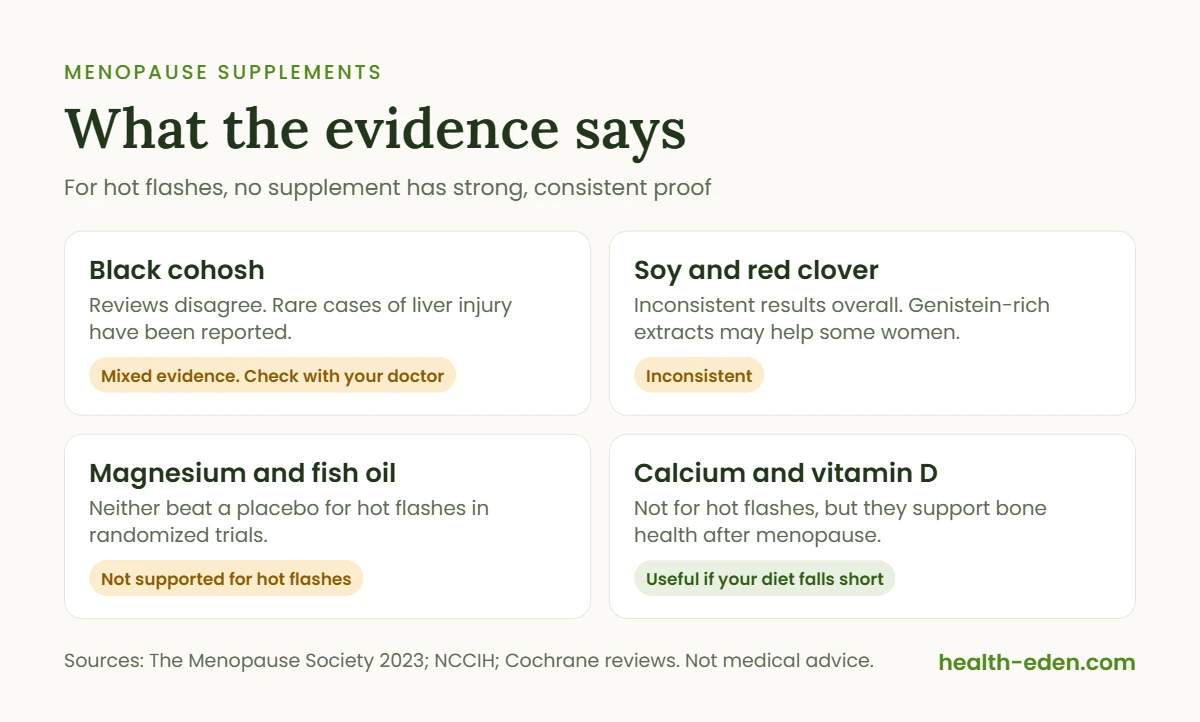
- Black cohosh has mixed results. Reviews disagree, and rare cases of liver injury have been reported.
- Soy and red clover isoflavones (plant estrogens) show inconsistent results overall. A Cochrane review found that extracts high in genistein, one type of isoflavone, may help some women.
- Magnesium and omega-3 fish oil didn’t reduce hot flashes in randomized trials.
- Calcium and vitamin D matter for bone health after menopause. Women over 50 need 1,200 mg of calcium a day, ideally mostly from food.
- “Natural” doesn’t mean safe. Supplements can interact with medicines, and US supplements aren’t approved by the FDA before they’re sold.
Why menopause supplements are so popular
Menopause brings a long list of possible symptoms, from hot flashes and night sweats to poor sleep, low mood, joint aches and brain fog. Our perimenopause symptoms guide covers them in detail. It’s no surprise that supplements promising natural relief sell well, especially to women who can’t take hormone therapy or would rather not.
The problem is that supplement marketing often runs far ahead of the research. In the US, dietary supplements don’t need FDA approval for safety or effectiveness before they go on sale, and studies have found that some herbal products contain the wrong herb or unlisted ingredients. So check what the evidence says before you spend money.
What the experts say
The clearest guidance comes from The Menopause Society (formerly the North American Menopause Society). Its 2023 position statement on nonhormone therapy for hot flashes reviewed the research on dozens of approaches.
It recommends cognitive behavioral therapy, clinical hypnosis, weight loss, a procedure called stellate ganglion blockade, and several prescription medicines. It does not recommend supplements and herbal remedies or soy products for hot flashes, because the evidence doesn’t show they reliably work.
Stephanie Faubion, MD, the society’s medical director, said the statement could help women and healthcare professionals “avoid the wasted time, energy, and expense associated with ineffective or unproven remedies.”
That doesn’t mean no woman ever feels better on a supplement. Hot flash trials have strong placebo effects, and symptoms naturally ease over time for many women. But it does mean that for most supplements, the benefit hasn’t been proven beyond those effects.
Menopause supplements: the evidence at a glance
| Supplement | What it’s sold for | What the research shows | Main safety concerns |
|---|---|---|---|
| Black cohosh | Hot flashes, night sweats | Mixed. Some reviews find no clear benefit; a 2023 review suggested possible benefit | Rare liver injury; product quality varies |
| Soy isoflavones | Hot flashes | Inconsistent overall; genistein-rich extracts may help some women | May not suit women who shouldn’t take estrogen |
| Red clover | Hot flashes | Inconsistent | As for soy |
| Evening primrose oil | Hot flashes, breast pain | Very little research | Generally mild stomach upset |
| Dong quai | Hot flashes | Too little research to judge | May interact with the blood thinner warfarin |
| Flaxseed | Hot flashes | No better than placebo in trials | Bloating; take with plenty of water |
| Omega-3 fish oil | Hot flashes, mood | No improvement in hot flashes in a 2013 trial | May interact with blood thinners |
| Magnesium | Hot flashes, sleep | No benefit for hot flashes in a 2015 trial | Diarrhea at high doses |
| DHEA | Energy, libido | Uncertain benefit | Possible liver damage; experts advise against routine use |
| Kava | Anxiety | Very little research for menopause | Linked to severe liver disease |
| Calcium and vitamin D | Bone health | Needed for bones; supplement only if diet falls short | Too much calcium can cause kidney stones |
Sources: The Menopause Society 2023; National Center for Complementary and Integrative Health (NCCIH); Cochrane reviews.
The most popular menopause supplements, one by one
Black cohosh
Black cohosh is a North American plant and probably the best-known menopause herb. The research is genuinely mixed. A 2012 Cochrane review found there wasn’t enough evidence to support its use for menopause symptoms. A more recent 2023 review of 22 studies, summarized by the NCCIH, found black cohosh products “potentially beneficial” for overall menopause symptoms and hot flashes, but not for anxiety or low mood.
Safety is the bigger question. Rare but sometimes serious cases of liver injury have been reported in people taking black cohosh. It’s not certain the herb caused them, and some products have been found to contain the wrong plant. The NCCIH advises stopping and seeing a doctor if you develop signs of liver problems, such as dark urine or unusual tiredness. Talk to your doctor first if you’ve had breast or uterine cancer, because its safety in hormone-sensitive conditions is uncertain.
Soy and red clover isoflavones
Isoflavones are plant compounds with a weak estrogen-like effect, found in soy, red clover and some other legumes. A 2013 Cochrane review of 43 trials found no conclusive evidence that phytoestrogen supplements reduce hot flashes or night sweats. However, four trials of extracts high in genistein (more than 30 mg a day) consistently reduced how often hot flashes happened, and the authors said that finding needs more research. The review found no evidence of harm to the lining of the uterus or the vagina with use for up to two years.
Because isoflavones may act a little like estrogen, the NCCIH notes they may not be safe for women who’ve been told to avoid estrogen. Eating soy foods such as tofu, edamame and soy milk as part of a normal diet is a different matter, and is generally considered fine.
Magnesium
Magnesium is often recommended online for hot flashes, sleep and mood. For hot flashes, the best trial is disappointing. In a 2015 study of postmenopausal women with a history of breast cancer, published in Menopause, magnesium oxide worked no better than a placebo. The authors concluded their results “do not support the use of magnesium oxide for hot flashes.”
Evidence for magnesium and menopause-related sleep problems is limited. If you do take it, the upper limit for magnesium from supplements and medicines is 350 mg a day for adults, according to the NIH Office of Dietary Supplements. Taking more can cause diarrhea, nausea and cramping. Magnesium from food doesn’t count toward that limit.
Omega-3 fish oil
Omega-3s have well-known benefits for heart health, but they don’t seem to help hot flashes. In the MsFLASH trial, published in 2013, omega-3 supplements didn’t improve hot flashes or night sweats compared with a placebo.
Evening primrose oil, dong quai and other herbs
For evening primrose oil, ginseng, wild yam and many other herbs, the NCCIH says there’s so little research that no conclusions can be drawn. Dong quai may interact with warfarin, a blood thinner. Kava, sometimes sold for anxiety, has been linked to severe liver disease. Flaxseed was no better than placebo for hot flashes.
Supplements that can make sense after menopause
While supplements aren’t a good bet for hot flashes, a few nutrients do matter more after menopause, mainly for your bones. Estrogen helps protect bone, so bone loss speeds up in the years around menopause.
| Nutrient | Daily amount for women over 50 | Upper limit | Food sources |
|---|---|---|---|
| Calcium | 1,200 mg | 2,000 mg | Dairy, fortified plant milks, canned fish with bones, tofu set with calcium |
| Vitamin D | 600 IU (15 mcg) to age 70; 800 IU (20 mcg) from 71 | 4,000 IU (100 mcg) | Oily fish, egg yolks, fortified foods, sunlight |
| Magnesium | 320 mg | 350 mg from supplements | Nuts, seeds, whole grains, leafy greens, beans |
Sources: Institute of Medicine (now the National Academy of Medicine) 2010 report; NIH Office of Dietary Supplements.
The chair of the Institute of Medicine committee said that calcium and vitamin D amounts higher than those in its report “are not necessary to maintain bone health.” Try to get calcium from food first, and use a supplement to fill the gap only if your diet falls short. Vitamin D is harder to get from food, so many people, especially in the UK and northern US during winter, are advised to consider a supplement. Ask your doctor whether you need a blood test.
Protein matters too. It supports the muscle that helps protect your bones and joints, and it can help with menopause weight gain. Strength training is one of the best things you can do for both.
A worked example: a menopause supplement check
Here’s how one woman might review her supplements. Imagine Linda, 54, who has hot flashes and takes four supplements she bought online, costing about $55 a month in total.
| Linda’s supplement | Evidence for her goal | Verdict |
|---|---|---|
| Black cohosh for hot flashes | Mixed; liver safety concerns | Stop, and ask her doctor about proven treatments instead |
| Magnesium for hot flashes | No benefit in trials | Stop for hot flashes; food sources are fine |
| Evening primrose oil | Very little research | Stop |
| Vitamin D | Useful for bone health, especially in winter | Keep, after checking the amount with her doctor |
By keeping only the vitamin D and talking to her doctor about effective treatment, Linda saves most of that money and gets a better chance of relief. (This is an illustration, not personal advice. Your needs depend on your health, diet and medicines.)
What works better for hot flashes
If hot flashes are affecting your sleep, work or mood, you don’t have to just put up with them. The Menopause Society’s guidance points to options with much better evidence than supplements:
- Hormone therapy (HRT). The most effective treatment for hot flashes and night sweats. It isn’t right for everyone, so talk through the benefits and risks with your doctor.
- Prescription nonhormonal medicines. Options include certain antidepressants (SSRIs and SNRIs), gabapentin, oxybutynin and fezolinetant, a newer drug that targets the brain’s temperature control center. Your doctor can explain which might suit you.
- Cognitive behavioral therapy (CBT) and clinical hypnosis. Both have good evidence for reducing how much hot flashes bother you.
- Weight loss, if you’re carrying extra weight.
For more on how menopause affects the rest of your body, see our guides to menopause skin changes and menopause hair loss.
Pros and cons of menopause supplements
| Pros | Cons |
|---|---|
| Easy to buy without a prescription | Most have weak or inconsistent evidence |
| Some women feel they help | Placebo effects make results hard to judge |
| Calcium and vitamin D can fill real gaps for bone health | Quality and contents vary between brands |
| Usually cheaper than a doctor’s visit in the short term | Can interact with medicines |
| Can delay you getting a treatment that works |
Who should be careful
- If you take prescription medicines. Herbs and supplements can interact with blood thinners, antidepressants, blood pressure medicines and others. Show your pharmacist everything you take.
- If you’ve had breast, uterine or ovarian cancer, or another hormone-sensitive condition. Avoid plant estrogens and herbal menopause products unless your cancer team says otherwise.
- If you have liver disease or drink heavily. Avoid black cohosh and kava, and tell your doctor about any supplement.
- If you have kidney problems. Be careful with magnesium and calcium supplements.
- Before surgery. Some supplements affect bleeding, so tell your surgical team.
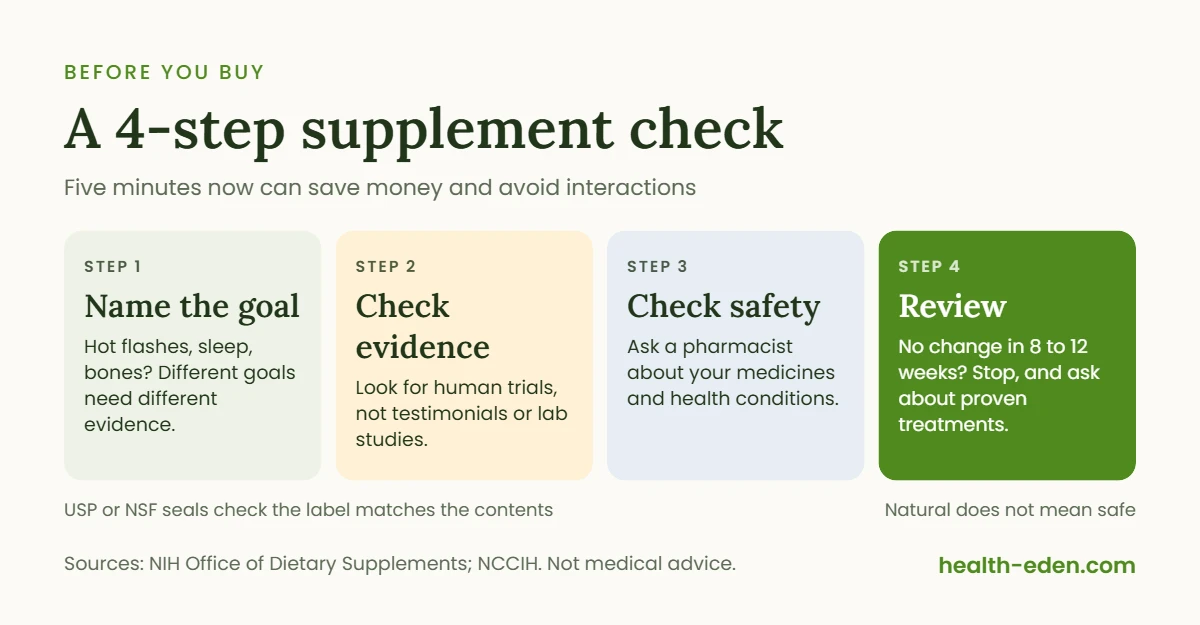
When you do buy supplements, look for products tested by an independent organization, such as USP or NSF in the US, which check that the label matches what’s inside. A seal doesn’t mean a product is safe or effective, though.
When to see a doctor
See your doctor or a menopause specialist if:
- hot flashes or night sweats are disrupting your sleep, work or relationships
- you have bleeding after menopause (12 months or more after your last period), which always needs checking
- you notice dark urine, yellowing skin or eyes, or unusual tiredness while taking any herbal supplement
- your mood is low most days, or you feel anxious or unable to cope
- you’re unsure whether a supplement is safe with your medicines
There are effective treatments for menopause symptoms, and a doctor can help you weigh them up.
Frequently asked questions
What is the best supplement for menopause?
No supplement has strong, consistent evidence for relieving menopause symptoms such as hot flashes. The Menopause Society doesn’t recommend herbal remedies or soy products for hot flashes. Calcium and vitamin D are useful for bone health after menopause if your diet doesn’t provide enough.
Does black cohosh work for hot flashes?
The evidence is mixed. A 2012 Cochrane review found too little evidence to support it, while a 2023 review suggested possible benefit. Rare cases of liver injury have been reported, so talk to your doctor first and stop if you notice dark urine or unusual tiredness.
Does magnesium help with menopause symptoms?
Not for hot flashes, based on current evidence. A 2015 randomized trial found magnesium oxide worked no better than a placebo. If you take magnesium for other reasons, keep supplements to 350 mg a day or less, the adult upper limit listed by the NIH Office of Dietary Supplements.
Are soy isoflavones safe during menopause?
Soy foods are generally considered safe as part of a normal diet. Isoflavone supplements appear safe for short-term use, but long-term safety isn’t established, and they may not suit women who’ve been told to avoid estrogen. A Cochrane review found no clear benefit overall for hot flashes.
How much calcium do I need after menopause?
Women over 50 need 1,200 mg of calcium a day, according to the Institute of Medicine. Try to get most of it from food, such as dairy, fortified plant milks and canned fish with bones. The upper limit is 2,000 mg a day, and more doesn’t give extra bone benefit.
Can supplements replace HRT?
No. No supplement comes close to hormone therapy for relieving hot flashes and night sweats. If you can’t or don’t want to take HRT, prescription nonhormonal medicines, CBT and clinical hypnosis have much better evidence than supplements.
The bottom line
Most menopause supplements don’t live up to the marketing. Black cohosh has mixed evidence and rare liver risks, soy and red clover isoflavones show inconsistent results, and magnesium and fish oil didn’t help hot flashes in trials. The supplements that make the most sense after menopause are the boring ones: calcium and vitamin D to support your bones, ideally alongside a good diet and strength training. If symptoms are getting in the way of your life, talk to your doctor about proven treatments. For more on staying well through midlife, see our guide on how to age well.
Sources
- The North American Menopause Society (now The Menopause Society). The North American Menopause Society releases its 2023 nonhormone therapy position statement. 2023.
- Healio. NAMS releases recommendations to treat menopause symptoms with nonhormone therapies. 2023.
- National Center for Complementary and Integrative Health. Black cohosh. Accessed 2026.
- National Center for Complementary and Integrative Health. Menopausal symptoms: in depth. Accessed 2026.
- Lethaby A, et al. Phytoestrogens for menopausal vasomotor symptoms. Cochrane Database of Systematic Reviews. 2013.
- Medical News Today. Insomnia in menopause may improve with yoga. 2013.
- Park H, et al. North Central Cancer Treatment Group N10C2 (Alliance): a double-blind placebo-controlled study of magnesium supplements to reduce menopausal hot flashes. Menopause. 2015.
- Institute of Medicine. Report sets new dietary intake levels for calcium and vitamin D. 2010.
- NIH Office of Dietary Supplements. Magnesium fact sheet for consumers. Accessed 2026.
Information checked as of November 2026. Read how we research and update articles in our editorial policy.
This article is for general information and isn’t a substitute for personal medical advice. Talk to your doctor or pharmacist before starting any supplement, especially if you take medicines or have a health condition. See our full medical disclaimer.

I'm Noah Orono, founder and editor of Health Eden. I write about skincare and healthy aging, strength and weight management, and women's health from your 30s into midlife and beyond. Every guide starts with published research and guidance from dermatologists, doctors and certified trainers, then turns it into clear, practical steps. I'm not a medical professional, so I'll always tell you when something is worth raising with your doctor.
More about Health Eden →