Self-Care for Busy Women: 12 Small Habits That Make a Real Difference
 Noah Orono
Creatine for women over 40 can help build muscle and strength when combined with resistance training, which matters more as muscle declines with age and menopause. The evidence for bone and brain benefits is promising but less certain. The usual recommended amount is 3 to 5 grams a day, and creatine is one of the most researched supplements for safety.
Key takeaways
- Creatine is a natural compound that helps muscles make quick energy. It’s found in meat and fish, and your body also makes some.
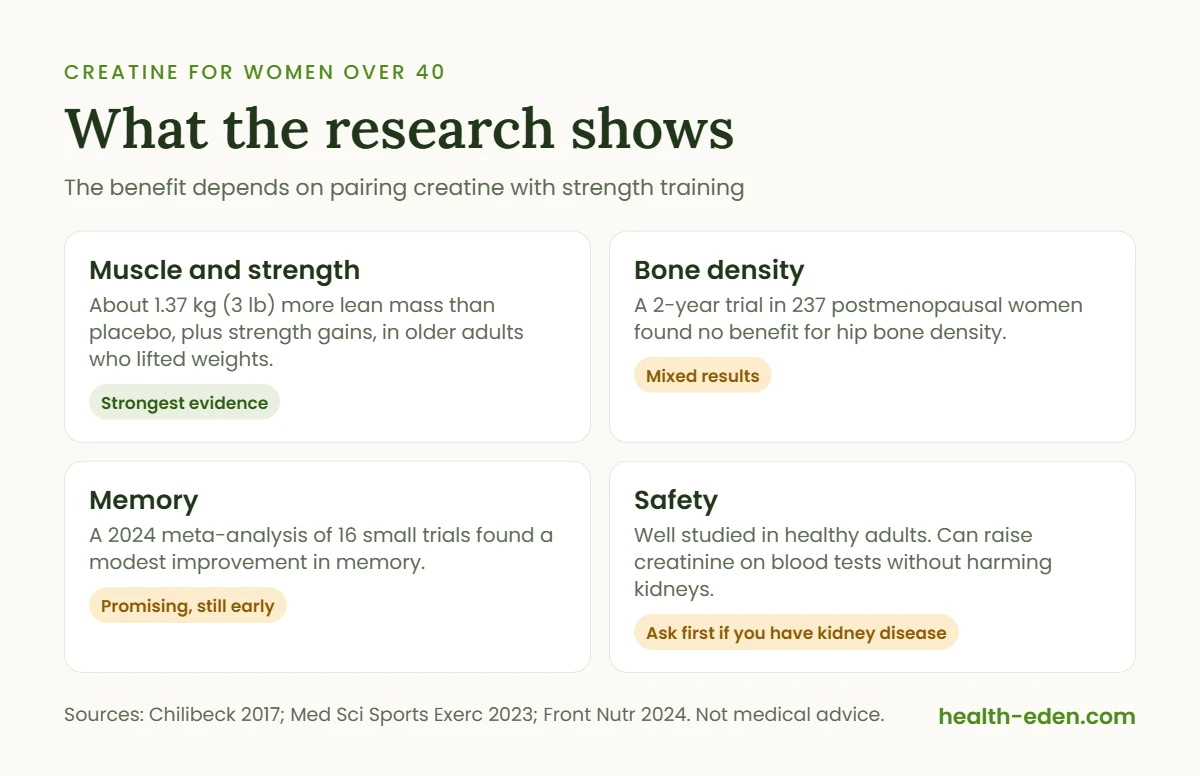
- Paired with strength training, it adds muscle and strength in older adults. A 2017 meta-analysis found about 1.37 kg (3 lb) more lean mass than placebo.
- For bone, the results are mixed. A 2-year trial in 237 postmenopausal women found no benefit for hip bone density, though it did improve some measures of bone shape and walking speed.
- Early research suggests creatine may help memory, but the studies are small.
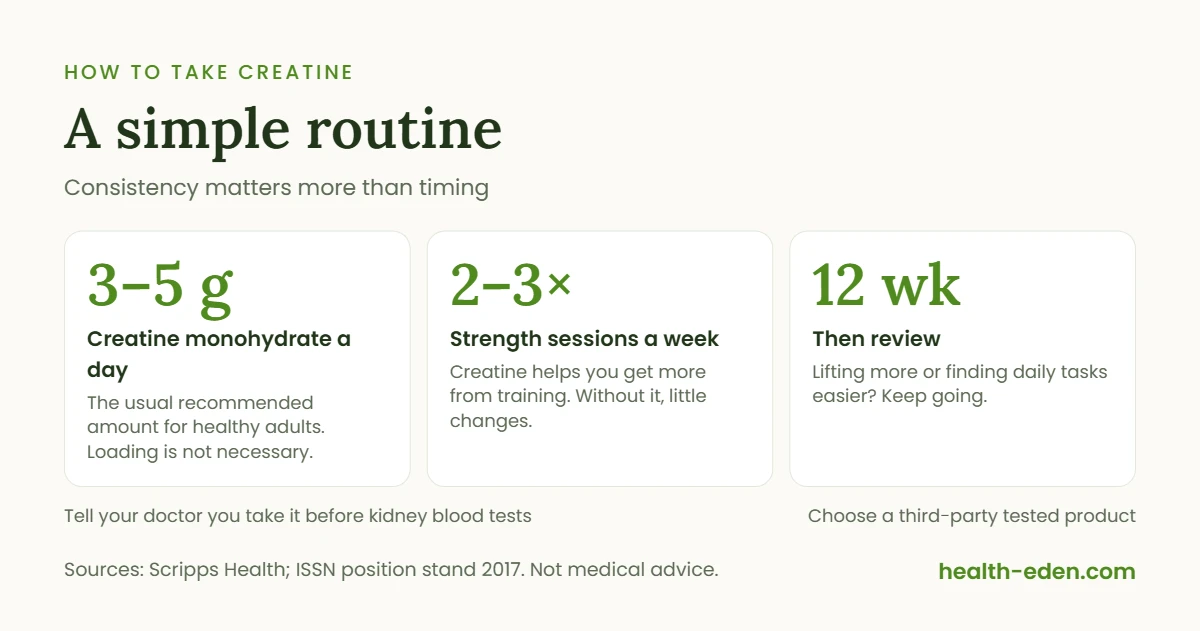
- The usual recommended daily amount is 3 to 5 grams of creatine monohydrate. A loading phase isn’t necessary.
- It’s considered safe for healthy adults, but talk to your doctor first if you have kidney problems. It can raise creatinine on blood tests.
What creatine is and how it works
Creatine is a compound made from amino acids, the building blocks of protein. Your liver, kidneys and pancreas make some, and you get more from meat and fish. About 95% of it is stored in your muscles, where it helps recycle ATP, the molecule your cells use for quick bursts of energy.
When you take a creatine supplement, your muscle stores rise. That lets you do a little more work in each set of exercises, such as an extra rep or two, and over weeks that extra work adds up to more muscle and strength. Creatine is also found in the brain, which is why researchers are studying it for memory and mood.
Creatine monohydrate is the form used in almost all the research. It’s usually sold as a flavorless white powder that dissolves in water or a drink.
Why creatine matters for women over 40
From around midlife, muscle mass and strength gradually decline, a process called sarcopenia when it becomes severe. Falling estrogen around menopause speeds up both muscle and bone loss. Less muscle means a slower metabolism, more difficulty with everyday tasks, and a higher risk of falls and fractures later in life.
Women also tend to make less creatine than men and get less from food, partly because they usually eat less meat. Vegetarians and vegans have lower stores still. This is one reason researchers think women, especially older women, may benefit from creatine.
A 2025 review in the Journal of the International Society of Sports Nutrition, led by Abbie Smith-Ryan of the University of North Carolina, looked at creatine across women’s lives. Smith-Ryan said there is “a lot of good data” on creatine after menopause, while research during perimenopause and pregnancy is more limited.
If you’re noticing menopause weight gain or a loss of strength, creatine is one tool alongside the most important one: lifting weights.
Creatine and muscle: the strongest evidence
The best-established benefit is for muscle, and it depends on exercise. Creatine doesn’t build muscle on its own. It helps you get more out of strength training.
A 2017 meta-analysis led by Philip Chilibeck at the University of Saskatchewan pooled 22 randomized trials with 721 adults, with average ages ranging from 57 to 70. People who took creatine while doing resistance training gained about 1.37 kg (3 lb) more lean mass than those on a placebo, and they also gained more upper- and lower-body strength.
That’s a modest but meaningful difference, especially when you consider how hard it is to add muscle in later life. For a practical plan, see our guide to strength training for women over 50 or our home strength training guide.
Creatine and bone health
Bone loss speeds up in the years after menopause, so the idea that creatine might protect bone is appealing. The evidence so far is mixed.
The largest trial, published in Medicine & Science in Sports & Exercise in 2023, followed 237 postmenopausal women for two years. All of them did resistance training and walking, and half took creatine. Creatine didn’t improve bone mineral density at the hip, which was the main outcome. It did help preserve some measures of the hip’s shape and strength, increase lean mass and improve walking speed.
So creatine isn’t a substitute for proven bone protection. Weight-bearing exercise, enough calcium, vitamin D and protein, and for some women medication, remain the foundations. Ask your doctor about a bone density scan if you have risk factors for osteoporosis.
Creatine and the brain
Your brain uses creatine too, and this is one of the most talked-about areas of research. A 2024 meta-analysis in Frontiers in Nutrition pooled 16 randomized trials with 492 adults. Creatine improved memory, with the authors rating that evidence as moderate certainty. It also slightly shortened the time people took to complete attention and processing-speed tasks, though that evidence was weaker. It didn’t improve overall cognition or executive function.
The studies were small and varied, and few looked specifically at women in midlife or at menopause brain fog. It’s a promising area, but not yet a reason on its own to take creatine.
How much creatine should women take?
The usual recommended amount for healthy adults is 3 to 5 grams of creatine monohydrate a day, according to a nephrologist at Scripps Health. That’s roughly one level teaspoon of powder, but check the scoop on your product.
- Loading isn’t needed. Some people take about 20 grams a day, split into smaller doses, for 5 to 7 days to fill muscle stores faster. It’s not necessary: a steady daily amount reaches the same level within about a month, with less chance of stomach upset.
- Timing doesn’t matter much. Taking it consistently matters more than when. Many people mix it into a morning drink or a post-workout shake.
- Choose creatine monohydrate. It’s the best-studied and usually the cheapest form. Look for a product tested by an independent organization, such as NSF Certified for Sport, Informed Sport or USP.
A worked example: adding creatine to a routine
Here’s how a 52-year-old woman who wants to get stronger might fit creatine into her week. (This is an illustration, not personal advice.)
| Day | Training | Creatine | Other habits |
|---|---|---|---|
| Monday | Full-body strength, 40 minutes | 3 to 5 g in a morning drink | Protein at each meal |
| Tuesday | 30-minute brisk walk | Same | Plenty of water |
| Wednesday | Full-body strength, 40 minutes | Same | Protein at each meal |
| Thursday | Rest or gentle yoga | Same | Plenty of water |
| Friday | Full-body strength, 40 minutes | Same | Protein at each meal |
| Weekend | Long walk or activity she enjoys | Same | Rest and sleep |
After 12 weeks, she checks her progress: Can she lift heavier weights or do more reps? Are everyday tasks such as carrying groceries or climbing stairs easier? If so, she continues. If she’s not training regularly, creatine alone won’t make much difference.
Side effects and safety
Creatine is one of the most researched supplements. The International Society of Sports Nutrition’s 2017 position stand, which reviewed more than 200 studies, concluded that creatine monohydrate is safe for healthy people and found “no compelling evidence” that it harms kidney function in healthy or clinical populations.
Possible side effects:
- Water weight. Creatine draws water into your muscles, so the scale may go up a little in the first weeks. That’s water in muscle, not fat.
- Stomach upset. Nausea, bloating or diarrhea are more likely with large doses, such as during loading. Smaller doses spread through the day help.
- Higher creatinine on blood tests. Creatine can raise creatinine, a marker doctors use to check kidney function, without any actual kidney damage. Tell your doctor you take it so your results are read correctly.
You might also have heard that creatine causes hair loss. That idea comes from one small 2009 study in young male rugby players, which measured a hormone linked to hair loss but didn’t measure hair loss itself. No later research has shown that creatine causes hair loss.
Pros and cons of creatine for women over 40
| Pros | Cons |
|---|---|
| Strong evidence for more muscle and strength with resistance training | Little benefit without regular strength training |
| Well researched for safety in healthy adults | Can cause temporary water weight |
| Inexpensive, especially plain creatine monohydrate | Mixed results for bone density |
| Possible memory benefits | Brain research is still early |
| Easy to take: one scoop a day | Can affect kidney blood test results |
Who should be careful
Talk to your doctor before taking creatine if you:
- have kidney disease or reduced kidney function, a kidney transplant, or only one kidney. The American Kidney Fund notes there isn’t enough data on the safety of creatine for people with kidney disease.
- have diabetes or high blood pressure, which raise kidney risk.
- take medicines that affect the kidneys, or regularly use anti-inflammatory painkillers such as ibuprofen or naproxen.
- are pregnant or breastfeeding, as research is limited.
- have liver disease or another serious health condition.
When to see a doctor
Stop taking creatine and contact your doctor if you notice:
- swelling in your legs, ankles or around your eyes
- passing much less urine than usual, or dark or bloody urine
- persistent nausea, vomiting or diarrhea
- unusual tiredness, shortness of breath, or severe muscle pain or weakness
See your doctor too if you’re losing strength or muscle quickly without a clear reason, or if you’ve had a fall or fracture. These can be signs of conditions that need proper assessment.
Frequently asked questions
Should women over 40 take creatine?
Creatine can help women over 40 build muscle and strength when combined with regular resistance training. It’s well researched and considered safe for healthy adults. It’s most useful if you’re already doing strength training at least two or three times a week. Check with your doctor first if you have kidney problems.
Does creatine help with menopause?
Creatine doesn’t treat menopause symptoms such as hot flashes. It may help counter the muscle loss that speeds up around menopause, when combined with strength training. Research on mood, memory and bone after menopause is promising but not yet conclusive.
How much creatine should a woman take a day?
The usual recommended amount for healthy adults is 3 to 5 grams of creatine monohydrate a day. A loading phase isn’t necessary. Taking it consistently matters more than timing, and you can mix it into water, coffee or a shake.
Will creatine make me gain weight or look bulky?
You may gain a little water weight in the first weeks, because creatine draws water into your muscles. It won’t make you bulky on its own. Any muscle you gain comes from training, and for most women that means a stronger, firmer look rather than bulk.
Does creatine cause hair loss in women?
There’s no good evidence that it does. The concern comes from a single small 2009 study in young men that measured a hormone linked to hair loss, not hair loss itself. No later study has shown creatine causes hair loss.
Is creatine bad for your kidneys?
Research hasn’t found that creatine harms the kidneys in healthy people at usual amounts. It can raise creatinine on blood tests, which can look like a kidney problem when there isn’t one, so tell your doctor you take it. If you have kidney disease, talk to your doctor before using it.
The bottom line
Creatine is one of the best-studied supplements for women over 40, and its main benefit is clear: paired with strength training, it helps build muscle and strength at an age when both are slipping away. The research on bone and brain health is promising but not settled. If you’re healthy and lifting weights regularly, 3 to 5 grams of creatine monohydrate a day is a low-cost, low-risk addition. Check with your doctor first if you have kidney problems, and remember that the training does most of the work. For more on staying strong and healthy as you get older, see our guide on how to age well.
Sources
- Chilibeck PD, Kaviani M, Candow DG, Zello GA. Effect of creatine supplementation during resistance training on lean tissue mass and muscular strength in older adults: a meta-analysis. Open Access Journal of Sports Medicine. 2017.
- NutraIngredients. Creatine shows no effect on postmenopausal bone mineral density (on Chilibeck PD, et al. Medicine & Science in Sports & Exercise). 2023.
- Xu C, Bi S, Zhang W, Luo L. The effects of creatine supplementation on cognitive function in adults: a systematic review and meta-analysis. Frontiers in Nutrition. 2024.
- NutraIngredients. From menstruation through menopause: review recaps effects of creatine in women (on Smith-Ryan AE, et al. Journal of the International Society of Sports Nutrition). 2025.
- NutraIngredients. Experts confirm safety and efficacy of creatine supplements (on Kreider RB, et al. ISSN position stand). 2017.
- Scripps Health. Is creatine safe for your kidneys? Accessed 2026.
- American Kidney Fund. The creatine scoop: essential cautions for the kidney community. Accessed 2026.
Information checked as of November 2026. Read how we research and update articles in our editorial policy.
This article is for general information and isn’t a substitute for personal medical advice. Talk to your doctor before starting a new supplement or exercise plan, especially if you have a health condition or take medicines. See our full medical disclaimer.

I'm Noah Orono, founder and editor of Health Eden. I write about skincare and healthy aging, strength and weight management, and women's health from your 30s into midlife and beyond. Every guide starts with published research and guidance from dermatologists, doctors and certified trainers, then turns it into clear, practical steps. I'm not a medical professional, so I'll always tell you when something is worth raising with your doctor.
More about Health Eden →