Self-Care for Busy Women: 12 Small Habits That Make a Real Difference
 Noah Orono
To start retinol over 50 without irritation, choose a low-strength formula, use a pea-sized amount just two nights a week, and apply it after moisturizer if your skin is dry. Build up slowly over two to three months, wear sunscreen every morning, and expect some mild dryness at first. Mature skin can benefit from retinol at any age.
Key takeaways
- Retinol works on older skin: a 2007 University of Michigan study found it improved fine wrinkles in volunteers with an average age of 87.
- Start low: Which? recommends beginners choose about 0.1% to 0.5% retinol, two or three nights a week.
- Use a pea-sized amount for your whole face, at night, on clean, dry skin.
- The “sandwich method” (moisturizer, then retinol, then moisturizer), suggested by Which?, can make it gentler for dry, thin skin.
- Some redness and flaking in the first weeks is common and usually settles as your skin adjusts. Cut back rather than giving up.
- Daily broad-spectrum SPF 30 or higher is essential, because retinol makes you burn more easily.
Why retinol is worth starting over 50
Retinol is a form of vitamin A and one of the most studied skincare ingredients for aging skin. Over months, it speeds up skin cell turnover and encourages collagen production, which can soften fine lines, smooth rough texture and fade uneven pigmentation.
It is never too late to start. In a 2007 study published in Archives of Dermatology, University of Michigan researchers applied 0.4% retinol lotion to one inner arm of 36 elderly volunteers (average age 87; 23 completed the study), up to three times a week for 24 weeks. The other arm got the same lotion without retinol. Fine wrinkles and roughness improved significantly on the retinol side, and skin samples showed more procollagen, a building block of collagen.
The catch is that skin after 50 tends to be drier and thinner, especially after menopause, when falling estrogen reduces the skin’s natural oils and moisture. That makes it more likely to sting or flake when a retinoid is introduced too fast. Our guide to menopause skin changes explains why skin feels so different at this stage.
Choosing your first retinol
Pick a low strength
Kamisha Darroux, principal scientific adviser at Which?, the UK consumer organization, says beginners should “start low and slow,” with 0.1% to 0.5% retinol or a retinyl ester (a gentler retinol relative), and work up from there. Consultant dermatologist Dr Anjali Mahto told Which? that retinol “is one of the milder forms of vitamin A, making it a good starting point for many people new to this ingredient.”
| Your skin | Sensible first product |
|---|---|
| Very dry, thin or sensitive | A retinyl ester or 0.1% to 0.2% retinol in a creamy base |
| Normal or combination | 0.2% to 0.3% retinol |
| Has used retinoids before without problems | 0.3% to 0.5% retinol, or a low-strength retinal (a stronger form) |
Cleveland Clinic notes that the amount of active retinol in over-the-counter products can be hard to judge, because brands mix it with other ingredients. If a product doesn’t list a percentage, treat it as a starting product and introduce it slowly anyway.
Look for a comforting formula
For mature skin, the base matters as much as the retinol. Creams and lotions are usually gentler than gels or alcohol-heavy serums. Helpful extras include:
- Ceramides: fats that help repair the skin barrier
- Glycerin and hyaluronic acid: humectants, ingredients that draw water into the skin
- Niacinamide: a form of vitamin B3 that Cleveland Clinic notes may help counteract retinol’s irritation
- No added fragrance: fragrance is a common cause of skin reactions
Skip the extras at first
Use only one retinoid product at a time, and pause other strong actives, such as glycolic acid, salicylic acid and scrubs, for your first few weeks. You can reintroduce them later on alternate nights.
How to apply retinol, step by step
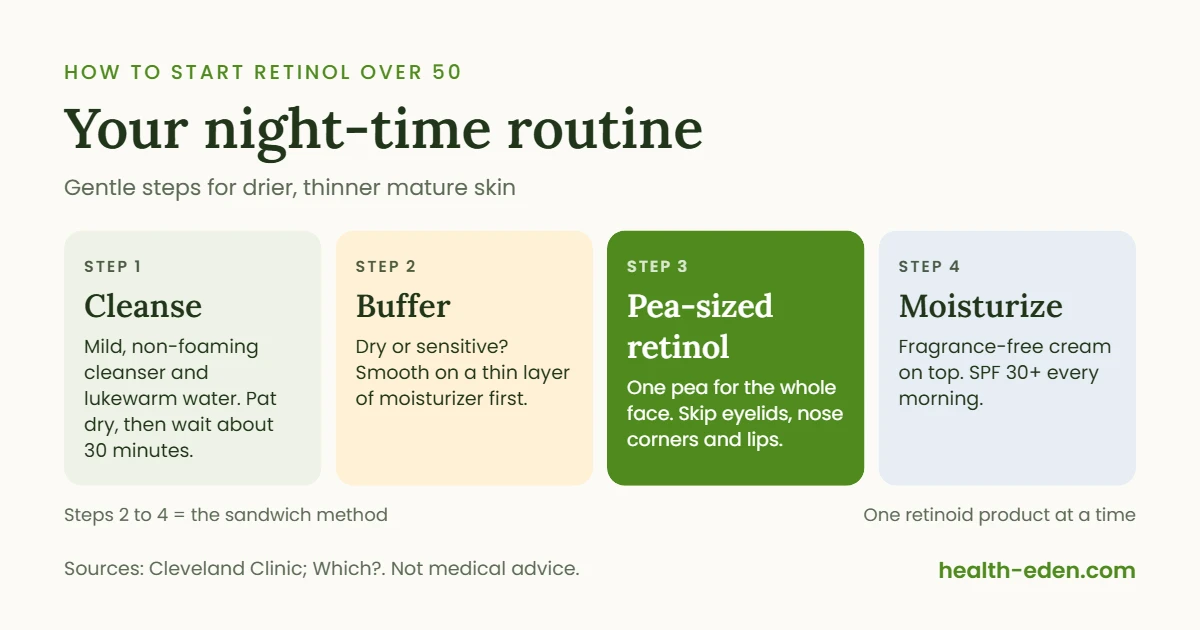
1. Cleanse gently in the evening with a mild, non-foaming cleanser and lukewarm water.
2. Pat your skin dry and wait. Cleveland Clinic suggests waiting 30 minutes after washing your face. Applying retinol to completely dry skin is also commonly advised to reduce stinging.
3. Apply a pea-sized amount for your whole face. Dot it on the forehead, cheeks and chin, then spread it thinly.
4. Avoid sensitive areas: the eyelids, the corners of the nose and the lips.
5. Moisturize with a fragrance-free cream.
6. In the morning, apply sunscreen of SPF 30 or higher, every day.
The sandwich method for dry skin
If your skin is dry or easily irritated, try “sandwiching” your retinol: a thin layer of moisturizer, then the retinol, then another layer of moisturizer. The first layer slightly dilutes and buffers the retinol, so it reaches your skin more gently. It may slow results a little, but most women would rather have calm skin and keep going.
A 12-week plan for mature skin
This example is for a woman in her 50s using a 0.2% retinol cream for the first time.
| Weeks | How often | Method | Notes |
|---|---|---|---|
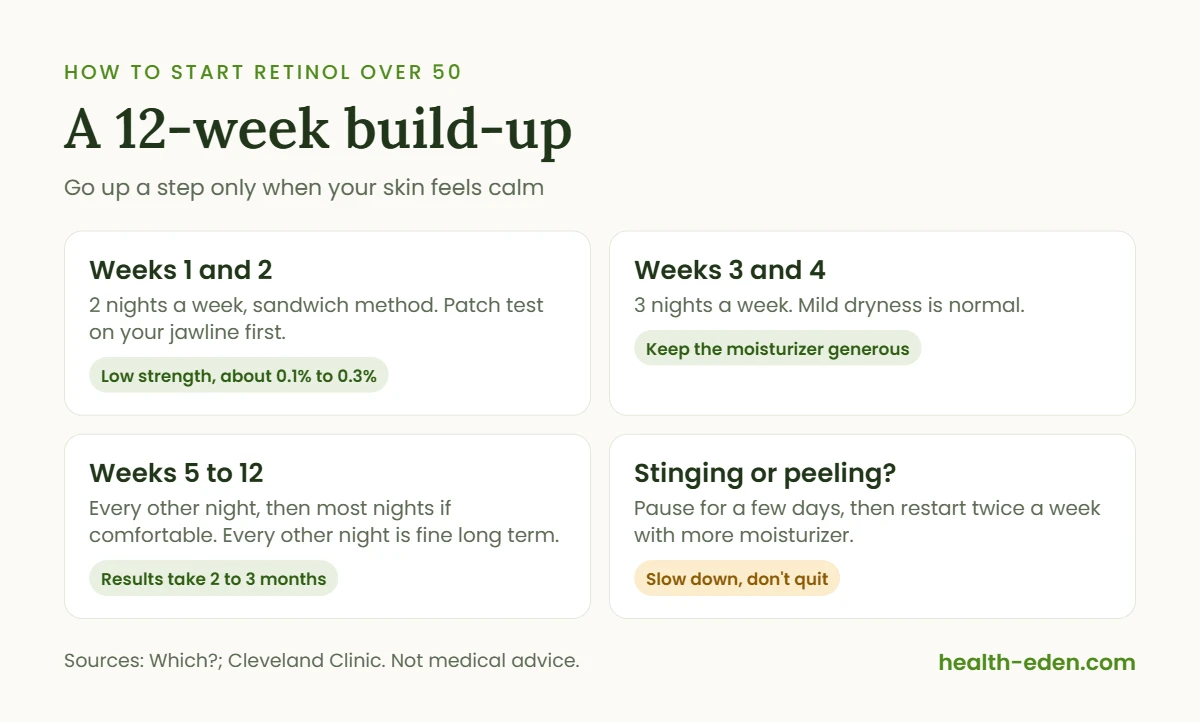
| 1 and 2 | 2 nights a week (e.g. Monday and Thursday) | Sandwich method | Patch test first on your jawline for a couple of nights |
| 3 and 4 | 3 nights a week | Sandwich method | Mild dryness is normal; stinging that lasts is not |
| 5 to 8 | Every other night | Moisturizer after retinol | Drop back a step if you flake or burn |
| 9 to 12 | Most nights, if comfortable | Moisturizer after retinol | Many women stay at every other night, and that’s fine |
| After 12 weeks | Same routine | Same | Consider a stronger product only if your skin is calm and you want more effect |
The goal isn’t to use retinol every night as fast as possible. The goal is to use it regularly, for months, without irritation. Which? notes that results can take 8 to 12 weeks, and Cleveland Clinic says improvements in wrinkles usually take several months.
What it costs
As of November 2026, many drugstore retinol creams and serums cost roughly $10 to $25 in the US (Which? found UK prices from around £6.50 to more than £200), and a 30 ml product used a few nights a week usually lasts a couple of months or more. A fragrance-free moisturizer and a daily sunscreen are things you should be using anyway.
Irritation, “retinol uglies” and purging
Some reaction in the first few weeks is common, even with careful use. Cleveland Clinic lists dryness, itching or burning, redness and peeling as typical side effects that are usually temporary and should fade as your skin adapts.
What to do if your skin gets irritated
Dr Mahto’s advice, given to Which?, is simple: “it’s best to pause use, allow skin to recover, and then reintroduce slowly with plenty of moisturiser.”
- Take a break of a few days until your skin feels calm.
- Restart at a lower frequency, such as twice a week, with the sandwich method.
- Use a plain, rich moisturizer or a barrier cream on irritated patches.
- Skip other actives until your skin has settled.
- Don’t apply retinol to sunburned, broken or freshly waxed skin.
Is it purging?
“Purging” means a temporary increase in breakouts when you start a retinoid, because it speeds up the turnover of skin cells and brings clogged pores to the surface. Cleveland Clinic describes it in the context of acne treatment, noting that skin “might even look worse” in the first couple of months before it improves. If you don’t usually get spots, new breakouts are more likely to be irritation, or a sign that the product doesn’t suit you.
Honest pros and cons
| Pros | Cons |
|---|---|
| Good evidence for fine lines and texture, even in very old skin | Takes months to see results |
| Widely available and affordable | Irritation is common at first |
| Works alongside a simple routine | Makes skin more prone to sunburn |
| Benefits build the longer you use it | Benefits fade if you stop |
Retinol can sit alongside other treatments you might be curious about, such as LED face masks. For an overview of the full routine it fits into, see our anti-aging skincare routine for women over 40.
Who should be careful
- Pregnancy and breastfeeding: Cleveland Clinic says pregnant people are generally discouraged from using retinoids, and breastfeeding people should check with a healthcare provider; the risk to babies is thought to be low, but you shouldn’t apply it to your breasts.
- Eczema, rosacea or very sensitive skin: retinoids can irritate skin affected by eczema or rosacea. Ask a dermatologist before starting.
- Other treatments: if you use prescription skin medicines or have had a recent cosmetic procedure, check with the prescriber or practitioner first.
- Waxing and peels: tell your practitioner you use retinol before waxing, peels or laser treatments; many advise stopping for several days beforehand.
When to see a doctor
See a doctor or dermatologist if:
- you have burning, swelling, blistering or hives, which could be an allergic or severe reaction
- irritation lasts more than a couple of weeks even after cutting back
- you have used an over-the-counter retinol for a few months with no improvement and want to discuss prescription options
- you notice a new, changing or bleeding spot or mole, which needs checking whatever products you use
- you have persistent redness, flushing or bumps that may be rosacea
Frequently asked questions
Is it too late to start retinol at 50 or 60?
No. A 2007 study found 0.4% retinol improved fine wrinkles and roughness in volunteers with an average age of 87. Starting slowly matters more than starting early.
What percentage of retinol should I start with over 50?
Which? recommends beginners start with about 0.1% to 0.5% retinol. If your skin is dry or sensitive, the lower end of that range, or a retinyl ester, is a gentler choice.
How often should I use retinol when starting?
Two nights a week for the first couple of weeks, then three nights, then every other night. Increase only if your skin is calm.
Should I put retinol on before or after moisturizer?
Normally after cleansing and before moisturizer. If your skin is dry or sensitive, apply moisturizer first or use the sandwich method to buffer it.
How long does retinol irritation last?
Mild dryness and redness usually settle within the first few weeks as your skin adjusts. If irritation continues, take a break, then restart less often with more moisturizer.
Can I use retinol and vitamin C together?
Yes, but not at the same time when you’re starting. Cleveland Clinic suggests vitamin C in the morning and retinol at night, introducing one product at a time.
The bottom line
Starting retinol over 50 is mainly about patience. Choose a low-strength, fragrance-free cream, use a pea-sized amount two nights a week, buffer it with moisturizer if your skin is dry, and build up over about three months. Some dryness at first is normal; lasting stinging is a signal to slow down, not to quit. Pair it with daily sunscreen and give it at least two to three months before judging results. For more ways to look after your skin and health as you age, see our guide on how to age well, and if you’re weighing up gadgets as well as creams, read our honest look at at-home beauty devices.
Sources
- Cleveland Clinic. Retinol: what it is, benefits and how to use it.
- Which?. What is retinol and is it worth buying?.
- Kafi R, et al. Improvement of naturally aged skin with vitamin A (retinol). Archives of Dermatology. 2007. Summary: ScienceDaily.
- DermNet. Topical retinoids.
Information checked as of November 2026. Read how we research and update articles in our editorial policy.
This article is for general information and isn’t a substitute for personal medical advice. Talk to your doctor or dermatologist before starting a new skincare treatment, especially if you have a skin condition or are pregnant or breastfeeding. See our full medical disclaimer.

I'm Noah Orono, founder and editor of Health Eden. I write about skincare and healthy aging, strength and weight management, and women's health from your 30s into midlife and beyond. Every guide starts with published research and guidance from dermatologists, doctors and certified trainers, then turns it into clear, practical steps. I'm not a medical professional, so I'll always tell you when something is worth raising with your doctor.
More about Health Eden →